Slant Bed vs Flat Bed CNC Lathes: How to Choose
Two turning shops, the same question, two answers. One will not buy a lathe that is not on a slant bed, and the other has run flat bed machines for twenty years and sees no reason to change. Both are producing parts that pass inspection, so the argument is not really about quality. It is about which layout suits the parts you actually run, and how much of your day goes into clearing chips and loading blanks.
The bed is the one decision on a lathe you cannot change later. Turrets, tailstocks, chip conveyors and bar feeders can all be added or swapped. The angle of the guideways, and the casting that holds them, are fixed from the day the machine is poured. So it is worth spending a few minutes on what each layout is actually good at before the specification conversation starts.
This comparison stays on the bed layout itself. If your question is whether the work should be turned or milled at all, the lathe versus mill-turn comparison covers that decision first.
What the Bed Layout Actually Decides
Every CNC lathe has the same basic elements: a headstock that turns the work, a bed that carries the guideways, a carriage or turret that moves along those guideways, and a tailstock on machines long enough to need one. The bed layout decides three things that follow you through every job.
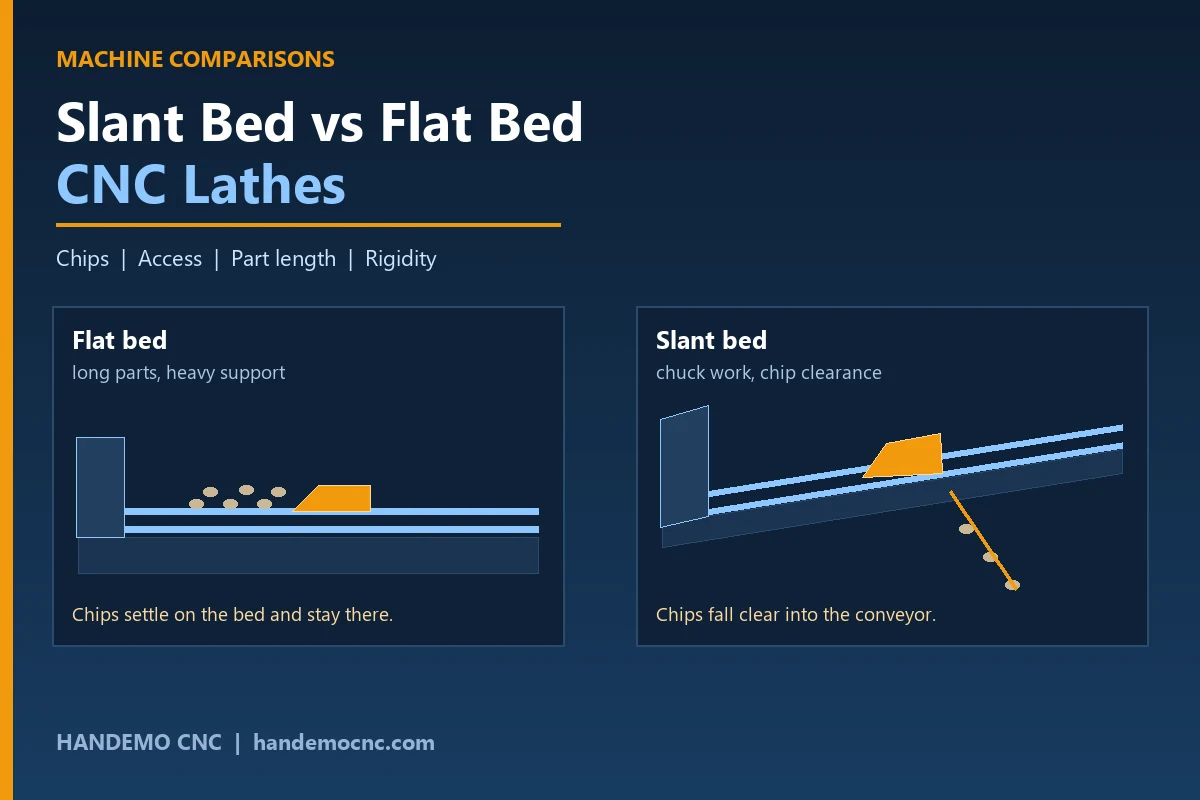
The first is where the chips go. On a flat bed the guideways are horizontal, so the chips land on the bed and on the guideway covers, and something has to move them out of the cutting zone. On a slant bed the guideways are inclined, so gravity does part of the conveying for you and the chips fall away from the cutting area towards the chip conveyor.
The second is how far the operator has to reach. A horizontal bed puts the spindle centre line at roughly waist height and a long way in from the front of the machine. A slanted bed brings the working area closer to the door, because the whole structure leans towards the operator.
The third is how the cutting force is carried. Turning pushes the tool down and towards the work. On a horizontal bed that load is taken across a wide, generously supported surface. On a slanted bed the same load arrives more directly against the structure, but the casting has to be designed for it rather than simply being a flat plate with rails bolted on.
Flat Bed Lathes: Where They Still Earn Their Place
The flat bed is the older arrangement and it did not survive by accident. Its strength is length. A horizontal bed can be made long without the same stiffness penalty, which is why heavy shafts, rolls, screws, pipe and long tube work still turn up on flat bed machines.
The other strength is access for heavy or awkward parts. On a long shaft or a large diameter tube, the part has to be introduced from above or from the end, and a flat layout makes that more straightforward for the crane and for the operator setting it.
Flat beds also remain common where the machine does a mixture of turning and other work in the same envelope, because the horizontal surfaces give you a place to mount steady rests, follow rests and additional supports without crowding the working area. On some long-part jobs the steady rests are the whole point of the machine.
The trade is that chips have nowhere obvious to go. They collect on the bed, around the chuck and under the saddle, and someone has to remove them. On a heavy cutting job with stringy material this becomes a real part of the cycle, and it is one of the reasons modern production turning moved away from the layout.
Slant Bed Lathes: What the Incline Buys You
Inclining the guideways changes the daily experience of running the machine more than any other single feature.
- Chips fall clear of the cutting zone instead of piling under the tool, so the finish passes run on a bed that is not already carrying the previous cut
- Thermal growth from hot chips sitting on the structure is reduced, because the chips leave rather than soaking the casting
- The working area is closer to the door, so loading, checking and changing inserts take less reach
- Cutting fluid drains towards the tank rather than pooling, which keeps the machine cleaner between shifts
- The turret can be mounted so the tool approaches the work from a position that suits rigid turning and, on machines with a Y axis, milling as well
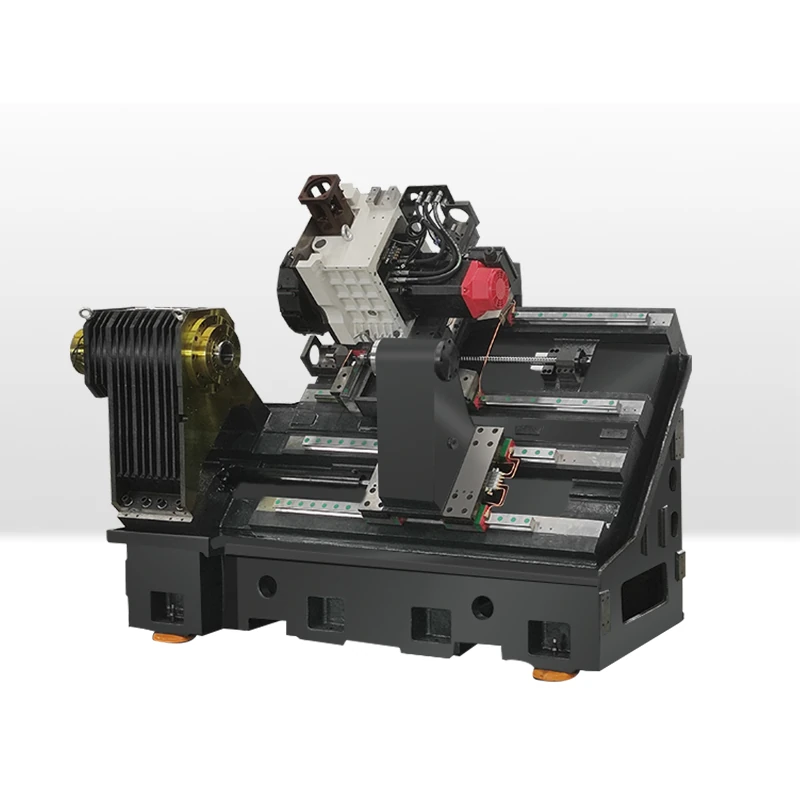
The cost of the layout shows up in two places. The first is the casting itself, because a slanted structure has to carry the same loads through a shape that is less obvious to manufacture, and it is usually ribbed and heat treated to keep it stable. The second is that a slant bed is less convenient when the part is long, because there is physically less room to bring a long shaft in from the side and support it along its length.
What the incline does not do, on its own, is make a machine faster or more accurate. Those come from the spindle, the guideway type, the drive and the thermal design of the whole machine. Treat the bed layout as a decision about chips, access and part shape, then specify the rest separately.
The Trade-Offs Side by Side
Put the two layouts next to each other and the picture is fairly clear.
On chip control, the slant bed wins on almost every chucking job and the difference grows with material that produces long or stringy chips. On a hard-turning or interrupted-cut job the volume of chip alone makes the flat bed a nuisance.
On rigidity for a given amount of material, a well-designed slant bed casting holds up well because the load path is short and direct. A flat bed compensates with size, which is why flat machines get heavy and long rather than tall.
On operator ergonomics, the slant bed is simply easier to live with over a shift. Reaching across a horizontal bed to set a workpiece, and then reaching again to clear chips from behind the turret, adds up over a year.
On long-part capability, the flat bed has the advantage and no amount of good design on the slant side fully removes it. When the part is a shaft longer than the bed is tall, the horizontal layout is the natural one.
On automation, the slant bed is easier to feed. Bar feeders, gantry loaders and robot tending all want a compact, repeatable pick-up position close to the door, which is what the inclined layout provides. On machines with a sub-spindle or a second spindle, the part is transferred between the two without the operator reaching into a horizontal envelope.
Which Part Families Point Where
In practice the decision usually comes down to the shape of the work.
Chucked parts, meaning anything held in jaws and mostly machined from the face and outside diameter, suit a slant bed. That covers hydraulic valve bodies, flanges and bearing caps, automotive hubs and brake components, pump and motor housings, sleeves and bushings, and small to medium gears. These parts are short relative to their diameter, they are loaded from the front, and they produce chips that need to leave quickly. Our automotive parts and valve and hydraulic parts pages show the families that sit here.
Between-centres parts, meaning shafts supported at both ends, split by length. Short and medium shafts run well on a slant bed with a tailstock or a sub-spindle. Long shafts, feed screws, tie rods, rolls and heavy pipe move towards a flat bed or a purpose-built long-bed machine, because the length and the support requirement dominate everything else.
Parts that need milling as well as turning, such as keyways and cross holes, shift the question again. On a slant bed that means a machine with a live tool turret or a Y axis, or a mill-turn platform. The mill-turn range exists for exactly that overlap, and the comparison article above covers when the extra cost is justified.
Machines We Would Put Each Family On
Because our own range is built around slant bed turning, it is easier to describe this the way we would in a quotation conversation.
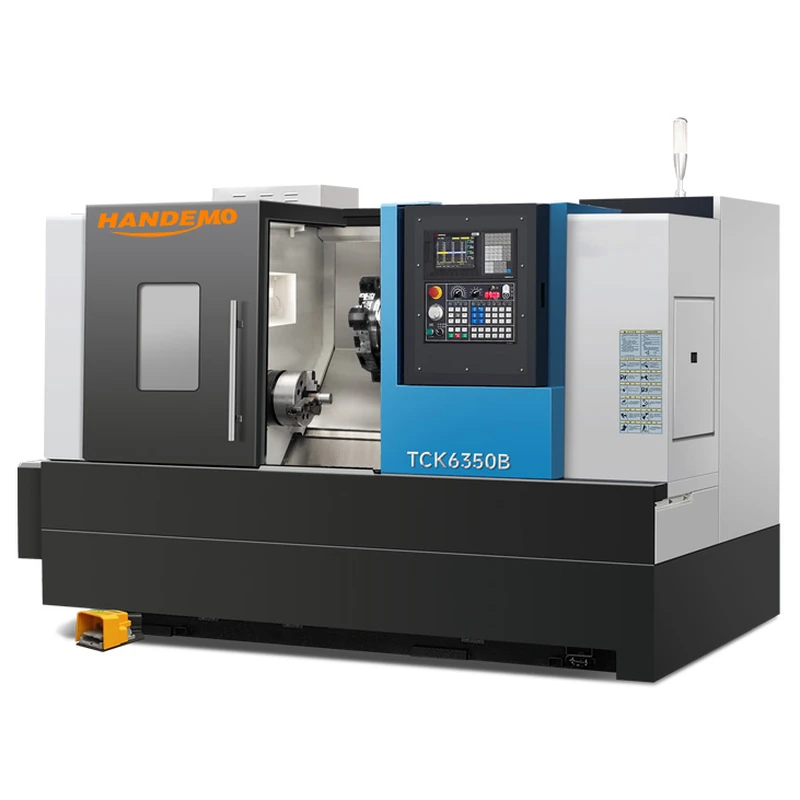
For general chucking work and short shafts, the entry to the range is the TCK50, with the TCK6050 stepping up for a wider range of diameters and a heavier cut. Both are straightforward production machines, and both are the machines we would normally pair with a bar feeder for smaller parts run in volume.
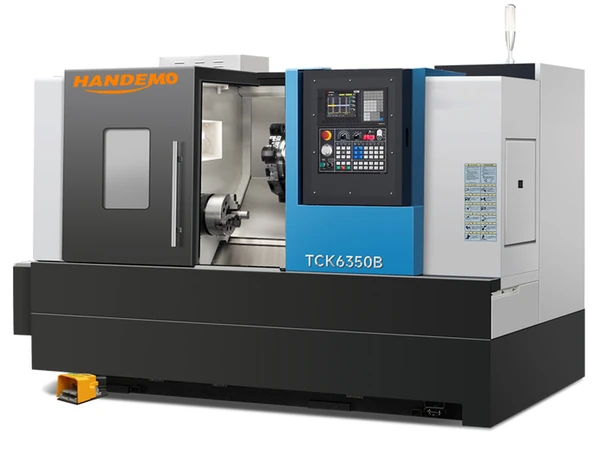
For larger work, longer parts and heavier stock removal, the TCK6350B carries a bigger swing and a heavier structure, which is the point at which operators stop complaining about interrupted cuts. Where the finish matters more than the metal removal rate, the high-end precision group, including the TCK6050D and the TCK70D, is built for shops that hold tight work on a daily basis and want the machine to stay there through the shift.
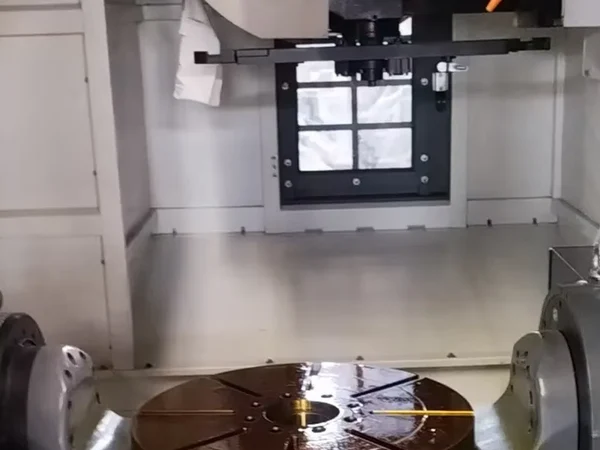
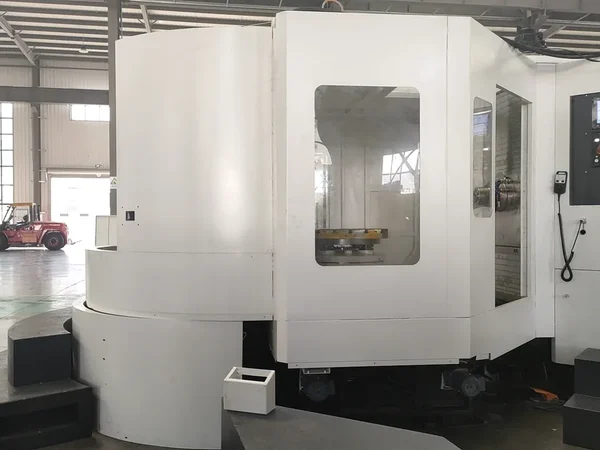
When the part needs milling features, or when both ends have to be machined without a second op, the answer moves to the mill-turn side. The TCK6050Y adds a Y axis to a live tool turret for cross features, and the 3100SY runs two spindles so the part is finished in one cycle. Where the turned part also needs a milled face or a pocket that cannot be reached from the turret, the work is usually split with a vertical machining centre, and where the housing needs machining on four sides the job belongs on a horizontal machining centre instead.
Long shafts are the case where we will say plainly that a slant bed is not the first choice. If the part is a roll, a screw or a long tie rod, the honest answer is a long-bed machine or a horizontal turning platform, and we would rather say so than sell a short machine that cannot hold the part.
Buying Advice That Survives the Meeting
Three things are worth writing down before the quotes come in.
First, measure the longest part you will really run, not the longest part in the catalogue. The bed length and the type of bed follow from that single number, and it is the one requirement that cannot be fixed with an option later.
Second, count the chips. If you are removing a lot of material on short parts, the layout that clears chips by itself is worth more per shift than any headline specification. If you are finishing near to size on long parts, the opposite is true and rigidity along the length matters more.
Third, decide whether the machine will ever be fed automatically. Adding a bar feeder to a machine chosen without that in mind, or discovering later that a gantry loader cannot reach the chuck cleanly, is a far more expensive mistake than getting the bed layout right at the outset. Our gantry loader and robotic machine tending pages show what each option expects of the machine.
Finally, ask for the working area dimensions rather than the bed angle. The angle is a marketing number. The distance from the door to the chuck, and the space behind the turret, are what your operator will live with.
FAQ
Is a slant bed always more accurate than a flat bed?
No. Accuracy comes from the guideway condition, the spindle, the drive and how the machine manages heat. A well-built flat bed lathe can hold tight work. The slant bed's advantage is chip clearance, access and rigidity in a compact footprint, not accuracy by itself.
Can a slant bed lathe machine long shafts?
Short and medium shafts, yes, usually with a tailstock or a sub-spindle. Very long shafts become awkward, because there is less room to bring the part in and to support it along its length. That is a case where a flat or long-bed machine is the better answer.
Why do most production turning machines use a slant bed?
Because they mostly run chucked parts, where chips need to leave the cutting zone, the operator needs to reach the work, and the part may later be fed automatically. The layout suits all three.
Does the bed angle matter?
Only as a design decision that affects chip fall and access. What matters more is how the casting is ribbed, how the guideways are supported and what spindle and drive are fitted.
Can I add a bar feeder or robot later?
Usually yes, if the machine was chosen with the interface and the access in mind. Ask about the bar capacity, the loader interface and the pick-up position when the machine is specified, not after it is installed.
Send Us the Part You Are Trying to Turn
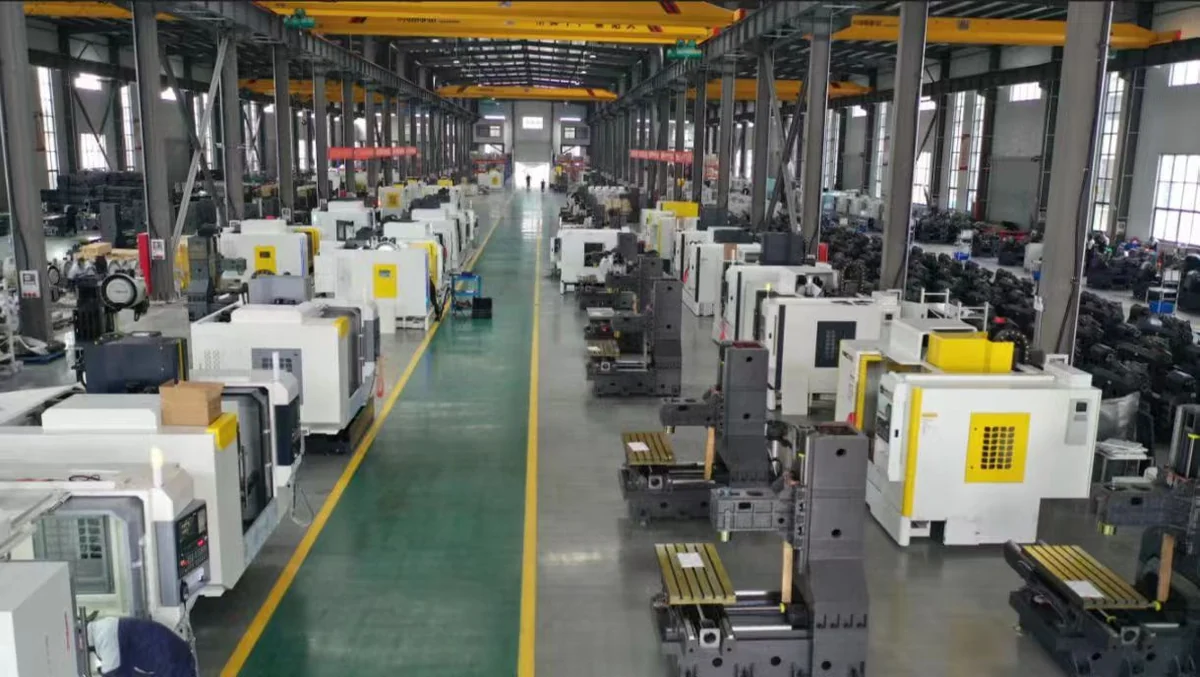
Tell us the material, the diameter, the length, the batch size and whether the part will be loaded by hand or automatically, and we will say which layout and which machine in our range fits. Handemo has been building machine tools since 2008 and supplies buyers in more than 150 countries from a plant of 220,000 m². We would rather point a long-shaft job at the right platform than sell a slant bed that fights it.
You can send a drawing directly through our drawing upload page and we will come back with a machining plan and a quotation against your part.
Contact Handemo CNC | Email: sales1@handemocnc.com | WhatsApp: +86 135 6320 3038
Related reading: CNC Lathe vs Mill-Turn: How to Choose | VMC vs HMC: How to Choose a Machining Center | 5-Axis vs 3-Axis Machining Centers