5-Axis vs 3-Axis Machining Centers: How to Choose
The question usually arrives with a drawing attached. A shop has a part that runs fine on a three-axis machine, and someone in the meeting asks whether a five-axis machine would pay for itself. Sometimes the honest answer is yes and the payback is under a year. Sometimes the answer is no, and the money is better spent on a fixture and a second pallet. The two machines are not a ladder with three axes at the bottom and five at the top. They solve different problems, and the part tells you which one you have.
This comparison is written for the person who has to justify the purchase, not for the person who enjoys axis counts. It covers what actually changes between the two machine types, where a three-axis machine still wins on cost, the part shapes that push a job toward five axes, and the running cost that decides the answer in the end. If your parts are housings rather than blades, our guide to choosing a machine for box and housing parts covers that family in more detail.
What Actually Changes Between Three and Five Axes
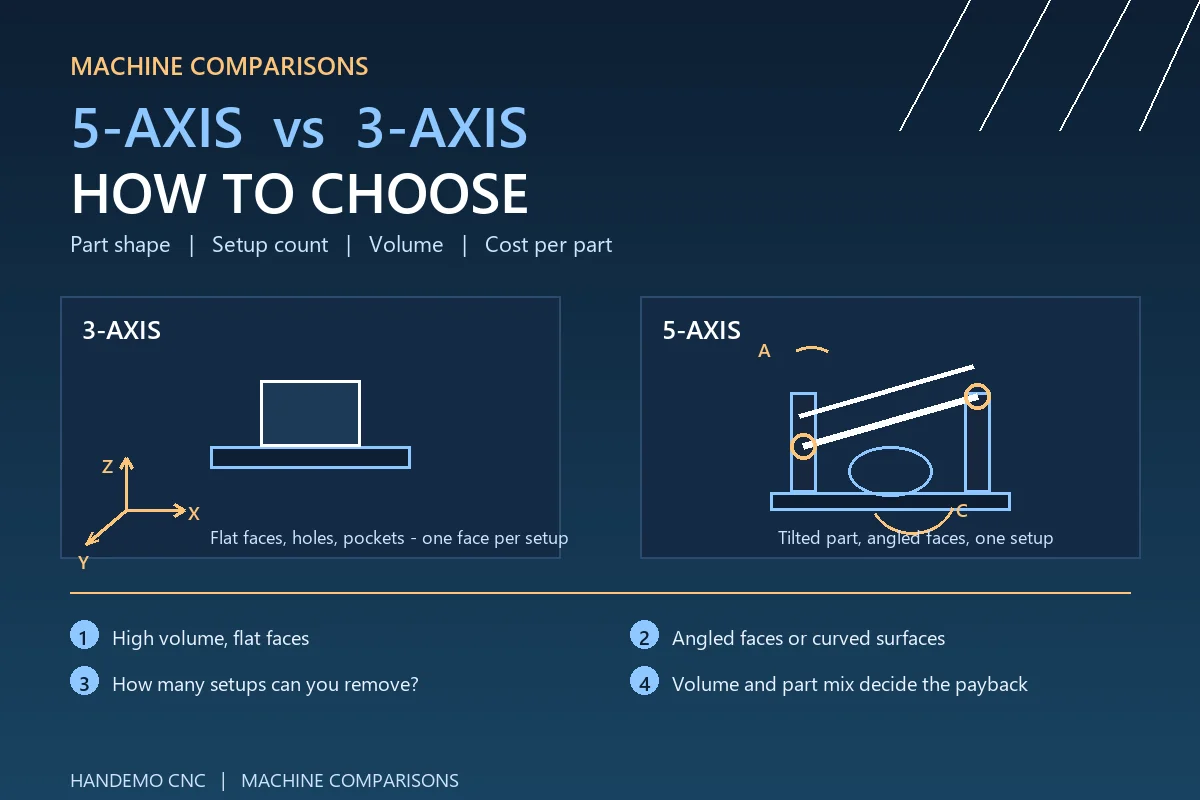
A three-axis machining centre moves the tool in three straight directions. The part stays where the fixture put it, and the cut happens on whichever face is pointing up. Anything on a different face is a new setup: unclamp the part, turn it, find it again, and hope the second operation lands where the first one left off.
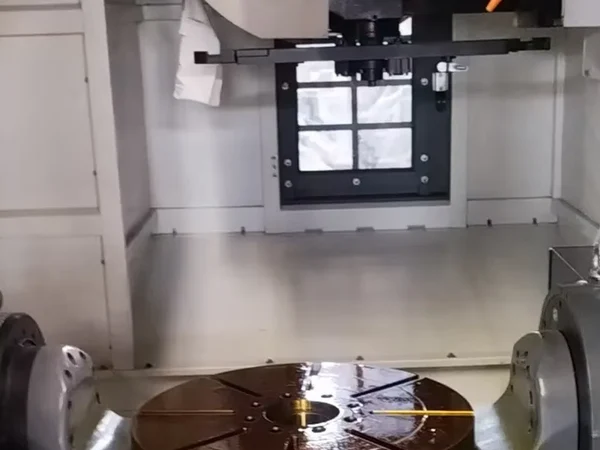
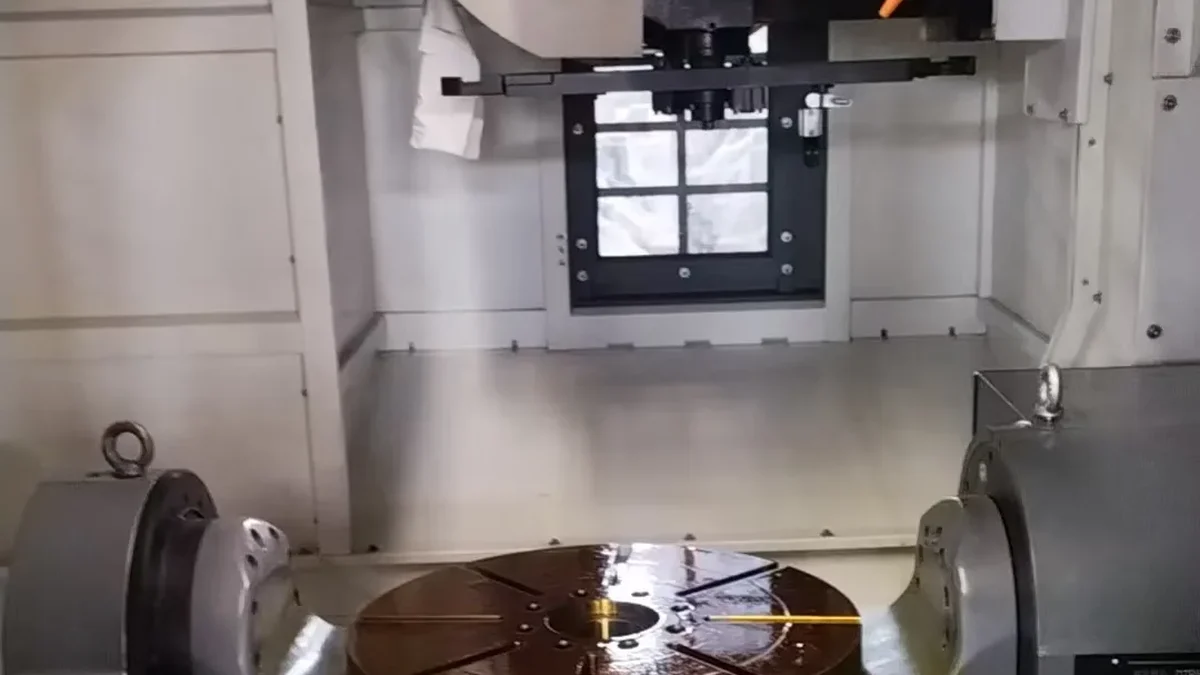
A five-axis machine adds two rotary motions. One turns the part around a vertical axis, the other tilts it. The tool is still a three-axis spindle; the part simply presents a different face to it without being taken off the table. That single change is the whole story. The value of a five-axis machine is not that it can reach more, but that it reaches more without the part ever leaving the fixture.
There is a practical difference between a machine with a trunnion table and a machine with a swivelling head. A trunnion carries the part and tilts it under the spindle, which suits heavier and rounder work. A swivelling head moves the spindle instead, which suits large flat parts where the part is too heavy to tilt. Both are five-axis machines, and the choice between them follows the weight and the shape of the part rather than the axis count.
Where Three Axes Still Wins
Three-axis machines are cheaper to buy, cheaper to tool and easier to keep accurate over years of production. On the right part they are also faster, because a machine that never moves a rotary axis spends all of its time cutting.
They win clearly when the work is flat and open. Plates, covers, brackets, and mould plates with pockets and holes on one face are three-axis work even when the annual volume is in the tens of thousands. Add a fourth axis in the form of a simple indexer and a large share of prismatic parts that need two or three faces can be handled without going near a five-axis machine.
They also win on labour and programming. A three-axis program is shorter to write, quicker to prove and easier for a new operator to take over. A shop running a mix of short batches with frequent changeovers should think hard before adding a machine whose setups are longer and whose programs have to be verified in more directions.
Where Five Axes Earns Its Cost
The case for five axes is almost never about a feature that cannot be cut any other way. It is about features that cannot be cut profitably any other way.
Angled Faces and Cross Holes in One Setup
A part with faces at an angle to each other, or holes that cross the part at different orientations, is the classic five-axis job. On a three-axis machine each direction is a separate clamping. On a five-axis machine the part is clamped once, tilted to each face in turn, and the relationships between the features are held by the machine rather than by the operator's re-fixturing. When a part needs four or more orientations, the setup time alone usually settles the argument.
Free-Form Surfaces and Blades
Curved surfaces that change direction as they sweep across the part cannot be followed by a three-axis machine without leaving marks where the tool steps over. Impellers, turbine and compressor wheels, propellers and the sculpted surfaces of dies are the parts where five axes is not a convenience but the only sensible way to produce the shape. The tool stays normal to the surface across the whole pass, which is why the finish comes off the machine rather than off a bench.
Deep Cavities and Short Tools
A deep pocket cut by a three-axis machine needs a long tool to reach the bottom, and a long tool deflects. Tilting the part lets the machine use a shorter, stiffer tool and reach the same corner. On mould work this often decides the choice, because the alternative is to hand-finish the part afterwards or to accept a heavier cut and a slower cycle.
The Cost That Decides It: Setups, Not Spindle Hours
Buyers often compare machine types by cutting speed. That is rarely where the money is. On a job that needs several orientations, the cost sits in the hours the part spends being moved rather than cut.
Take a part that needs work on five faces. On a three-axis machine that is three or more clampings, each one with a load, a re-datum, a first-cut check and the risk of a scrapped part if a locating feature has moved. The cutting itself might be forty minutes out of a much longer day. On a five-axis machine the same part is loaded once, and the operator's time goes into the next part while the machine indexes. Where a shop runs the same part repeatedly, that difference compounds every shift.
Against that, a five-axis machine costs more, its rotary axes need care, and its programs take longer to prove. The calculation is not the price of the machine against the price of a three-axis machine. It is the saved hours over the life of the part against the extra cost, plus a hard look at how much of the shop's work is actually multi-face and free-form, and how much is flat plate that would run just as well on a rigid vertical machine.
A useful rule of thumb: if a part family needs three or fewer orientations and the surfaces are flat or cylindrical, stay with three axes and invest in fixtures and pallets. If a family needs four or more orientations, carries angled faces, or has curved surfaces that must come off the machine finished, five axes is not a luxury.
Which Part Families Point Which Way
Most work arriving at a machine shop falls into recognisable groups, and the group usually makes the decision.
Three-Axis Territory
Plates, covers, brackets, base plates, flanges and simple housings with features on one or two faces. Mould plates and die shoes. Long parts such as beams and bed plates where the part is too large to tilt and too heavy to move between operations.
Five-Axis Territory
Impellers, turbine wheels and bladed discs. Sculpted mould cavities and cores. Parts with angled faces and cross bores, such as valve bodies, manifolds and complex fittings. Medical and instrumentation parts with contours on several sides. Any part where a bench finish would otherwise be needed to make the surface acceptable.
Round Parts That Want a Lathe Instead
Shafts, sleeves, pins and turned fittings are not really a three-axis or five-axis question. They go onto a lathe first. Where the same part also carries cross holes, flats or off-centre features, a mill-turn machine finishes both ends in one go, and a five-axis mill-turn centre takes the more complex round parts without a second fixture at all.
Machines We Would Put Each Family On
Handemo builds all three families, so we have no reason to push one type over another. What follows is the short version of how we would allocate the work.
Vertical Machining Centres for Flat and Prismatic Parts
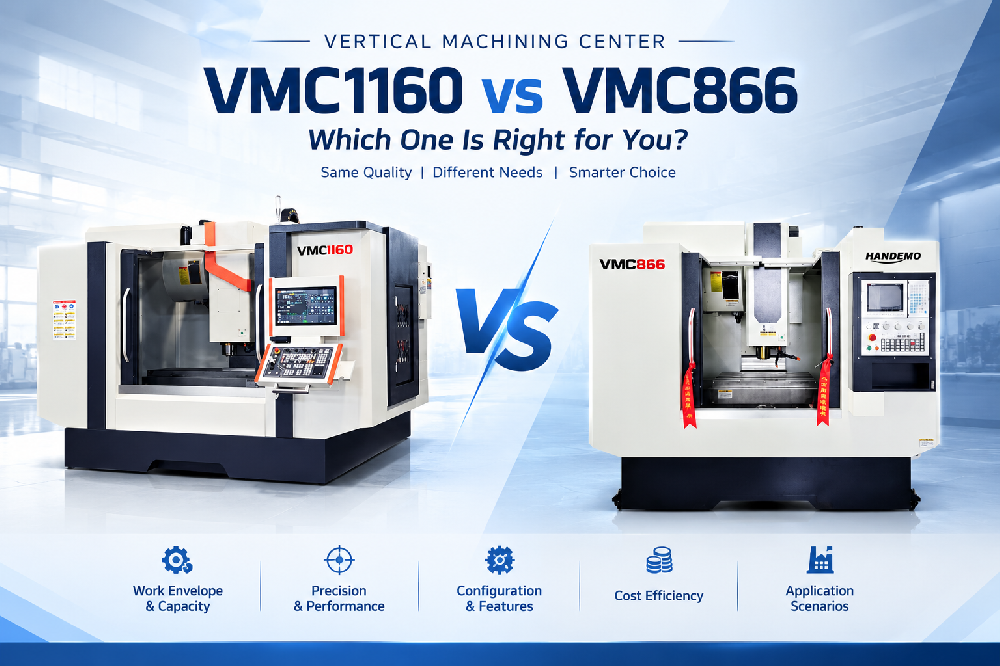
A rigid vertical machine remains the most economical tool for plates, covers and brackets. The VMC1160 has the envelope for a door-sized casting, and the VMC855 covers the smaller families where the cycle is short and the fixture does most of the work. The full vertical range runs from light, fast models to heavy castings for mould work.
Compact Five-Axis Centres for Multi-Face Work
For small and medium parts with angled features, cross holes or contours on several sides, a compact five-axis centre keeps the whole job on one table. The U260 and its larger stablemates in the five-axis range are built around a trunnion table, so the part is tilted rather than moved between operations. This is the class we would quote for a shop whose work has drifted from flat plate into contoured parts.
High-Speed Five-Axis Centres for Mould and Die Work
Mould and die shops need the extra reach and speed that comes with a gantry or overhead structure. The TMC630 covers mould and die parts where the cavity has to come off the machine finished, and the note on machine selection in our mould and die application page sets out how we match it to the size of the block and the depth of the cavity.
Five-Axis Mill-Turn Centres for Complex Round Parts
When a part is round but also carries angled holes, off-axis features or a machined back end, a five-axis mill-turn centre removes the second operation entirely. For a shop already turning shafts and sleeves, this is often the more useful purchase than a separate five-axis milling machine, because it absorbs the work the lathe is already doing.
Buying Advice That Survives the Meeting
Three questions settle most of these decisions.
First, how many orientations does the part need? Count them honestly. If the answer is one or two, the discussion is over.
Second, how much of the shop's work looks like that part? A five-axis machine bought for a single awkward job will sit idle. A five-axis machine bought because a third of the order book is multi-face is a different proposition.
Third, what would the money do elsewhere? A three-axis machine plus a proper fixture, a pallet system and a second cutting tool budget may remove more hours per shift than a five-axis machine would. In many small shops the fixture is the cheaper lever.
If the answer still points to five axes, buy enough machine to cover the part families you expect, not just the part in front of you. Rotary tables and envelopes are difficult to upgrade later, while tools and workholding can be added as the work arrives.
FAQ
Is a five-axis machine always more accurate than a three-axis machine?
No. Accuracy comes from the structure, the rails and how well the machine is set up and maintained, not from the axis count. A well-built three-axis machine will hold a better result than a poorly maintained five-axis machine. What the extra axes give you is the ability to hold the relationship between features that would otherwise be set by hand re-fixturing.
Can a five-axis machine replace several three-axis machines?
Where the work is genuinely multi-face, yes, and that is the usual reason to buy one. Where the work is flat plate and simple housings, it cannot, because a three-axis machine cutting a simple part is both faster and cheaper to run. Most shops that move to five axes keep their vertical machines for the simple families.
Do I need five simultaneous axes, or is positioning enough?
Many jobs only need the part tilted to a new orientation and then cut in three axes. That is five-axis positioning, and it covers a large share of angled-face work. Simultaneous five-axis motion is needed where the tool has to stay normal to a surface that changes direction, as on impellers and sculpted dies. The two are different requirements, and knowing which one your part needs changes the price.
What should I check before buying a used five-axis machine?
The rotary axes, first and above everything else. Ask for a record of their maintenance, check the table for play and repeat any test cut the seller will allow. Electronics for older controls can be hard to source, and a machine with tired rotary axes is more expensive than a new three-axis machine, not less. If you cannot inspect it running, we would not buy it.
How do I decide for a part family rather than a single part?
Send us the drawings for the family, with annual quantities, and we will sort them into flat work, multi-face work and round work, then show you which machine carries each group and where the setup count drops. That is a more useful exercise than arguing over a single part, because one part rarely pays for a machine and a family often does.
Send Us the Parts You Actually Run
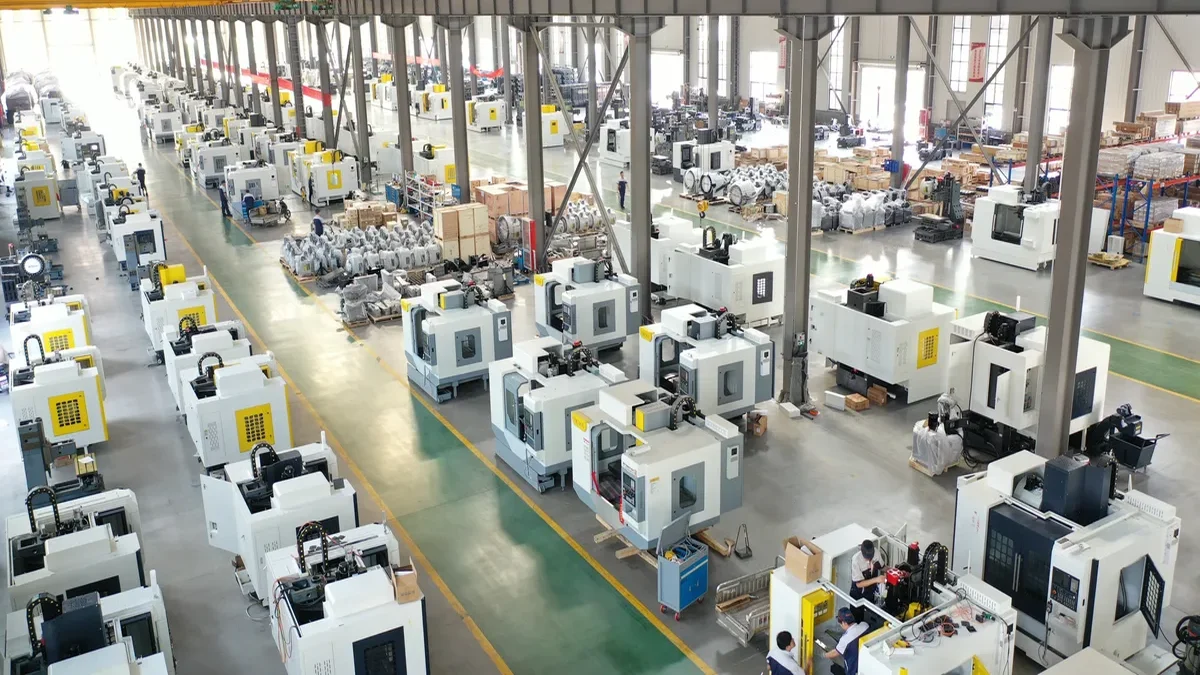
If you are weighing a five-axis purchase, send us the drawings and the annual quantities rather than a single sample. We will come back with the axis configuration we would recommend, the machine in our range that matches it, and an honest note on which of your parts should stay on a three-axis machine. Handemo has been building machine tools since 2008 and supplies buyers in more than 150 countries from a plant of 220,000 m², which means we would rather sell you the right machine once than the wrong one twice.
Contact Handemo CNC | Email: sales1@handemocnc.com | WhatsApp: +86 135 6320 3038
Related reading: VMC vs HMC: How to Choose a Machining Center | CNC Lathe vs Mill-Turn: How to Choose | How to Choose a Machining Center for Box and Housing Parts | CNC Machines for Mold and Die Manufacturing