CNC Lathe Selection: Swing, Bore and Chuck
Most lathe enquiries we get start with a diameter. "We need to turn a 400 mm flange." That is a good start and a bad finish, because the diameter alone does not tell you whether the part fits through the spindle, whether the chuck can hold it, or whether the turret can reach the far end of it. Three numbers decide almost everything on a lathe, and buyers usually quote only one of them.
We build slant bed lathes from a 500 mm swing compact model up to a 1000 mm swing pipe threading machine with a 240 mm bore, and we quote against drawings every day. The same conversation happens over and over: the customer has measured the biggest diameter on the part, and the machine that gets chosen is wrong for a reason that had nothing to do with that diameter.
This article is the checklist we run through internally before we recommend a model. It sits in our machine comparisons section alongside the notes on slant bed versus flat bed and lathe versus mill-turn, because those two decisions come after this one, not before it.
The three numbers, and the one everyone forgets
Swing, bore and chuck. Get those three right and the lathe will do the work. Get them wrong and no amount of options will fix it, because they are cast into the machine.
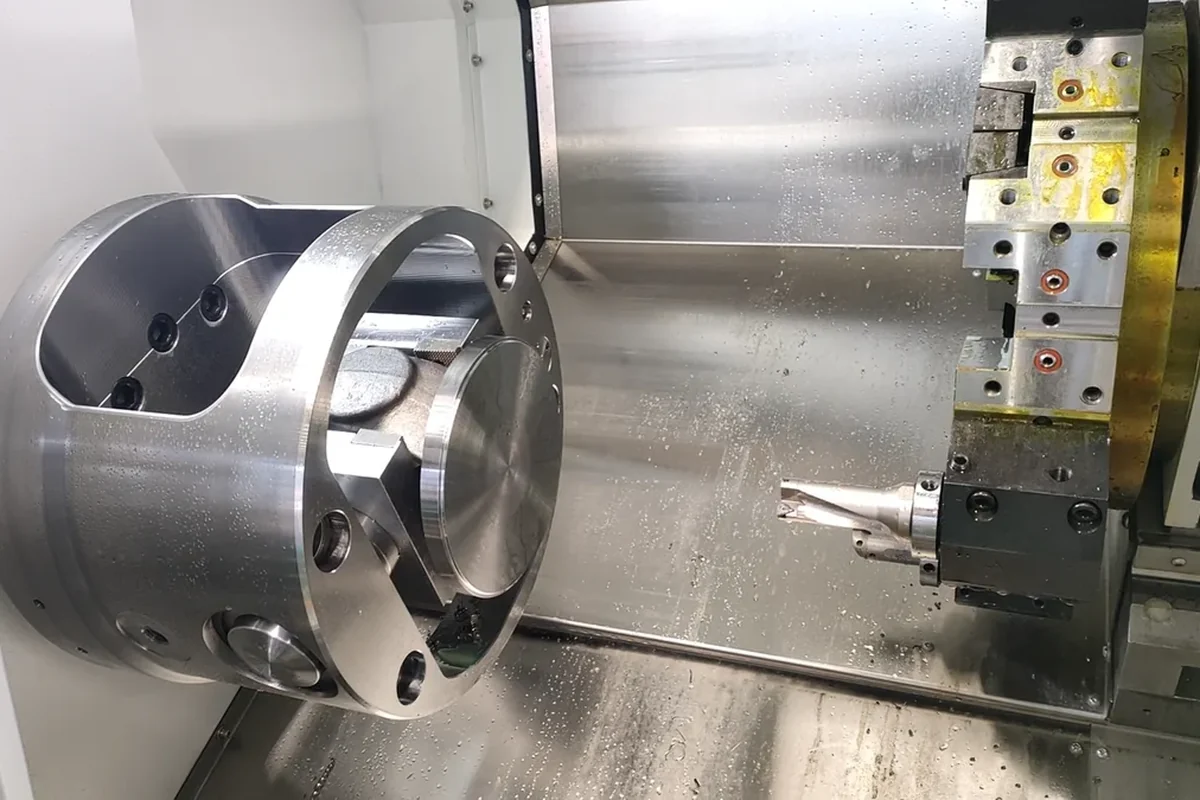
Swing is how large a part can rotate without hitting something. Bore is how large a bar can pass through the spindle, which decides whether you can run bar work at all or whether every part starts as a sawn blank. Chuck is the gripping size, and it decides how much weight and how much grip you have at the front of the spindle.
The fourth number is turning length, and it is the one buyers most often misread. A machine with 1000 mm of turning length does not cut a 1000 mm part in one go if the part needs a tailstock at one end and a chuck at the other. The usable length is what is left between them. This is why two lathes with the same quoted length can behave completely differently on a shaft with a centre hole at each end.
Reading swing properly
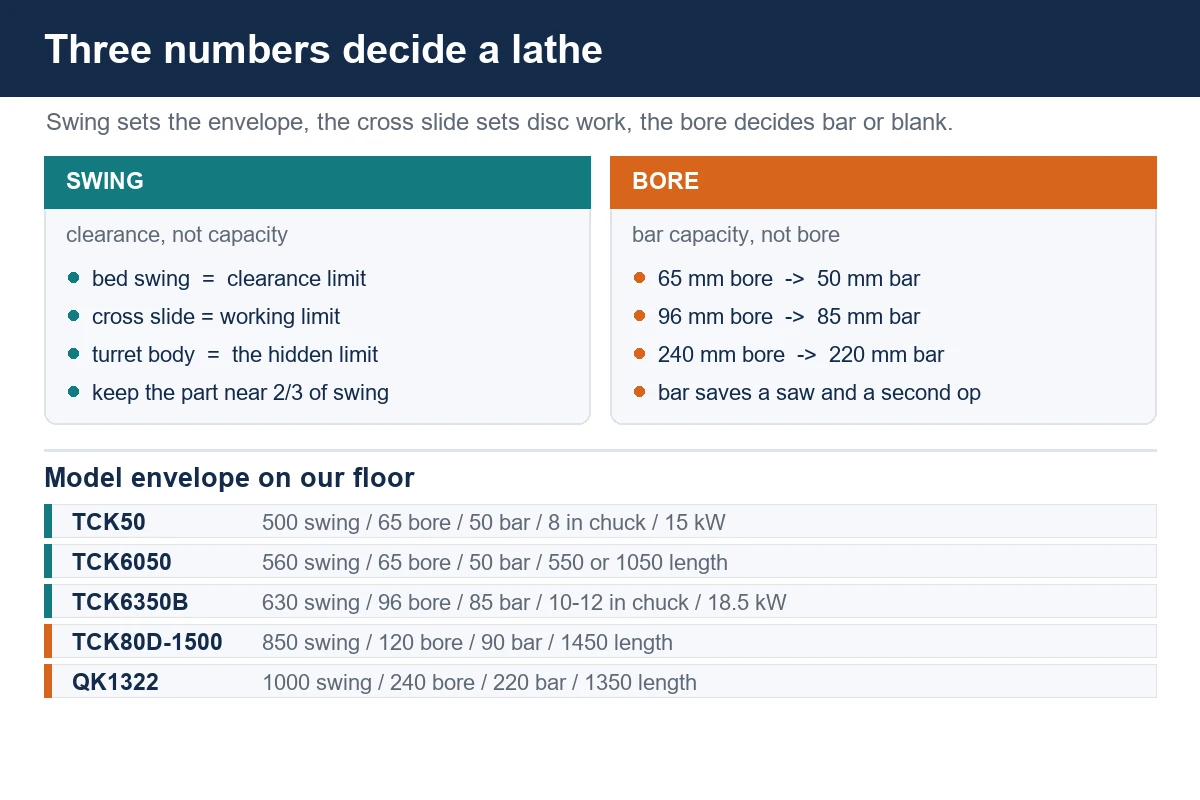
Swing over bed is the clearance between the spindle centreline and the nearest fixed part of the machine, doubled. It is the largest diameter that can physically rotate. It is not the largest diameter you can machine, and it is certainly not the largest diameter you can machine well.
Swing over cross slide is the honest number for disc work, because the cross slide sits between the tool and the part. On a 560 mm swing machine, the cross slide figure is typically 320 mm, and that is the diameter a facing or grooving operation can actually reach without the turret body fouling. If your part is a disc with a groove near the outside, the cross slide number is the one that decides the job, not the bed number.
There is a third limit that appears on no specification sheet: the turret. A 12 station turret has a body, and that body has to sit somewhere when the tool is at the far side of a large diameter. Shops discover this when a 500 mm part that "fits" cannot be faced in one pass because the turret hits the part before the insert does. The practical answer is usually a bigger swing machine running well below its limit, or a different tool orientation.
Our own rule of thumb when quoting: the part's largest turned diameter should sit at about two thirds of the bed swing, and inside the cross slide figure with margin. A part that uses the full bed swing every day is a part that will be awkward to load, awkward to measure, and slow to run.
Bore and bar capacity are not the same number
The spindle bore is the hole through the spindle. Bar capacity is what you can actually feed through it, and it is always smaller, because the bar has to clear the draw tube, the chuck jaws and the hydraulic cylinder behind the spindle. A 65 mm bore is usually quoted as 50 mm bar capacity. A 96 mm bore gives 85 mm. A 240 mm bore gives 220 mm.
This matters more than buyers expect. If the part is made from bar, the difference between 50 mm and 85 mm bar capacity decides whether you can run the family on one machine or whether half of it has to be sawn and chucked. Sawn blanks cost a saw, a second handling step, and a second op to face and centre. Over a year of production that is usually more than the price gap between the two lathes.
The bore also decides whether you can pass a long part through the spindle and grip it at the far end, which is the standard way to machine a long shaft without a tailstock fight. A 1500 mm shaft through a 96 mm bore, held in a chuck at one end and a chuck or collet at the other, is a different and much better job than the same shaft between centres.
Chuck size, and the weight nobody mentions
Chuck size is quoted in inches and it is really a statement about gripping force and part weight. An 8 inch chuck on a 15 kW spindle is a light-duty arrangement: it will hold a 200 mm part comfortably and it will struggle with a heavy casting that overhangs. A 10 or 12 inch chuck on an 18.5 kW spindle is the normal pairing for general disc work up to a few hundred millimetres.
The number that is never on the brochure is the weight the jaws can hold at speed. A heavy disc gripped on a short land will move if the speed is high, and the operator will hear it before anything breaks. This is why big diameter parts are usually run slower than the machine's ceiling, and why a lathe with a generous chuck and a modest top speed is often the better buy for heavy disc work than a fast machine with a small chuck.
For thin parts the problem reverses. A thin ring or a thin-walled sleeve distorts under chuck pressure, so the part is either gripped on a bored soft jaw, held on a faceplate, or held on a mandrel. If your family is thin rings, tell us at the quotation stage, because the answer may be a bigger bore machine with soft jaws rather than a bigger chuck.
Turning length, tailstock and the second op
Length is where the model range spreads out most. A compact lathe with 550 mm of cutting length covers short shafts and disc work. A 1000 mm machine covers most general shaft work. Beyond that the machine grows quickly in weight and price, and the question becomes whether the long parts are a regular product or an occasional repair job.
For shafts, the tailstock is not optional. A shaft that is long relative to its diameter will deflect under the cut, and the deflection shows up as a taper along the length, not as a diameter error at the chuck. If the part has a centre hole at each end, a lathe with a tailstock and a travelling steady will hold it far better than any amount of chuck pressure.
There is also the second operation. A shaft that needs a keyway, a cross hole or a milled flat is not finished on the lathe, and the honest question is whether it goes to a machining center afterwards or whether a mill-turn machine should do the whole part in one clamping. Our lathe versus mill-turn article covers where that line falls. As a rough rule, one or two cross features on a part that is otherwise round is usually still lathe work plus a second op; a ring of features on several faces is mill-turn work.
What the material changes
Material does not change the envelope, but it changes the power and the stiffness you need inside it. Cast iron and mild steel are forgiving: a 15 kW spindle with a 12 station turret will rough a cast skin and finish a bore on the same part without drama. Alloy steel such as 4140 wants more power and a heavier turret, because the depth of cut that clears a pre-hardened skin is larger than the one that clears a casting.
Stainless is the one that surprises buyers. It cuts with more force for the same chip, it work hardens if the tool rubs, and it holds heat at the edge. A lathe that is comfortable in 1045 can feel underpowered in 316, not because the spindle is small in kilowatts but because the whole loop from turret to chuck is being asked for more. Thin stainless parts add the distortion problem on top.
Aluminium goes the other way. It rewards speed and chip clearance more than power, and the limit is usually chip evacuation and thermal growth rather than the cut itself. If your work is mostly aluminium, a lighter and faster machine is the better match, and buying heavy iron for it is money spent on capability you will not use.
Turret, tool count and live tools
Twelve stations is the standard for general work and it is enough for most families: rough turn, finish turn, face, bore, groove, thread, and a few spare pockets for the odd feature. Eight stations is enough for simple parts and it is what you find on compact machines. The question to ask is not how many stations, but how many tools a typical setup actually needs before you start swapping inserts mid-batch.
Live tooling is a separate decision. A turret with driven tools can drill an axial hole or mill a flat on the same clamping, which removes a second op and a second fixture. It costs more, and it only pays if the parts genuinely have those features. If the drawing has one cross hole on a part that is otherwise turned, a drilled hole on a drill press is often cheaper than the live tool option.
Y-axis is the next step up, and it is what lets an off-centre feature be milled without a second setup. Our slant bed lathe guide covers how the bed angle and the turret arrangement interact, which is worth reading before you add axes.
Where our range sits
Concretely, this is what we build and what each one is for.
The TCK50 swings 500 mm over the bed with a 65 mm bore, 50 mm bar capacity, an 8 inch chuck, 15 kW and an 8 station turret. It is the compact machine for small disc work, small hubs and bar parts up to 50 mm, and it is the cheapest way into slant bed turning.
The TCK6050 swings 560 mm with a 65 mm bore and 50 mm bar capacity on an 11/15 kW spindle, with 550 mm or 1050 mm of turning length depending on the bed. It is the general-purpose machine: flanges, sleeves, small housings, short shafts, and anything where the part is under 500 mm and the batch is mixed.
The TCK6350B is the workhorse for disc work. It swings 630 mm over the bed, takes a 96 mm bore and 85 mm bar, runs a 10 or 12 inch chuck on an 18.5 kW spindle with a 12 station servo turret, and comes in 500 mm and 1000 mm cutting lengths. Flywheels, pulleys, bearing housings, brake discs and pump parts all land here.
The TCK80D-1500 swings 850 mm over the bed with a 120 mm bore, 90 mm bar capacity and 1450 mm of turning length on an 18.5/22 kW spindle. It is for the parts that are too big for the 6350 and too short for a pipe lathe: large housings, long sleeves, big flanges.
At the top, the QK1322 swings 1000 mm over the bed with a 240 mm bore, 220 mm bar capacity and 1350 mm of turning length. It is the large-bore machine for pipe, tube and heavy ring work, where the part goes through the spindle rather than into a chuck.
The three wrong calls we see most
The first is buying swing for one part. A shop takes on a single large casting, buys a machine that swings it, and then runs small work on a big slow lathe for three years. The large part would have been cheaper to subcontract.
The second is ignoring the bore. A 65 mm bore machine looks fine on the specification sheet until the family moves to 70 mm bar and every part has to be sawn, chucked and faced on both ends. That is a permanent cost paid to save a one-off price difference.
The third is buying length without checking the tailstock. A long bed with a tailstock that takes 900 mm of travel is a very different working envelope from the number printed on the brochure, and the difference only shows up when the first long shaft arrives.
If you are weighing a lathe against a machining center for the same part family, the logic in our multi-face parts comparison runs the same way: match the machine to the feature pattern, not to the biggest dimension on the drawing.
What to send with an enquiry
The fastest way to a correct model recommendation is a drawing and four numbers. Send the largest turned diameter, the largest diameter that has to pass through the spindle if the part starts as bar, the finished length between centres, and the part weight. Add the material and its condition, the batch size, and whether the part has features that are not round.
If the part is a family rather than a single item, send the extremes. The machine has to cover the largest and the heaviest, and the smallest part is what tells us whether the chuck and the turret are usable across the range.
For the parts themselves, our notes on transmission shafts, eccentric shafts and bushings, sleeves and rings show how the same three numbers play out across three very different part types.
Frequently asked questions
Can I machine a part as large as the swing over bed?
Physically it will rotate, but you will not have room for a tool, a steady or a measuring step. Treat the bed swing as a clearance limit and the cross slide figure as the working limit, and leave margin on both.
Is a bigger spindle bore always better?
No. A bigger bore means a bigger spindle, bigger bearings and a heavier chuck, and the machine costs more and takes longer to accelerate. If the work is all chucked blanks, a smaller bore machine with the same swing is usually the better value.
How much bar capacity do I lose against the bore?
Roughly 15 mm on a 65 mm bore, 11 mm on a 96 mm bore, and 20 mm on a 240 mm bore, because the draw tube and chuck jaws sit inside the bore. Always ask for bar capacity rather than bore when the part is fed from bar.
Do I need a tailstock if all my parts are short?
Not for short parts, but the tailstock is what makes the machine useful later. A lathe bought without one is a lathe that cannot take a shaft job, and shafts are the work that most often arrives unannounced.
Should I buy a bigger machine to be safe?
Only if the parts justify it. A larger lathe runs small work slower, uses more floor space and more power, and the extra swing buys nothing on a part that is a third of the envelope. Buy the machine the parts need, and subcontract the outlier.
Can a lathe do the milling as well?
With live tools and a Y-axis it can do a lot of it, and for parts with a few off-centre features that is usually the right answer. For parts with features on several faces, a mill-turn machine or a second op on a machining center is the better route.
Next step
Send us the drawing and the four numbers and we will tell you which model fits and where the limits are. The slant bed lathe range runs from the TCK50 through the TCK6050 and TCK6350B to the TCK80D-1500, with the large-bore work on the QK1322.
Email sales1@handemocnc.com or message us on WhatsApp at +86 135 6320 3038 with the drawing, the material and the batch size. You can also send the drawing through our contact page, and we will come back with a model recommendation, a chuck and turret configuration, and a delivery estimate.