Gantry vs Vertical Machining Center: How to Choose
A shop I know won a contract for welded frames and long plates, and did what most shops do: bought the biggest vertical machining center that fit the budget and the door. The table was 1600 by 800 mm, the travels looked generous on the spec sheet, and the first three jobs ran well. Then a frame arrived that was 2.2 m long. The machine could reach one end or the other, never both without sliding the part along the table, re-indicating, and hoping the second grip landed where the first one left off. Nobody had asked the question that actually mattered, which was not "which machine is better" but "which of our parts does not fit the way we assumed".
That is the question this guide works through. It belongs to our machine comparisons series, where each article takes a real buying decision and follows it from the part to the machine, rather than from the brochure to the machine.
Two structures, not two sizes
A vertical machining center moves the table in X and Y under a fixed column, and the spindle moves up and down in Z. That arrangement is compact, fast and cheap to build, and it is why the VMC became the default machine in almost every shop. Its limit is structural rather than a matter of quality: the table has to carry the part and position it at the same time, the column is a cantilever, and the further the head reaches from the column, the more the geometry works against you.
A gantry machine turns that around. The table is fixed and only has to support the work. A bridge spans the table, the spindle carriage travels along the bridge, and the bridge itself travels along the length of the machine. The part never moves between operations, the tool stays supported on both sides of the cut, and the working area is open from above, so a crane can set a heavy part down without threading it past a column.
Once you see it that way, the choice stops being about brand or price tier. It becomes a question about the parts: how big, how heavy, how many faces, and whether the datum has to survive across a length the machine cannot span.
Four signs the vertical machine has stopped being the answer
The part is longer than the useful table
Table length is not the same as the length you can machine. Clamps and fixtures eat 150 to 300 mm at each end, and the head still has to reach the far feature without the spindle nose colliding with the work. A 1600 mm table with 1600 mm of X travel is honest about its envelope; a part that needs 1.9 m of continuous work does not fit, however you clamp it.
The part weighs more than the table is rated for
Table load ratings are real limits, not marketing. A large vertical machine in the 1600 mm class typically carries around 1500 kg, and that figure has to include the fixture, which on a big part can be 300 kg on its own. Beyond that, the table is moving that mass all day, and the drives and guideways pay for it.
The datum has to survive across the full length
This is the one that costs money quietly. Machine beds, linear guide seats, rail mounting faces and long weldments are judged by how flat and how parallel two features are when measured a metre or two apart. On a vertical machine that means either a very long table or a repositioning step, and a repositioning step means the second setup inherits whatever the first one left behind. On a gantry the part is clamped once and the whole length is cut against the same datum.
The part cannot be flipped, or cannot be lifted onto a table
Some parts are heavy, some are awkward, and some are both. If the only way to load the part is from above with a crane, a bridge machine lets you do it. On a vertical machine the column and the enclosure are in the way, and the part usually arrives at an angle no rigger enjoys.
Where the vertical machine is still the better purchase
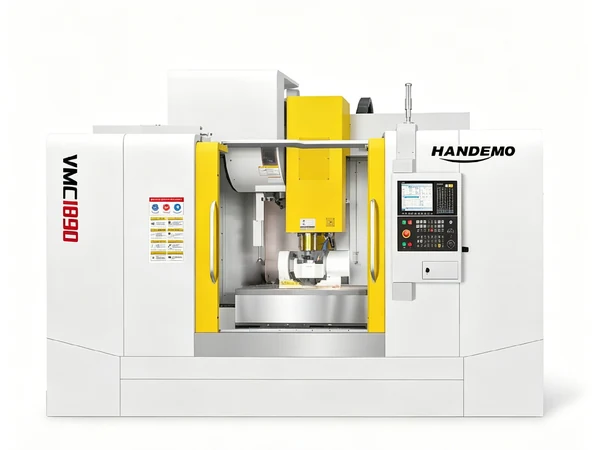
It would be dishonest to end the comparison there, because for most shops most of the time the vertical machine wins. A well-chosen large VMC covers an enormous amount of work. The VMC1690, for example, carries a 1600 by 800 mm table rated to 1500 kg with 1600 / 900 / 700 mm of travel, which takes die plates, mold bases, brackets and housings that would have needed a much bigger machine a decade ago. The VMC1890 goes further for the largest plates and machine components. Both are covered in more detail in the VMC1690 guide and the VMC1890 guide.
A vertical machine is the right answer when the work fits inside the travels with the fixture in place, when parts change over several times a day, when the building has a normal ceiling and a normal floor, and when the operator has to be productive on the first afternoon rather than after a foundation project. It is also the right answer when the large work is a small share of the order book: buying a bridge machine for fifteen percent of your parts means the other eighty-five percent are paying for it.
What changes in the cut, not just in the layout
The structural difference shows up in three places. First, stiffness across the width: a bridge is supported at both ends, so the cutting force is shared instead of being carried by a single column. Second, reach: on a vertical machine the head hangs further out as it moves away from the column, and that overhang is exactly where deep cavities and long Z work get expensive. Third, thermal and mass behaviour over a long cycle: a fixed table does not accelerate a two-tonne part, so the machine spends its energy on the cut.
What you give up is agility. A bridge and its carriage are moving mass, so rapids and accelerations are lower than on a compact VMC, and a gantry is not the machine you choose for a thousand small parts a week. It is the machine you choose when the setup is the expensive part of the job.
The four questions that decide it
Before comparing prices, answer these in writing. It takes half an hour and it prevents the wrong machine.
Largest part, including fixture. Length, width and height, with the fixture and clamps on. Compare against travels and against the distance from the spindle nose to the table, not against the table size printed on the brochure.
Heaviest part, including fixture. Then add the weight of the fixture you have not designed yet. If the total is within twenty percent of the table rating, the vertical machine is already at its comfortable limit.
How many faces, and which datum. Count the setups the part needs today, and count how many of them exist only because the machine cannot reach. That number is the real justification for a gantry.
The building. Ceiling height, door width, floor loading, crane capacity, and whether a foundation pit is allowed. A bridge machine is taller and heavier than its footprint suggests, and this is the step where projects lose a month.
Part families where the gantry route usually wins
Machine tool structural parts. Beds, columns, saddles, rams and tables are long, heavy, and judged by faces that have to stay parallel over the whole length. This is the job the gantry was invented for, and it is also the work our own shop knows from the inside, having machined the bases and beds that go under the machines we sell.
Large mold bases and die plates. Once a plate passes the practical limit of the biggest vertical machine in the shop, the alternatives are a bigger VMC, a gantry, or sending it out. A gantry keeps it in-house and keeps the plate on one datum.
Welded frames and structural weldments. Construction, agricultural and energy equipment all use frames that are long, thin-walled and full of faces that have to line up after welding. Clamping a weldment once and machining every pad and bore against one datum removes the accumulated error that comes from moving it.
Long rails, beams and guide seats. Continuous mounting faces are a geometry problem before they are a cutting problem, and geometry is decided by the machine's structure.
Large housings with faces at both ends. Pump bodies, gearboxes and motor housings where the bore at one end has to agree with the flange at the other. On a vertical machine that is a flip; on a gantry it can be one setup with the spindle reaching both ends.
Where a five-axis gantry fits
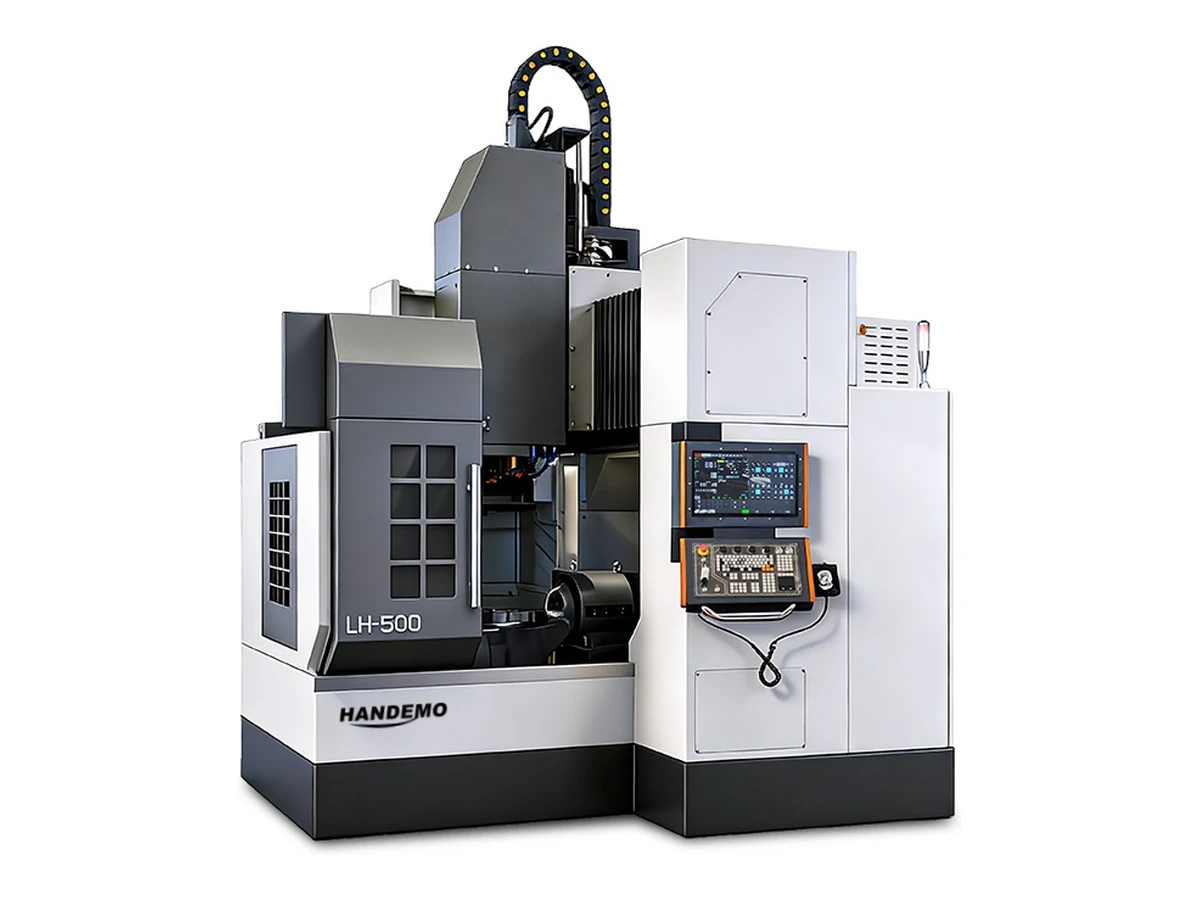
Not every bridge machine is a three-axis plate mill. A bridge-type five-axis machine keeps the fixed table and the overhead beam, and adds a rotary table so the part can be indexed or cut continuously without being re-clamped. The LH400 and LH500 sit in that family: a bridge structure with 600 / 1000 / 600 mm of travel and a rotary table, which suits tall parts, deep cavities, and work that needs access to five faces while the datum stays put.
That configuration is worth considering when a part is awkward rather than merely large. A tall housing with angled ports, a part with a bore that must be true to a face on the opposite side, or a family where the same fixture has to serve several variants. It is not the cheap way to machine a flat plate; a three-axis bridge machine does that better for less.
Cost, floor space, and the rest of the shop
The purchase price is the smallest part of the difference. A gantry needs floor area, height, usually a foundation with more mass under it, and a lifting plan. It also changes the flow: parts arrive by crane, not by hand, and the machine tends to become a cell with its own loading area rather than a machine in a row.
The honest comparison is cost per good part, which means counting the setups you remove, the scrap you avoid at the second operation, and the parts you stop subcontracting. On that basis a gantry is often cheaper than it looks. On the basis of machine price alone it never is.
One more option deserves a mention, because it is sometimes the right one: if only a handful of parts a year need the envelope, subcontract those and keep the vertical machine busy with everything else. A machine that runs at thirty percent utilisation is expensive whatever its structure.
Frequently asked questions
Can a large vertical machining center machine a two-metre part?
Sometimes, but not the way the spec sheet suggests. The part has to fit within the travels with the fixture in place, the clamps cannot sit where the tool needs to go, and the head has to reach the far features without the spindle nose hitting the work. If the job needs a repositioning step in the middle, you are no longer comparing one setup against one setup, and that is usually where the economics change.
Is a gantry machine slower than a vertical machine?
Per move, yes: there is more mass to accelerate. Per finished part it depends entirely on setup count. A gantry that machines five faces in one clamping usually wins against a vertical machine that needs three setups and two machines, even with slower rapids.
Does a gantry machining center need a special foundation?
It needs a foundation that matches its mass and its height, and in many buildings that means a separate block or a pit rather than a standard slab. Check floor loading and headroom before the machine is ordered, not after it lands, and confirm whether the building owner allows any floor work at all.
Do I need five axes, or is a three-axis gantry enough?
Three axes cover plates, frames, rails and most structural work. Five axes earn their cost when the part has angled faces, when bores have to be machined true to faces that cannot be reached from one direction, or when a family of parts shares a fixture and the variants differ by angle. If none of those apply, the rotary table is money spent on capability you will not use.
Talk about the part, not the machine
Send us the largest part you cannot machine comfortably today: a drawing or a photo, the length, width and height with the fixture, the weight, the faces that need work, and the batch pattern. Handemo will come back with a recommendation that says plainly whether a large vertical machine covers it, whether a bridge machine is the honest answer, and what the setup plan looks like either way. Contact Handemo CNC | Email: sales1@handemocnc.com | WhatsApp: +86 135 6320 3038
Related reading: Vertical vs Horizontal Machining Center for multi-face parts covers the other axis of the same decision, and box ways vs linear guides explains the guideway choice that sits underneath it.