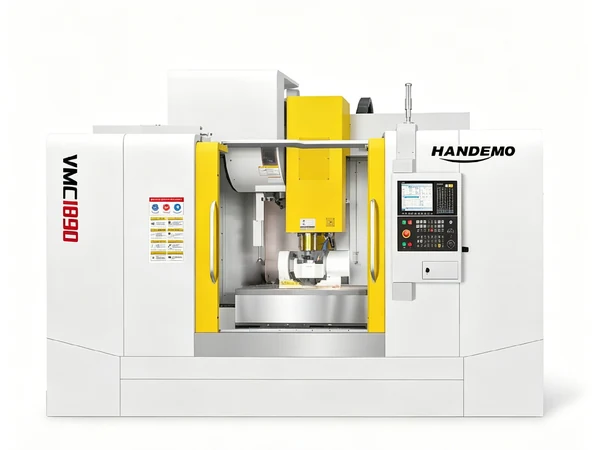
VMC1890 Vertical Machining Center Guide
The VMC1890 is Handemo's largest vertical machining center, and it exists for the jobs that do not fit anywhere else. Machine tool beds and columns, very large mold and die plates, energy-sector housings and heavy castings that will not sit still on a smaller table - this is the machine for the parts at the top of the size range. It carries a 2000 x 900 mm table, an 1800 mm X travel and a BT50 spindle, in a 14,000 kg structure. This article covers what the machine is, what its numbers mean when a real part is clamped to the table, and how to decide between the VMC1890 and the VMC1690 below it.
What the VMC1890 Is
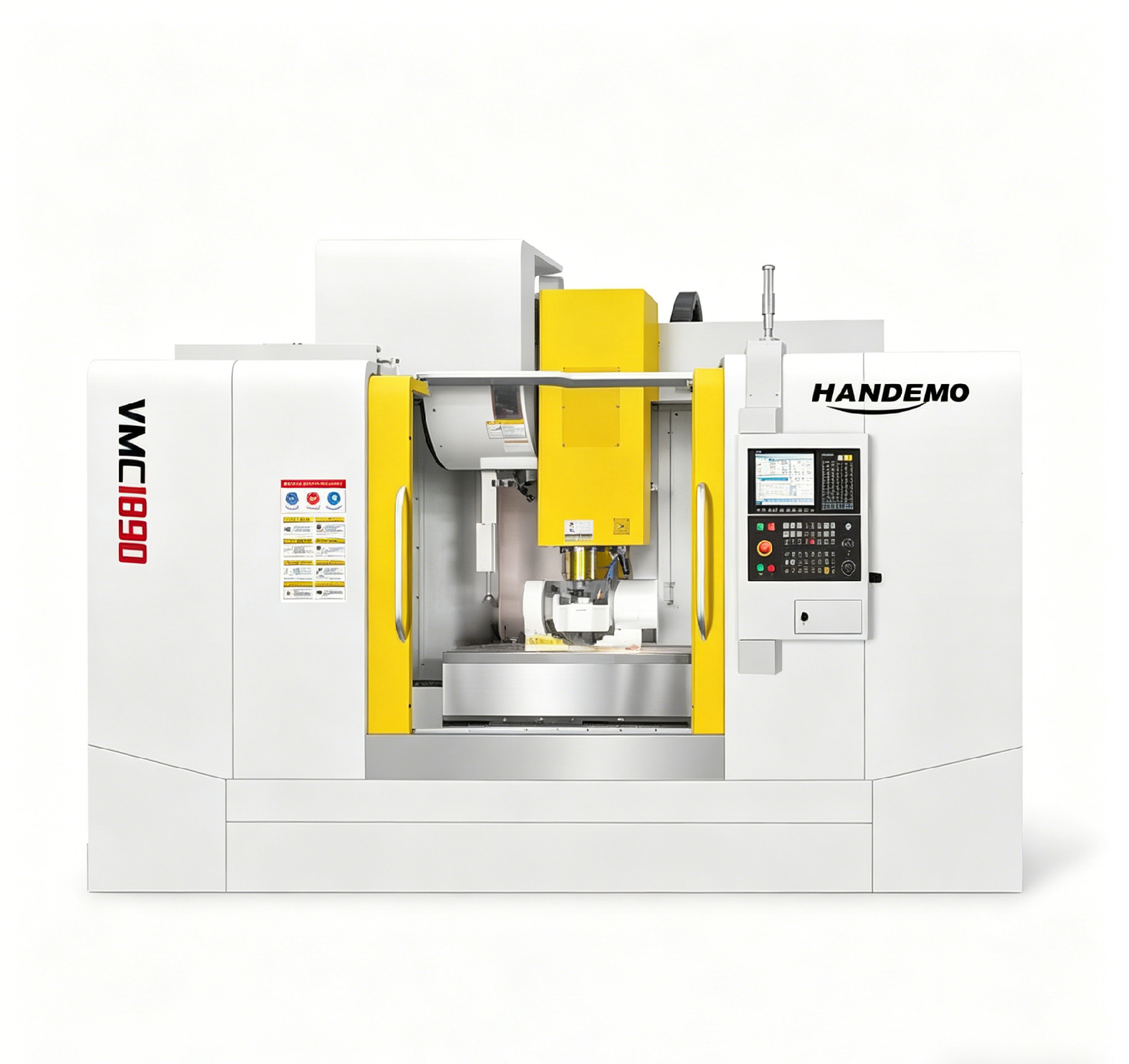
The VMC1890 is the flagship of the heavy-duty vertical machining center range. Everything about it is sized for large, heavy work: a wide table, a long X travel, a reinforced base and a BT50 spindle, in a machine that weighs 14,000 kg. Where the smaller machines are built to be quick and versatile, this one is built to stand under a heavy cut on a part that weighs as much as a car.
The travel is 1800 mm in X, 900 mm in Y and 600 mm in Z. The table is 2000 x 900 mm, rated to 1600 kg. Rapid traverse runs at 20 m/min in X and Y and 15 m/min in Z, the spindle is BT50-190 running to 6000 rpm, and the machine occupies roughly 5000 x 3000 x 2900 mm on the floor.
The Numbers That Decide Whether a Part Fits
A 2000 x 900 mm table sounds like a great deal of room, and it is, but the part that goes on it is planned against three limits rather than one.
The first is the usable table area. Clamps, stops and the fixture take their share, and the spindle has to be able to reach every feature over the full travel, so a part may fit on the table and still not be machinable at its far end. The practical working area is smaller than the nominal figure, and the question to ask is whether the spindle reaches the last bore, not whether the plate sits on the table.
The second is the 1600 kg load rating, which covers the part and the fixture together. On work this size the fixture can be a heavy casting or a weldment in its own right, and its weight counts against the same figure as the part.
The third is Z travel, at 600 mm. That is the depth of work the spindle can reach in the vertical direction with the part on the table, and a tall part or one set up on a riser can run the head out of travel sooner than expected.
Why the Structure Matters as Much as the Travel
On a machine this size the reason to buy it is not only the envelope. It is that a 14,000 kg structure with a reinforced base and a BT50 spindle holds its geometry while it takes a heavy, interrupted cut. Large parts in cast iron and steel are usually roughed hard and then finished, and the pressure to finish them in the same setup is high, because moving a two-tonne component is an event.
The heavy structure is what makes that possible. It absorbs the vibration that a lighter machine would pass into the tool, so a large face is cut with a consistent finish instead of a pattern of chatter marks, and the geometry of a long part is held through the roughing pass and into the finishing cuts.
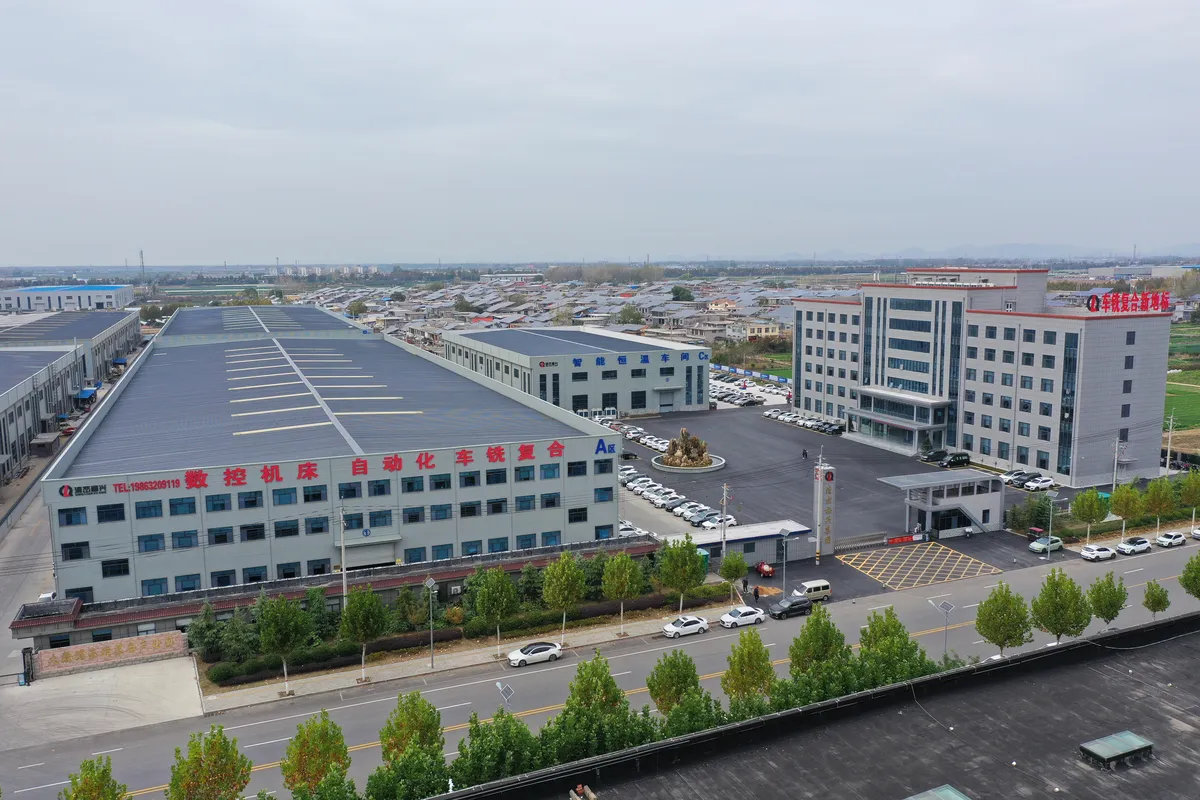
Jobs That Belong on the VMC1890
The parts that need this machine tend to fall into a few groups. Machine tool structures come first: lathe beds, machining center bases and columns, and the heavy slideways that carry them. Then the very large mold and die plates, the ones that fill a table rather than sit on it. Then large cast housings for energy, mining and heavy industrial equipment, and the base plates and frames that carry a whole assembly.
There is also a group of jobs that arrive here for handling reasons rather than size. A part that is the full width of the table on the VMC1690 may be better on the 1890, because the larger table and the extra travel let it be set up once and cut completely, rather than worked from two positions with a re-clamp in the middle.
VMC1890 or VMC1690
The two machines overlap enough that the choice is usually a question of margin. The VMC1690 vertical machining center has a 1600 x 800 mm table, 1600 mm X travel, a 1500 kg load rating and a 12,000 kg frame. The VMC1890 adds 400 mm of table length, 200 mm of X travel, 100 kg of load and 2,000 kg of mass, and gives up 100 mm of Z travel in exchange.
Three questions settle it. Does the part, with its fixture, fit the smaller table with room to clamp it and reach every feature? Is the part within the smaller load rating? And does the job need the extra mass, because the cut is heavy or the part is long and the finish has to hold over its full length? If the answer to any of them is no, the VMC1890 is the machine. If a shop makes parts in both sizes, running the large jobs on the 1890 and the rest on the 1690 usually uses both machines better than pushing everything onto the largest frame.
Setting Up Very Large Parts
On work this size, the setup is the job. A heavy part is placed and supported so that the clamping load lands on stiff sections and on machined surfaces, not on raw casting skin or on thin walls between ribs. The datum is established on a machined face and everything else is cut from it, because a part of this size cannot be re-set twice and still be expected to hold its geometry.
Where the part is too large to cut completely from one face, the work is planned so that the datum is carried across the second setup by indicating against a machined feature rather than by trusting a stop. Roughing and finishing are separated, both so the part can settle and because a machine of this size loses time and tool life if it tries to finish through a variable allowance left by a heavy first cut.
Frequently Asked Questions
How big a part can the VMC1890 machine?
Guide figures: up to roughly 1800 mm in X and 900 mm in Y, up to 1600 kg including the fixture, and 600 mm in the spindle direction. The usable size is smaller than these figures, because clamping and tool clearance take space from the table and the spindle has to reach the last feature over the full travel. The machine footprint is about 5000 x 3000 x 2900 mm.
What is the largest vertical machining center Handemo makes?
The VMC1890. It is the top of the vertical range, with a 2000 x 900 mm table and an 1800 mm X travel, above the VMC1690 and the VMC1560. Where a part is larger again, or has work on several faces, the answer is usually a horizontal machine or a turning machine rather than a bigger vertical.
What is the VMC1890 used for?
Machine tool beds, bases and columns; very large mold and die plates; large cast housings for heavy and energy equipment; and large base plates and frames. It is also used for parts that fit a smaller machine but are better handled on a table large enough to set them up once and cut them completely.
Can a large part be finished in one setup on the VMC1890?
Where all the features are on the top face or reachable from it, yes, and that is the main reason to choose the machine. Where a part has work on more than one face, the second setup is planned so the datum is carried across by indicating against a machined feature, rather than by re-clamping against a stop.
Is a horizontal machine better for very large parts?
Not for size alone - the choice is about how many faces carry work. A large part with its features on one face is a vertical job and the VMC1890 fits it. A part with bores and faces on four sides, or the same part in a batch, is usually cheaper on a horizontal machine with a pallet, even when the vertical would physically hold it.
Get a Recommendation for Your Parts
Send us the part drawings - the overall size, the weight with its fixture, the faces that carry work, the material and the batch size - and Handemo will tell you whether the VMC1890 has the table, the travel and the structure for the job. Contact Handemo CNC | Email: sales1@handemocnc.com | WhatsApp: +86 135 6320 3038
Related reading: Machine Comparisons covers the rest of the selection questions we get, VMC866 vs VMC1160 looks at the bottom of the range, and VMC vs HMC explains when a part has enough sides to leave the vertical machine behind.