Box Ways vs Linear Guides: How to Choose
Ask two machinists whether a machine should have box ways or linear guides and you will get two confident, opposite answers. Both are right, because the question is not which one is better. It is which one matches the work on the table. A shop cutting deep interrupted passes in a casting needs damping and stiffness. A shop running aluminium at speed with small tools needs acceleration and low friction. This article sets out how each type behaves, where each one earns its cost, and the mixed arrangements that are common on modern machining centers.
What a Guide System Has to Do
The guide system carries the table or the column, keeps it on a straight line, and resists the cutting force that is trying to push it off that line. It has to do that without letting the slide lift, twist or chatter. Everything else - speed, life, maintenance - follows from how the machine is built to meet that requirement.
Two numbers matter most. The first is stiffness: how far the slide deflects under a given force. The second is damping: how quickly a vibration dies out once it starts. A guide system with high stiffness but poor damping will hold position under a steady load and still chatter in a heavy interrupted cut.
Box Ways
A box way is a hand-scraped or ground sliding surface, usually cast iron, sometimes hardened and sometimes lined with a low-friction material such as Turcite or a bronze-filled polymer. The table or column rides on a wide, flat contact face, and the load is spread over a large area rather than over a handful of rolling contacts. Box ways are also called slide ways or hard ways, and the terminology shifts between regions.
The advantages are real. The large contact area gives high stiffness in every direction, including the twisting direction that rolling guides handle less well. Cast iron on a low-friction lining damps vibration strongly, which is why a box way machine tends to sound calm in a heavy cut. Box ways survive interrupted cutting, hard scale and rough castings better than rolling elements, which can be dented by a chip that finds its way onto the rail.
The trade-offs are friction and speed. A sliding way needs continuous lubrication and it loses some of the drive force to friction, so rapid traverse rates and acceleration are lower than a rolling system of the same size. It also needs more frequent attention, and it wears over a long life and eventually needs re-scraping or re-fitting.
Linear Guides
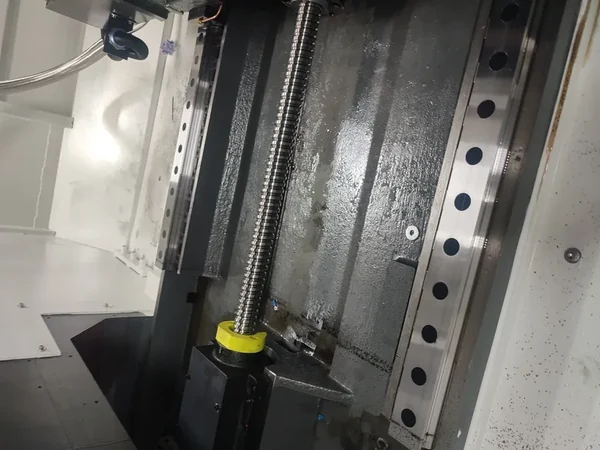
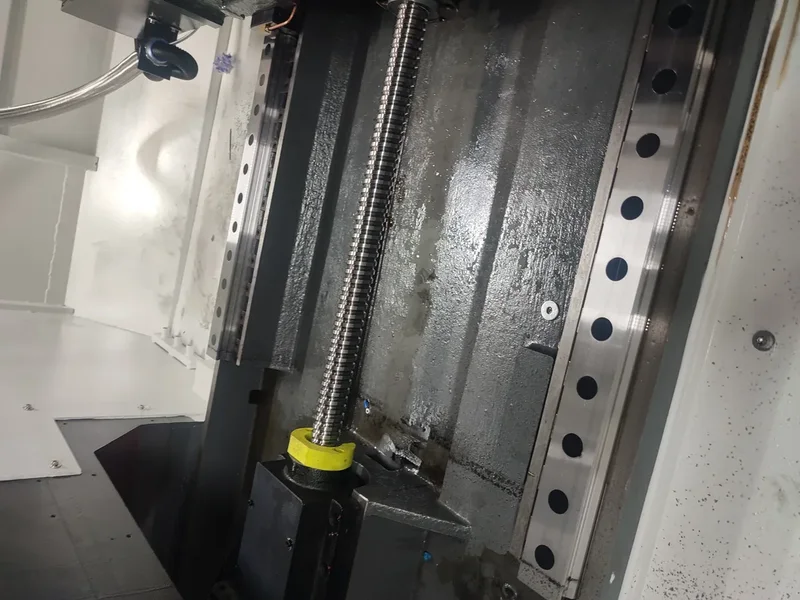
A linear guide is a hardened rail with rolling elements - balls or rollers - running between the rail and a block. A recirculating bearing carries the load through the rolling elements rather than across a sliding surface. Because the contact is rolling, friction is low and consistent, which means the axis can accelerate hard and hold high feed rates without losing position to stick-slip.
The advantages are speed, accuracy and low maintenance. Preloaded blocks remove almost all clearance, so the slide follows the drive closely even in small moves. Rail and block are bought as a matched assembly with a long, predictable life, and lubrication only needs topping up rather than being monitored as a film.
The trade-offs are damping and tolerance to abuse. A rolling contact has a small contact area, so a linear guide deflects more under the same force than a well-made box way of comparable size, and it damps vibration poorly. A dent in a rail from a dropped part or a trapped chip is a permanent defect that shows up as a bump in the axis. For that reason linear guides are usually protected with covers, bellows or way wipers, and the machine is kept cleaner than a box way machine needs to be.
The Mixed Arrangement
Many machining centers are not one or the other. A common layout puts box ways on the axis that takes the heaviest cutting load - often Z, because that is where the column or the spindle head is pushed hardest - and linear guides on the axes where speed matters more. That arrangement buys the damping where the cut demands it and the acceleration where the cycle time demands it.
The choice also runs through the rest of the machine. Box ways suggest a heavier structure and a drive sized for sliding friction. Linear guides suggest a lighter structure, faster drives, and more attention to chip and coolant protection. A machine is designed as a whole, and swapping one system for the other is not a like-for-like change.
How We Decide on a Real Job
Four questions sort most jobs quickly. What is the material - cast iron and steel pushing a heavy, interrupted tool load, or aluminium and plastics at high speed with small tools? What depth of cut matters - roughing one pass or many? How many faces and tools are in the cycle, so how much rapid movement is wasted? And how hard is the part to hold, because a part that has to be approached gently suits a lower-vibration setup.
Where the part is a large casting, the cut is deep, and the finish comes from damping rather than from spindle speed, box ways on the heavy axes are the practical answer. Where the parts are smaller, the material is light, the tools are small, and cycle time is the thing being fought, linear guides carry the day. Where the shop makes both, a mixed machine or two different machines is usually cheaper than one compromise.
Frequently Asked Questions
Are box ways better than linear guides?
Neither is better in general. Box ways give higher stiffness and much better damping, which suits heavy and interrupted cuts in cast iron and steel, and they tolerate a dirtier shop. Linear guides give lower friction, higher speed and acceleration, and more predictable life, which suits high-speed work in lighter materials with smaller tools.
Why do heavy-duty machines still use box ways?
Because damping is what keeps a heavy interrupted cut quiet. A large sliding contact absorbs vibration that a rolling contact would pass on to the tool, and it resists the twisting load from a deep cut in a way that is harder to achieve with a rolling guide of similar size. The cost is speed, which matters less on a heavy machine that is taking big cuts rather than fast ones.
Do linear guides wear out faster than box ways?
Not usually. A linear guide is a sealed assembly with a rated life, and it does not develop the sliding wear that a way needs to be re-scraped for. What it does not survive is damage: a dented rail changes the axis for good. Box ways are more tolerant of a shop that is not spotless, but need lubrication and periodic attention over a long life.
Can a machine have box ways on one axis and linear guides on another?
Yes, and it is common. Putting the sliding ways on the axis that carries the heaviest cutting load and linear guides on the axes where speed matters gives the machine damping where the cut needs it and acceleration where the cycle time needs it. The machine structure and drives are designed around that combination rather than chosen independently.
Choosing the Right Machine for Your Parts
Send us the parts, the material, the depth of cut you expect to take and the cycle time you are aiming for, and Handemo will recommend the machine layout that fits - including which axes should carry sliding ways and which should carry linear guides. Contact Handemo CNC | Email: sales1@handemocnc.com | WhatsApp: +86 135 6320 3038
Related reading: Machine Comparisons covers the other selection questions we get, VMC vs HMC deals with machine type rather than the guide system, and 5-Axis vs 3-Axis looks at the same trade-off from the axis count.