BT40 vs BT50 Spindle: How to Choose
Two machining centers can stand on the same floor, look almost identical from the aisle and behave like different machines the moment a 50 mm face mill touches steel. Usually the casting is not what separates them, and neither is the control. It is the cone at the bottom of the spindle.
BT40 or BT50 is one of the first questions a buyer has to answer, and it is usually answered badly — either out of habit ("we have always run 40s") or out of optimism ("50 sounds stronger, so let us take 50"). Neither is a reason. The cone decides what the machine can hold, how hard it can push, how quickly it swaps tools, and how much of the budget is left over for holders. This article takes the two apart and puts the decision back where it belongs: on the parts you actually run.
It belongs to our machine comparisons series, where each article takes one buying decision that shops get wrong, and works through it with the parts and the numbers in view.
What the cone is really doing
A spindle interface has one job: hold a cutting tool rigidly enough that the cutting force goes into the workpiece instead of into deflection. Every BT holder does that with three features working together. The taper centres the tool. The flange face seats against the spindle nose and carries the axial load. The two drive keys in the spindle nose take the torque, and a pull stud at the small end, gripped by a drawbar inside the spindle, holds the whole assembly in place.
The taper is self-releasing at seven to twenty-four, which is why a light tap on the drawbar is enough to release a holder that was just taking a heavy cut. That is the whole design, and it has not changed in decades because it works.
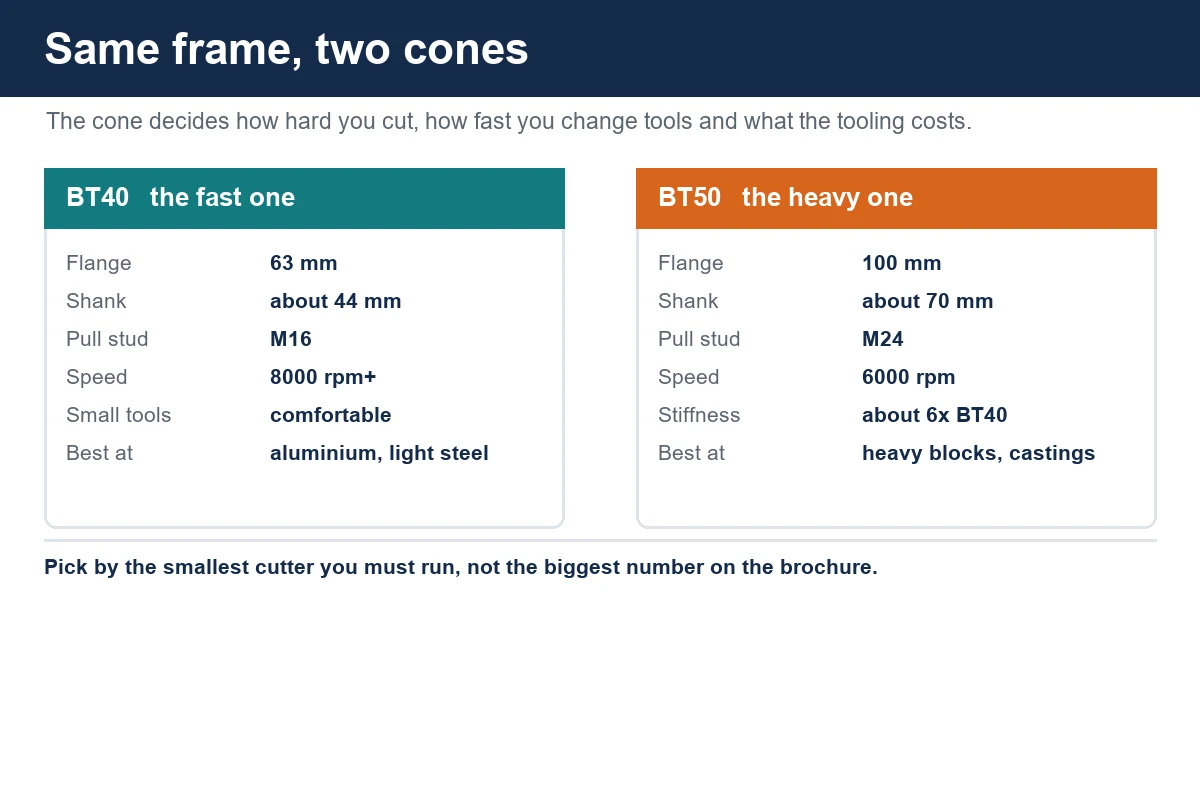
What changes between BT40 and BT50 is simply size — and size changes everything downstream. A bigger shank is stiffer, its drive keys are larger, its pull stud is coarser, and the spindle that carries it needs bigger bearings, a stronger drawbar and more mass. You cannot get the strength of a 50 taper in a 40 spindle, and you cannot get the speed of a 40 taper in a 50 spindle. The choice is a trade, not an upgrade.
The two interfaces, side by side
The naming is not arbitrary. BT40 and BT50 refer to the flange size in millimetres, and everything else scales from there. A BT40 holder has a 63 mm flange and roughly a 44 mm shank at the gauge line. A BT50 has a 100 mm flange and roughly a 70 mm shank. The pull stud thread goes from M16 to M24, and a typical BT50 holder weighs two to three times what the equivalent BT40 holder weighs.
That last point sounds like a footnote. It is not. Tool weight sets how fast an automatic tool changer can move, how much the carousel or the umbrella has to carry, and how hard the arm has to grip. Every kilogram added to the tool is a kilogram the machine has to accelerate on every single tool change, all day, for years.
What a BT50 buys you in the cut
Stiffness in bending does not scale with diameter, it scales with the fourth power of it. Going from a 44 mm shank to a 70 mm shank is not a 60 percent increase in rigidity — it is roughly six times. That single relationship explains almost every practical difference between the two interfaces.
It means a BT50 machine will take a deep pass in P20 or a heavily interrupted cut in a casting without the tool singing. It means you can hang a large face mill on a long arbor and still get a decent floor finish on a big plate. It means a boring bar with real overhang stays usable instead of chattering on the first pass. It means bigger drills go in without a pilot, and bigger taps go in without a floating holder fighting the spindle.
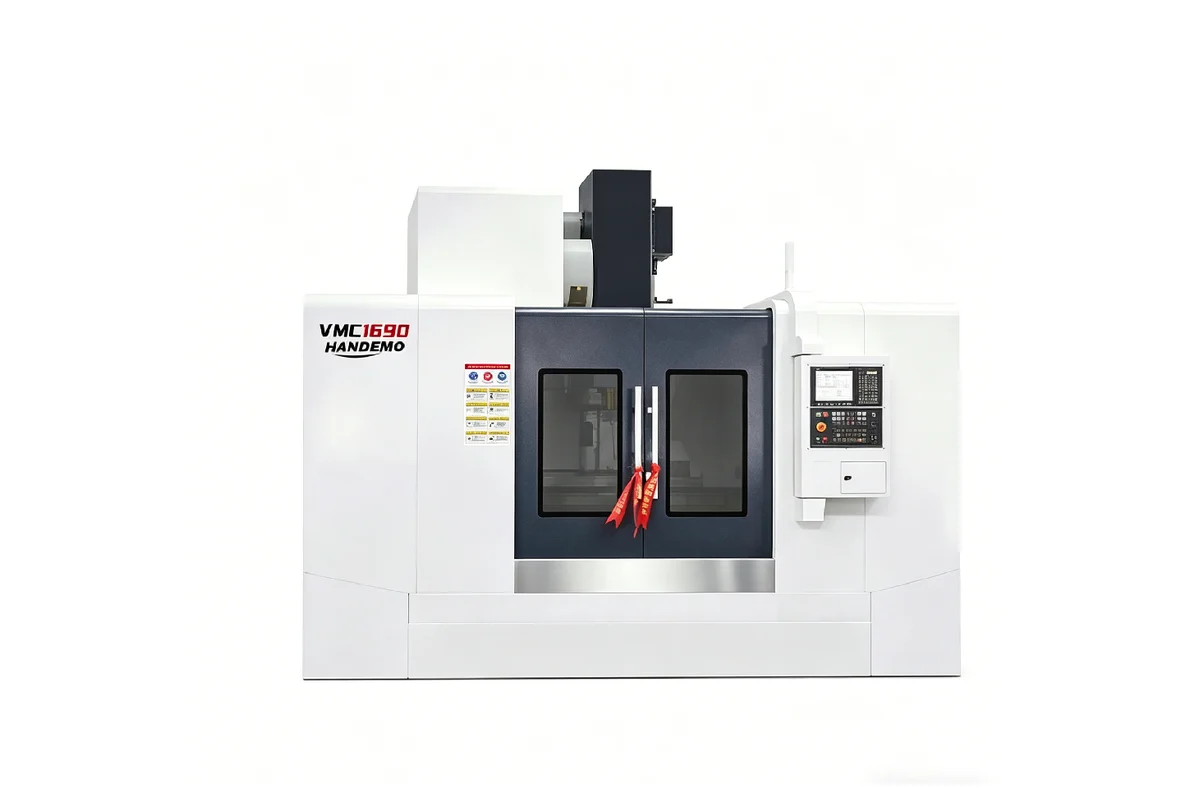
It also means the machines that carry a BT50 are built to match. Our own range shows the pairing clearly. The VMC1690 runs a BT50-190 spindle at 6000 rpm on a 1600 × 800 mm table rated for 1500 kg, with 1600 mm of X travel and 700 mm of Z. The VMC1890 goes to a 2000 × 900 mm table and 1600 kg, 1800 mm of X and BT50-190 at 6000 rpm. Those are not machines that were designed around the spindle; the spindle and the table were sized together, because a 50 taper is only worth having if the table can carry the block that justifies it.
What a BT40 buys back
A BT40 machine gives up brute stiffness and takes back three things that matter just as much in daily production.
The first is speed. Lighter holders and a lighter spindle assembly can be accelerated harder and spun faster, which is why 8000 rpm is the standard on our BT40 models and why 40-taper machines are commonly offered well above that. Faster tool changes, faster rapids between features, less time in the air.
The second is small-tool capability, and this is the one buyers forget. A 6 mm end mill in a BT50 spindle running at 6000 rpm is a compromise; the same cutter in a BT40 at 8000 rpm is in its comfort zone. If your work is aluminium housings, brass fittings, plastic components, electrode blanks, small pockets and mould detail, the 50 taper is the wrong tool no matter how strong it is — you need revolutions, not rigidity.
The third is money, in tooling and in floor space. BT40 holders are cheaper, stocked everywhere, and most shops already own a shelf of them. A BT50 shop has to buy a second, heavier, more expensive set from zero, then find somewhere to put it and someone strong enough to load it.
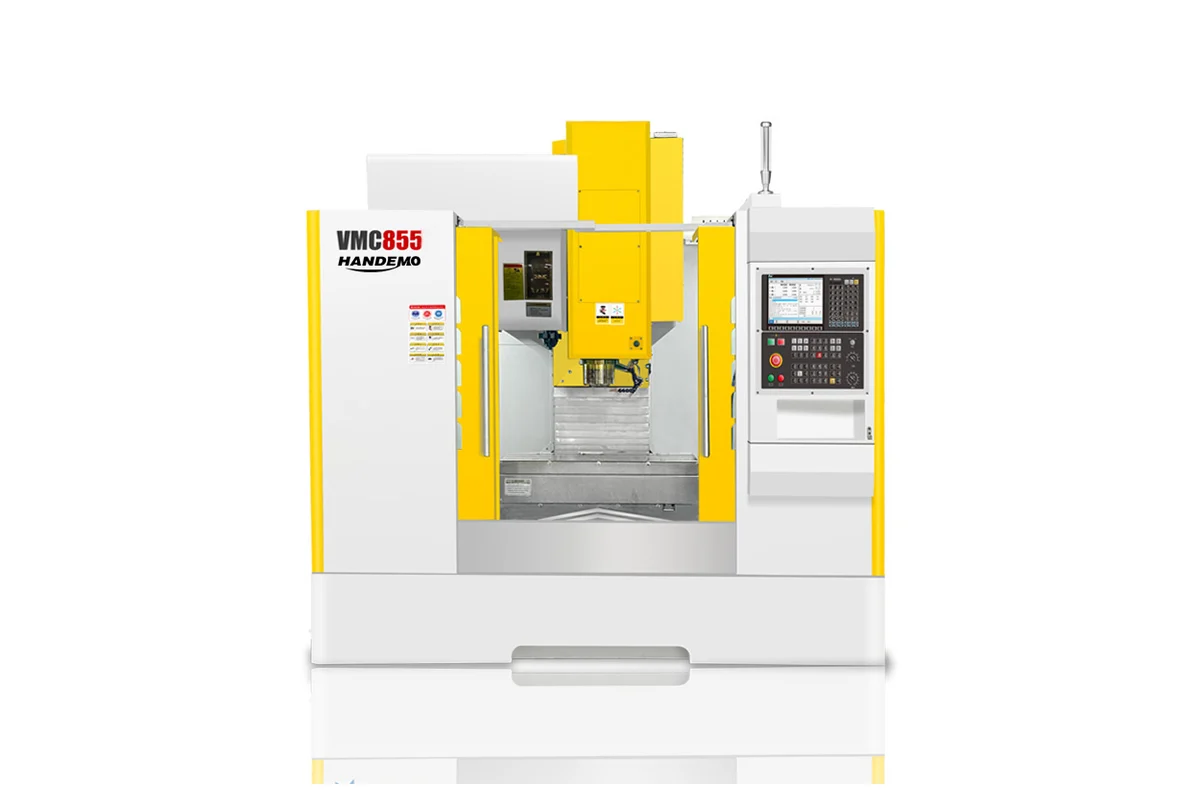
Our BT40 models are built around that logic. The VMC855 pairs a BT40 Φ150 spindle at 8000 rpm with a 1000 × 550 mm table rated for 600 kg, 800 mm of X travel and 550 mm of Z. The VMC1160 keeps the same BT40 Φ150 / 8000 rpm spindle but moves to a 1200 × 600 mm table, 800 kg, and 1100 / 600 / 600 mm of travel. Between the two you cover a very wide band of general subcontract work without ever needing a 50 taper.
The tooling bill nobody quotes
When a shop compares a BT40 and a BT50 machine on price, the comparison is usually machine against machine. The real comparison includes holders, and the holders can quietly change the answer.
BT50 holders cost noticeably more per unit, and you need a full set: collet chucks, side-lock end mill holders, shell mill arbors, drill chucks, boring heads, tapping holders. On a machine with a 24-tool magazine that is a serious line item, and it arrives after the machine has been paid for. Storage is a smaller but real cost — a BT50 shell mill arbor takes up shelf space that four BT40 holders would share.
The counter-argument is honest too. BT50 tooling survives abuse that destroys 40 tooling. In a shop running heavy roughing all day, the 50 taper often pays for its holders by not breaking them, and by holding a heavy face mill rigidly enough that inserts last a full shift.
Where the line actually falls
In practice the decision comes down to five questions, and the smallest tool matters as much as the largest part.
Part size and weight. If the block is 1200 kg and 900 mm tall, a BT50 machine on a 1600 × 800 table is not a luxury, it is the entry ticket. If the part is a 300 mm aluminium housing, the same machine is a waste of money and floor.
Material removal. Deep passes in tool steel, interrupted cuts in castings and hardened mould bases want the bigger cone. Light passes in soft material do not care.
The smallest cutter you must run. Below about 12 mm, the 40 taper wins on speed alone. This single line rules out a BT50 for a lot of die and mould finishing work.
Reach and depth. Long boring bars and deep pockets amplify whatever flex the shank has. A BT50 with real overhang is a different proposition from a BT40 with the same bar.
Machine mix. If this is your only machine, be honest about the mix of work. If it is your second or third, put the heavy iron on the 50 and keep the 40 for everything else — that is usually cheaper than one machine trying to be both.
The two wrong calls we see most
The first is buying BT50 "to be safe". Shops do it after one bad experience with chatter on a heavy job, then discover that small work runs slower, holders cost more, and the machine sits idle on light aluminium jobs that a 40 would have finished sooner. Safety in spindle size is not free.
The second is pushing a BT40 into work it was never sized for: 200 mm face mills in hardened steel, deep pockets with long bars, castings that interrupt the cut four times per revolution. The machine does not fail dramatically. It just runs slow, eats inserts, and gets blamed for a decision made at the quotation stage.
If you are already weighing the frame around the spindle, the same logic applies to the guideways — our guide to box ways versus linear guides follows the identical pattern of matching structure to the cut rather than buying the biggest number.
Matching the cone to the machine
Once the interface is settled, the rest of the specification follows. On the BT40 side, the VMC866 and VMC1160 comparison is the usual next question: same spindle, different table and travel, and the right answer depends on how much fixture you need to fit. On the BT50 side, the VMC1690 guide and the VMC1890 guide work through table loading, travel and part handling for heavy work.
It is also worth remembering that the cone is not the only axis of comparison. If your parts are box-shaped, with features on four or five faces, the fixture count may matter more than the spindle — which is why we keep a separate article on vertical versus horizontal machining centers for multi-face parts.
What to send with an enquiry
Spindle size is one of the first things we ask about, and it is much easier to answer with the parts in front of us. Send the drawing or the model, the blank size and weight, the material and its condition, the features that matter most, the smallest cutter you expect to run, and how you plan to fixture it. If you have a target cycle time or a batch size, include that too — it often decides between a BT40 machine with a bigger table and a BT50 machine running below its capacity.
For context on what the parts themselves demand, our hydraulic valve body and mould cavity articles show two very different answers to the same question: one wants a rigid block and a boring strategy, the other wants spindle speed and small tools.
Frequently asked questions
Is a BT50 machine more rigid than a BT40 machine of the same size?
Yes, at the tool. The shank is roughly six times stiffer in bending, and the drive keys and pull stud are larger, so more of the cutting force reaches the workpiece instead of being absorbed by deflection. Whether that matters depends entirely on how hard you intend to cut.
Can a BT40 machine run a large face mill?
It can hold one, and it will cut, but a 160 or 200 mm face mill on a 40 taper is where you start to feel the shank rather than the insert. If large face milling is a regular job rather than an occasional one, that is the point at which a BT50 machine earns its price.
Why do BT50 spindles usually stop around 6000 rpm?
Because the whole assembly is heavier. Bigger bearings, a bigger drawbar, a heavier holder and a heavier tool all generate heat and load at speed. Spinning that safely for years is a different engineering problem from spinning a 40 taper at 8000 rpm, and the practical ceiling reflects it.
Can I use BT40 holders in a BT50 spindle?
Only through an adapter, and an adapter puts a second interface between the spindle and the cutter, which is exactly what you were trying to avoid. If you need both, buy both machines, or standardise on one.
Which is better for aluminium?
BT40, almost always. Aluminium rewards spindle speed and small cutters far more than it rewards stiffness, and the higher rpm available on a 40-taper machine is worth more than the extra rigidity a 50 taper brings.
Does the cone decide how well the machine holds a dimension?
No. That comes from the frame, the guideways, the thermal behaviour of the machine and how well it is maintained. The cone decides how much material you can remove per pass without the tool complaining. A worn BT50 spindle is worse than a sound BT40 one, in both respects.
Next step
If you are still deciding, send us the part and the blank size and we will tell you which of our models fits it — BT40 on the 855 and 1160, BT50 on the 1690 and 1890, with the table, travel and load figures that go with each.
Email sales1@handemocnc.com or message us on WhatsApp at +86 135 6320 3038 with your drawing, material and batch size. You can also send the drawing directly through our contact page, and we will come back with a model recommendation, a holder list and a delivery estimate.