Gantry Loader vs Robot for CNC Machine Tending
A shop I visited had just finished commissioning a six-axis robot in front of two lathes. The arm was fast, the gripper was well made, the safety fence was neat, and the cell ran beautifully for about forty minutes at a time. Then it stopped. Not because of the robot — because the operator had to walk over and refill the magazine. The cell could move a part in four seconds and had nothing to move.
That is the most common way machine tending projects fail, and it fails for a reason that has nothing to do with the arm. The arm is the visible, expensive, easy-to-argue-about part of the project. The part flow — how blanks arrive, where they sit, how they are located, how the finished parts leave — is the part nobody draws on the layout, and it is the part that decides whether the cell runs for one shift or for a week.
So when a customer asks whether to buy a gantry loader or a robot, the honest answer is that the question is slightly wrong. Both move parts. The decision is about how many machines the handling system has to reach, whether the part needs to be turned over, and how the parts are queued. This article goes through those three things first, then the mechanics, then the money, and it sits with the other machine-to-machine comparisons in our machine comparisons section.
Two different jobs, often confused
There are two jobs inside what people call automation. The first is the transfer: take a blank from a known position, put it in the chuck or the vice, take the finished part out, put it down somewhere. That is a motion problem, and it is the easy half.
The second is the queue: where do blanks come from, how many are available without a human, how are they oriented, what happens to the finished part, and what happens when one blank is out of place. That is a logistics problem, and it is where the project is won or lost.
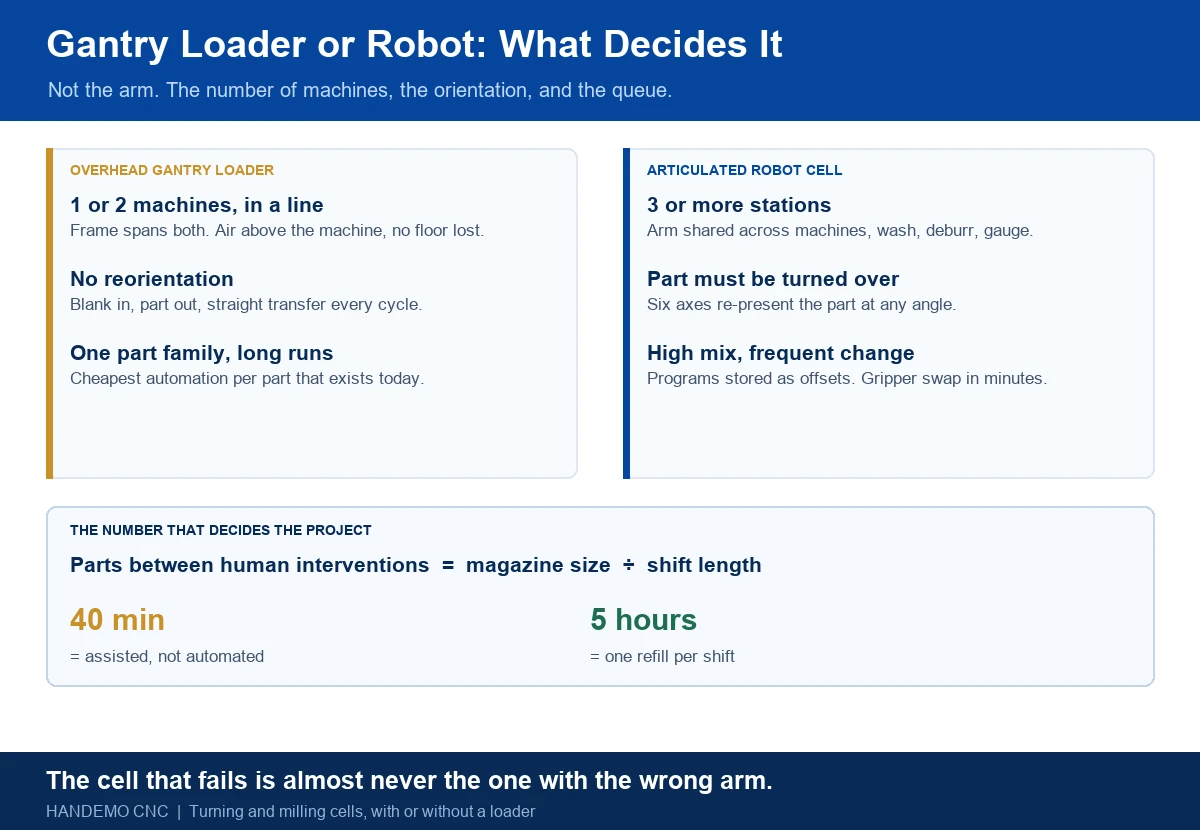
A gantry loader is a good answer to the first job when the queue is simple: one part family, one or two machines, parts stacked in a tray that the loader can reach without turning around. An articulated robot is a good answer when the queue is complicated: several machines, parts that have to be reoriented, a deburring station, a wash, an inspection stop.
What is not a good answer is buying the more capable handling system to cover a queue that was never designed. A robot feeding a tray with two hours of parts in it is an expensive way to move a bottleneck from the machine door to the tray.
How a gantry loader actually works
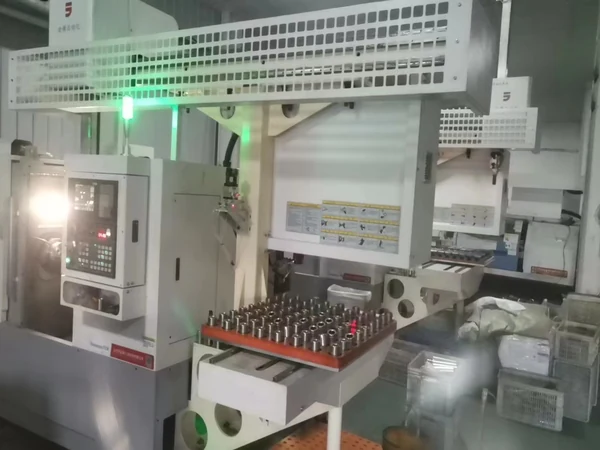
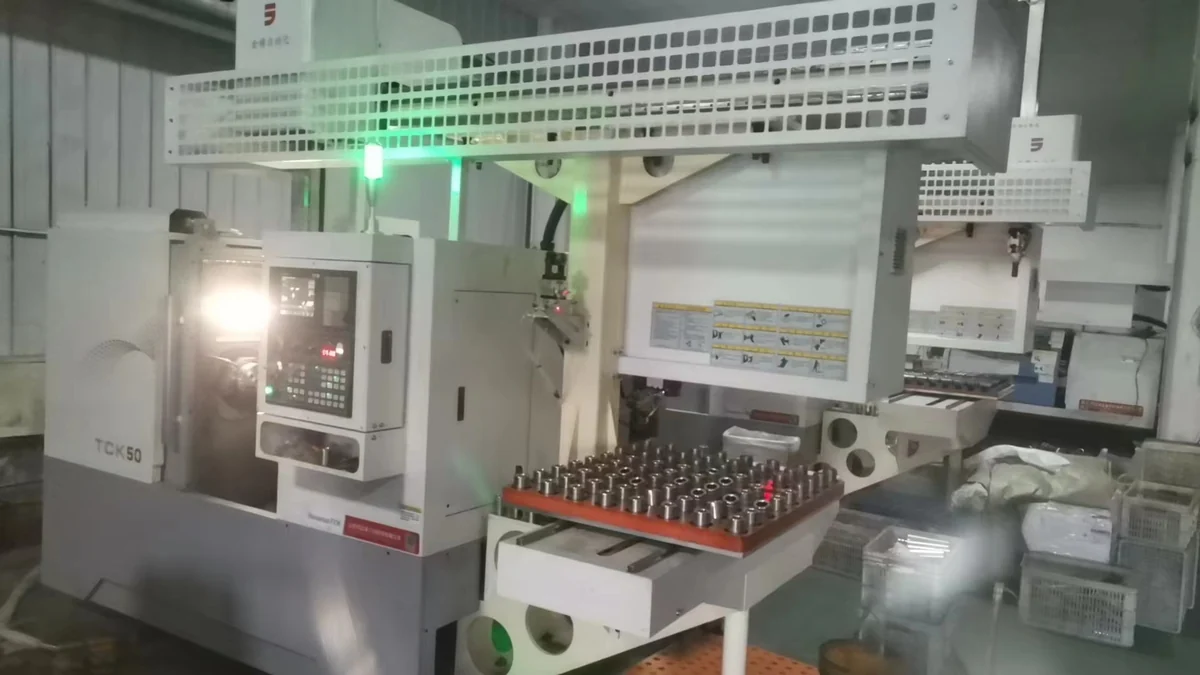
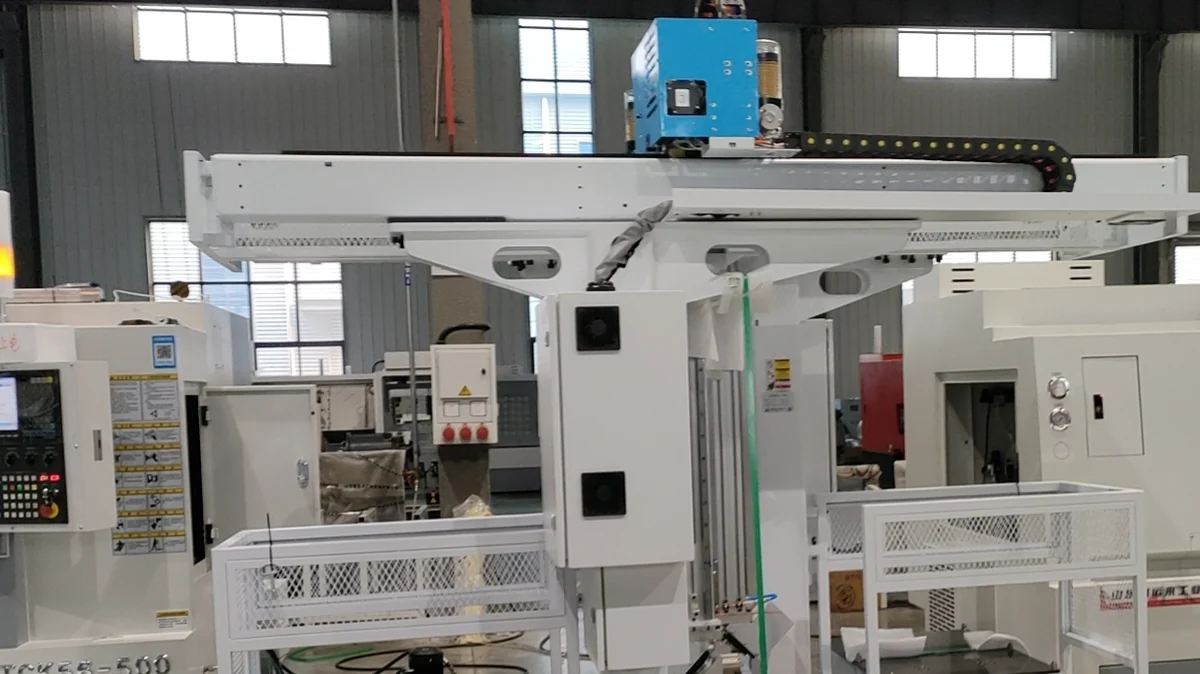
A gantry loader is a three-axis handling system built on its own frame over the machine. A horizontal beam spans the machine, a carriage travels along it, a vertical axis drops the gripper to the door, and a gripper picks the part. On a lathe the loader usually works through the door opening; on a machining centre it works through the side or the front opening, depending on the machine layout.
Three consequences follow from that geometry, and they explain most of why gantries are popular in lathe cells.
The first is that the loader does not consume floor space beside the machine. It uses the air above it. In a shop where the aisle is already tight and the machines are close together, that is the difference between a project that fits and one that does not.
The second is that the motion is essentially straight. Two positions, one transfer, no reorientation. A three-axis system doing straight transfers is simple, and simple systems are cheap to build, cheap to maintain and easy to guard. There is no arm swinging through a working envelope, so the guarding question is usually settled by the machine's own enclosure plus a light curtain at the loading table.
The third is that a gantry is dedicated. It belongs to that machine or that pair of machines. It does not walk to another machine, it does not do a second operation somewhere else, and it does not deburr. If the process changes, the gantry does not follow.
How an articulated robot actually works
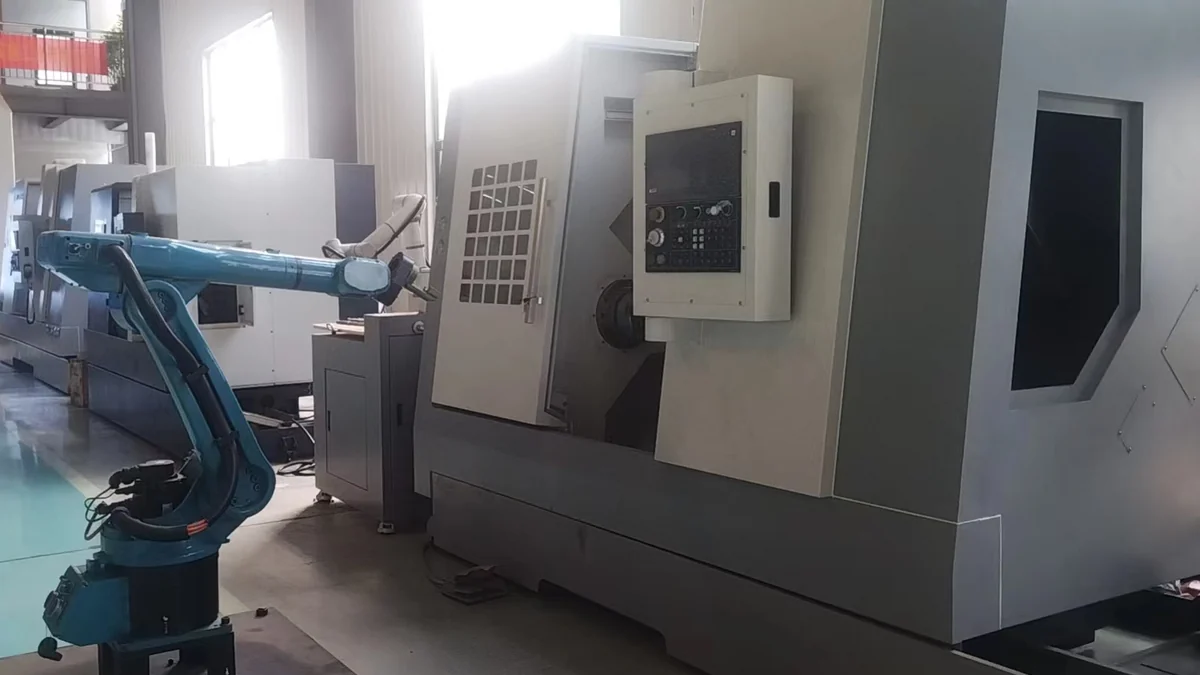
A six-axis robot is a general-purpose arm on a floor pedestal or a linear track. Its advantage is reach and dexterity: it can approach a chuck from the front, turn a part over, present it to a second machine at a different height, drop it on a conveyor, and pick up a different gripper from a rack.
Its cost is not the arm. On a typical cell the arm is a minority of the project. The rest is the fence, the safety system — interlocked gates, light curtains, area scanners — the layout engineering that gives the arm reach to every station without collision, the gripper design for each part family, the PLC that sequences the whole thing, and the programming and commissioning time for each part.
That is why a robot cell has a floor plan and a gantry has a bracket. A robot cell needs a radius of floor around it, and that radius is often the reason a shop with an existing machine line cannot fit one without moving machines.
It is also why the robot becomes clearly correct at a certain point: when the handling task is shared. Three machines fed by one arm, plus a wash and a deburr stop, is a cell. Three separate gantries is three projects, three sets of spare parts and three things to maintain. The robot wins on the day the layout has more than two stations.
Our own robotic machine tending page sets out the same split from the cell-design side, and the gantry loader page covers sizing the loader from the cycle time. This article is the decision between them.
Five questions, in order
The order matters, because the first two questions eliminate most of the options and the last three only refine what is left.
One: how many machines share the handling task
One or two machines, one loader: gantry. Three or more machines that the same parts visit in sequence: robot, or a gantry on a common rail if the machines are in a straight line and the parts never need turning. The rule is not about machine count for its own sake. It is about whether one handling system can be amortised across several stations, which is the only way the extra cost of a robot cell gets paid back.
Two: does the part have to be turned over or reoriented
A shaft going into a lathe chuck arrives in the same orientation it is machined in. A housing that needs a second face machined on a vertical machine usually has to be flipped, or at least presented at a different angle. A gantry with a two-jaw gripper and a turnover unit can do a simple flip; it cannot do a general reorientation. If the process needs the part presented at three different attitudes, that is a robot.
Three: is there a second operation in the cell
Deburring, washing, air blow-off, marking, a quick gauge check. A gantry can carry a part to a fixed blow-off nozzle on its way past, and that is the limit. Anything that needs the part presented to a tool — a brush, a deburring spindle, a laser marker — wants an arm that can hold it at the right angle and dwell there. If the cell has secondary operations, count them before choosing the handling system, because they are the reason robot cells exist.
Four: how often does the part change
This is the question that is asked last and should be asked second. A dedicated gantry set up for one part family, running that family for months, is the cheapest automation per part that exists. A gantry that has to be re-tooled every week is a maintenance burden: new tray, new jaws, new positions, re-teach, re-verify.
A robot with stored programs and quick-change grippers handles a family change in minutes rather than hours, because the positions are taught once as offsets from a common frame. So high mix favours the robot even at low machine count, and single-part high volume favours the gantry even at three machines.
Five: floor, door height and the machine you already own
A gantry needs vertical room above the machine and a frame that does not fight the machine's own sheet metal or the coolant tray. A robot needs floor and a fence. Both need the machine door to be automated, and both need the machine to accept that its door is now opened by something other than a human.
On a machine that was bought before the automation was planned, this is where the project gets expensive. Retrofitting a pneumatic door, a chuck confirmation signal and a parts catcher to a lathe is not difficult, but it is not free, and it is the item that turns a two-week installation into a six-week one.
The queue is the project
Here is the part that gets drawn last and matters most. In a cell that runs unattended, the parts have to be queued in a way that the handling system can pick them from without a human correcting anything. That means three things: a known position, a known orientation, and enough of them.
Known position comes from the tray, not from the arm. A tray with V-blocks for shafts, or bored bushes for discs, or pin locations for housings, puts every blank within a fraction of where the gripper expects it. Shops that try to solve a loose tray with a vision camera usually end up with a camera, a lighting problem, a calibration routine and a slower cycle — and the underlying problem was that the tray let the parts roll.
Known orientation means the blank cannot be loaded into the tray backwards or upside down. The cheap fix is asymmetric nest geometry: a shape that only accepts the part one way. The expensive fix is a sensor and a reject routine. Do the geometry.
Enough of them means sizing the magazine to the shift, not to the cycle. If the cell needs a refill every forty minutes, it is not automated, it is assisted. A lathe cell running a ninety-second cycle consumes forty parts an hour. A tray that holds two hundred parts gives five hours, which covers a shift with one refill, which is the point at which the operator can do something else.
And then the finished parts have to go somewhere. This is the item that is almost always under-designed: the outfeed. A cell that picks blanks from a neat tray and drops finished parts into a bin has created a second job — sorting the bin — and in a shop where finished parts are then washed or gauged, that job lands on the same operator the automation was supposed to free.
What the machine has to provide
Automation is a conversation between two controllers, and the machine side of that conversation is smaller than people expect but non-negotiable.
The machine needs to report that it is ready: door closed, chuck or vice clamped, cycle complete, no alarm. It needs to accept commands: open door, unclamp, clamp, start cycle. On most current controls that is a handful of M codes and a set of digital inputs and outputs. On an older machine it may be a relay board and a careful read of the ladder.
Three signals are worth insisting on even when they are not in the standard package. Chuck clamp confirmation, because a gripper that lets go on an unconfirmed clamp drops the part. Door position, because a loader that reaches in while the door is half open is a crash. And cycle-complete with a distinct parts-counter pulse, because that is how the cell knows a part exists rather than assuming it from time.
There is also the small matter of swarf. A lathe that has been running manually gets cleaned at shift change. A lathe running unattended for six hours accumulates chips in places nobody looked at, and the first thing they jam is usually the parts catcher or the door track. If the cell is meant to run lights-out, the chip conveyor and the coolant flow need to be specified for continuous running, not for a shift of interrupted cutting. On a slant bed machine the chips fall away from the work by geometry, which is one of the quieter reasons slant beds became the default for automated turning cells.
The money, honestly
Comparing a gantry loader with a robot cell on purchase price is misleading, because the two do not include the same things. A gantry quote usually includes the frame, the axes, the gripper, the loading table and the integration with one or two machines. A robot quote often includes the arm, and then the fence, the safety devices, the grippers, the PLC, the layout and the commissioning arrive as separate lines.
The number that decides the project is cost per part over the life of the cell, and it has four terms: the handling time per part, the number of parts between human interventions, the changeover time per part family switch, and the downtime per year for maintenance and recovery from faults.
Handling time favours the robot slightly, and it almost never matters. On a ninety-second lathe cycle, a four-second transfer and an eight-second transfer are both invisible. What is visible is the twenty seconds of manual loading that the automation removed, which is about eighteen percent of capacity on that cycle.
Parts between interventions favours whichever system has the bigger magazine, and that is a design choice rather than a technology. This is why the honest comparison is often gantry with a two-hundred-part tray against robot with two machines and a shared tray, not gantry against robot.
Changeover favours the robot as soon as the shop runs more than a few part numbers, for the reason above: taught positions as offsets, stored programs, quick-change grippers.
Downtime is where gantries quietly win in small shops. A three-axis gantry is something a maintenance fitter can diagnose with a multimeter and a manual. A robot cell has a safety PLC, an interlock chain and a controller that most shops do not have in-house experience with, and when it stops, production stops until someone who knows it arrives.
What lights-out actually requires
Every automation conversation eventually reaches the phrase "run it unmanned at night". It is worth being blunt about what that requires, because the handling system is the smallest part of it.
Tool life has to be predictable, and the machine has to act on it. Either the control manages tool life and forces a change, or the cell checks parts and reacts. Running a fixed number of parts on a fixed insert and hoping is not a strategy; it is a schedule for scrapping the last hour of the night shift.
Broken tool detection has to exist. A tap that snaps at 2 a.m. will produce a tray of parts with no thread, and the cell will keep going because nothing told it to stop.
First-piece confirmation has to be automatic or absent. If the process relies on an operator measuring the first part, the cell is a one-shift cell. That is a fine outcome, and it is worth saying out loud before the purchase order rather than after.
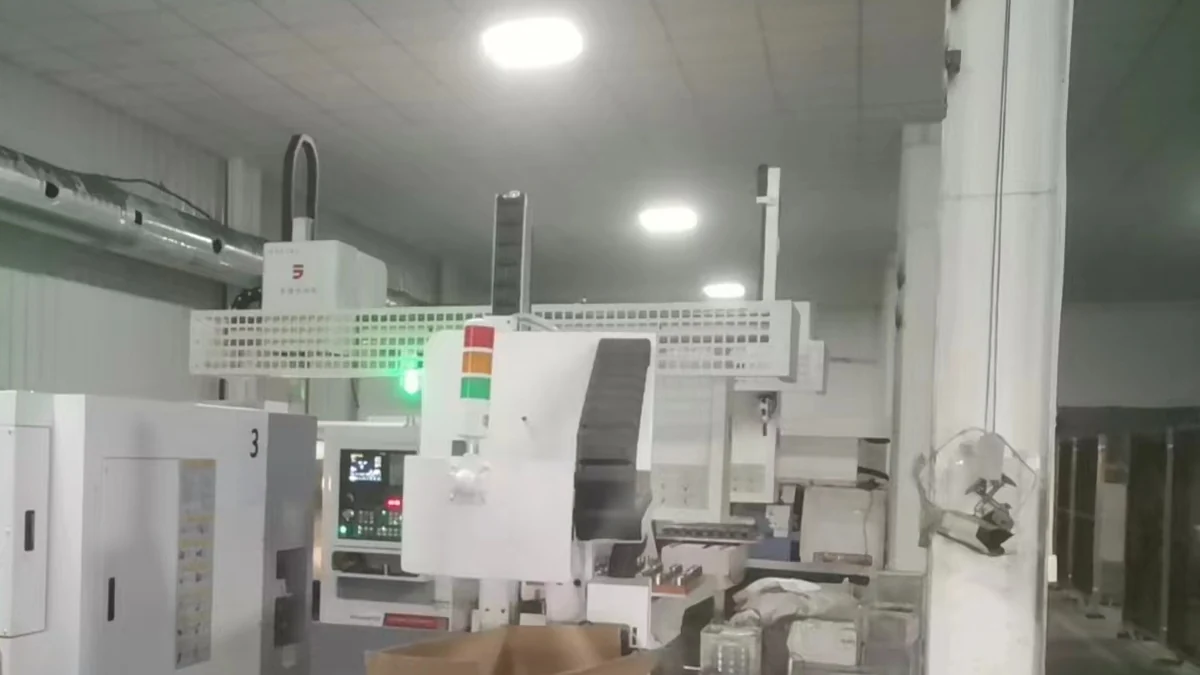
And someone has to own the alarm. A cell that pages nobody at 3 a.m. does not run unattended; it runs until it stops and then sits there. The realistic first step is a cell that runs one shift without an operator standing at the door, with a person on call, and a clear rule for what stops the cell and what waits until morning.
When not to automate
There are three cases where the right answer is a bar feeder, a second spindle, or nothing at all.
If the part is made from bar stock and is concentric, a bar feeder beats any tending system. It loads itself, it needs no tray, and it costs a fraction of a gantry. On a lathe with a 50 mm bar capacity, a bar feeder plus a parts catcher covers a very large share of small turned parts, and the TCK50 class of machine — 500 mm swing over the bed, 500 mm cutting length, 360 mm maximum cutting diameter, 65 mm spindle bore, 50 mm bar capacity, 4500 rpm, 15 kW, 8 inch chuck — is exactly the machine that gets bought with a bar feeder and no gantry at all.
If the part needs both ends machined, a dual-spindle machine removes a whole handling operation instead of automating it. We went through that trade-off in the dual spindle turn-mill article, and the logic is the same one used here: eliminate the transfer before automating it.
If the volume is low and the parts are heavy or awkward, a person with a crane or a hoist is cheaper and more flexible than any cell, and will stay that way. Automation pays on repetition, not on difficulty.
Two configurations we build around
For turning cells, the common shape is a pair of slant bed lathes with an overhead gantry spanning both, a two-position loading table on the operator side, and the finished parts dropping onto a conveyor that runs out of the cell. The gantry takes a blank from the left position, loads the first machine, unloads it into the right position for the second machine to pick up, and the second machine's finished part goes to the conveyor. Two machines, one handling system, one operator refilling the table every few hours.
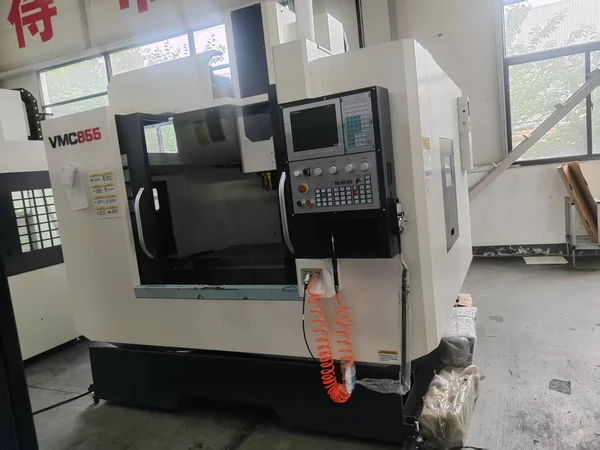
For milling cells the shape is usually a vertical machine with a robot on a pedestal at the side, a nest tray for blanks, a wash station, and a deburr spindle. The robot picks a blank, loads the vice, unloads, presents the part to the deburr spindle, then to the wash, then places it on the outfeed. A VMC855 with its 1000 by 550 mm table, 800 by 550 by 550 mm travels and BT40-150 spindle at 8000 rpm is the size of machine this cell is usually built around, and a VMC1160 when the parts or the fixture plate outgrow it.
In both shapes the machine is chosen first for the part, and the handling system is chosen second for the flow. That order is the whole argument of this article, and it is the opposite of how these projects are usually discussed.
A short checklist before you request a quote
Write these six answers down before talking to anyone about automation. The answers decide the configuration, and the configuration decides the price.
- How many machines does the handling system have to reach, and are they in a line?
- Does the part ever need to be turned over or presented at a second angle?
- Are there secondary operations in the cell — deburr, wash, mark, gauge?
- How many part numbers will run in the cell, and how often do they change?
- How many parts must the magazine hold to cover one shift without a refill?
- Does the machine already have an automated door and chuck confirmation, or is that part of the project?
If the answers are one or two machines, no reorientation, no secondary operations and a stable part family, a gantry loader will do the job and cost less to own. If any of the first three answers goes the other way, the robot is not an upgrade, it is the only thing that fits.
Questions we get asked
Can a gantry loader serve a vertical machining centre as well as a lathe?
Yes, and it is common. The difference is the approach: on a lathe the loader works through the front door into a chuck, on a vertical machine it works from the side or the top into a vice or a fixture. What changes is the gripper and the loading position, not the principle. What does not work well is a gantry trying to serve machines at different heights or facing different directions without a rail and a reorientation unit, at which point the cost advantage is gone.
Do we need a vision system to pick parts from a tray?
Usually not, and adding one to compensate for a bad tray is the wrong fix. Locate the part mechanically: a nest that only accepts it one way, a V-block for a shaft, a bored bush for a disc. Vision earns its place when the parts arrive in a bin in random orientation, which is a different problem and a much harder one.
How long does a changeover take?
For a dedicated gantry on a stable part family, a changeover is a tray swap plus a jaw change plus a position check: well under an hour, and often twenty minutes. For a robot cell with stored programs and quick-change grippers, the program side is minutes; the gripper and the nest are the real time. Either way, the number to plan with is the one measured on your own parts, not the one in the brochure.
Can an older machine be automated?
Almost always, at a cost. The machine needs an automated door, chuck or vice confirmation, a cycle-start input and a cycle-complete output. On a machine with a modern control those are configuration items. On an older machine they are a relay board, a pneumatic door cylinder and a day of ladder work. What cannot be fixed cheaply is a machine with no door at all or a control that cannot report its state, and those are the machines to leave manual.
What is the smallest sensible automation project?
One lathe, one gantry, one tray, one part family, running two shifts. That is the project where the numbers work and where the learning is cheap. Shops that start with a multi-machine robot cell as their first automation project usually spend the first year on integration and the second year on reliability, which is an expensive way to learn the same lessons.
Next step
If you are sizing a turning or milling cell and want to know whether the machine you are considering can accept a loader — door automation, chuck confirmation, parts catcher, chip handling — send us the part drawing and the cycle you expect. We will tell you which machine in the range fits the part and what the handling system has to be told by the control. Write to sales1@handemocnc.com or send a message on WhatsApp to +86 135 6320 3038.
And before any of that, answer the six questions above. The cell that fails is almost never the cell with the wrong arm. It is the cell with the wrong queue.