Case Study: Machining a Flange End Cover in One Setup
The enquiry that started this one was short. A drawing, a material, and a question we get a lot: can you hold the bolt circle and the bore on the same part without sending it round the shop three times? The part was a flange end cover — the kind of round cover that bolts onto a gearbox, a pump housing or a bearing seat and closes it off. Nothing about it looks difficult on paper. It is when you count the setups that the job gets expensive.
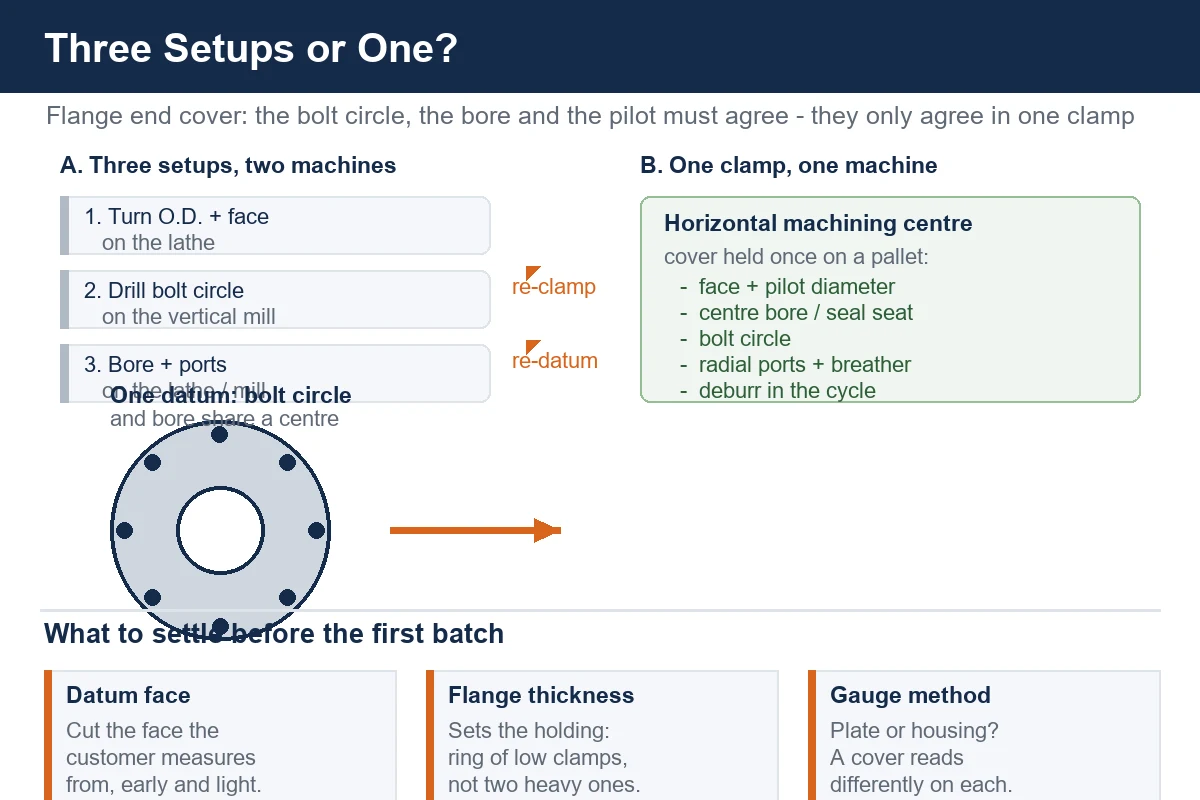
In that shop the cover was running through three operations on two machines. Turn the outside and the face. Move to a vertical mill to drill the bolt circle. Move again to bore the centre. Every move meant a new fixture, a new datum, and a fresh chance for the cover to sit somewhere slightly different from where it sat before. The parts passed inspection. The margins did not.
What the Part Is, and Why It Punishes Extra Setups
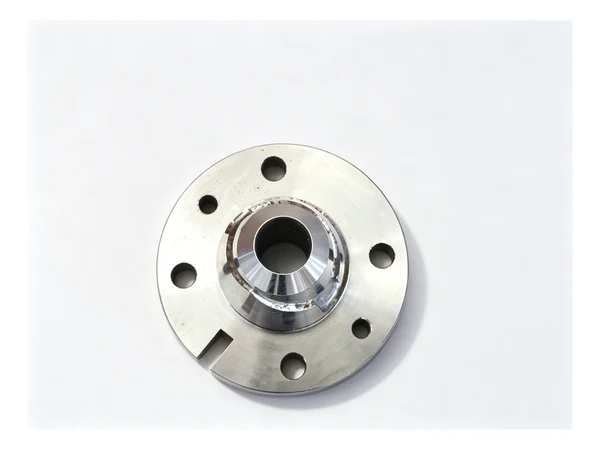
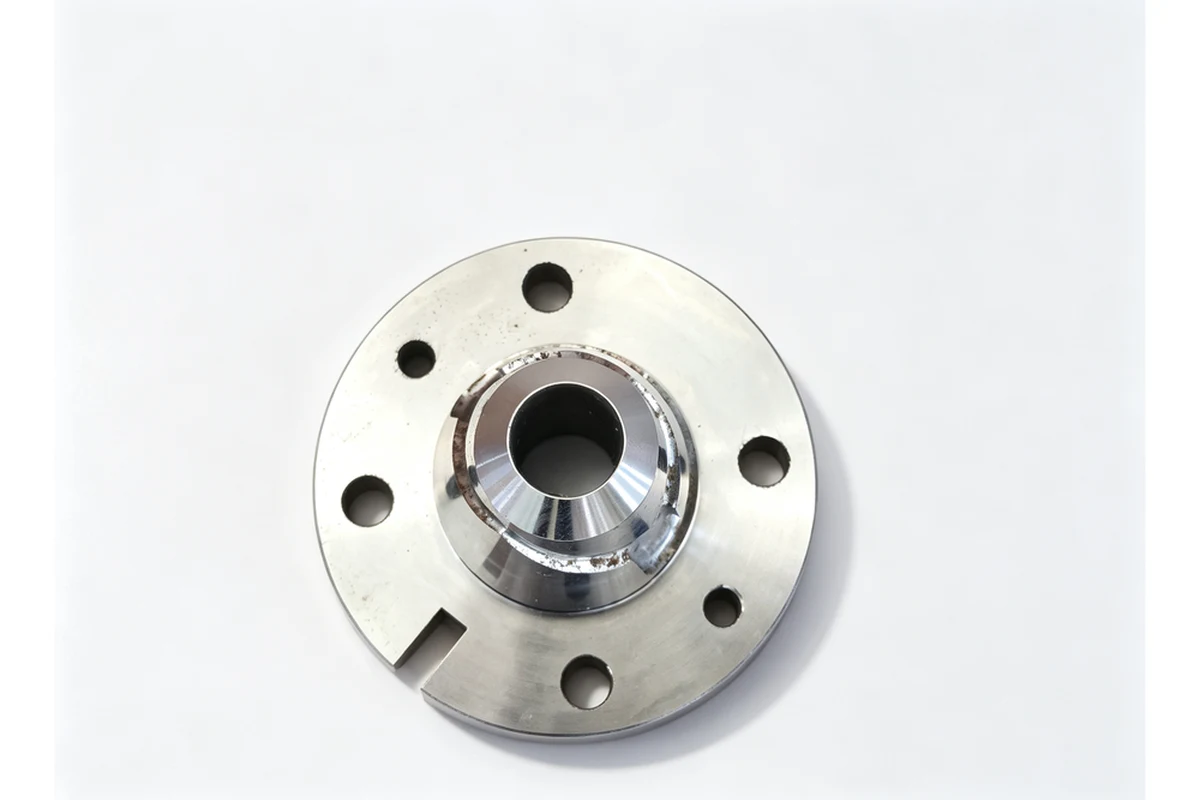
A flange end cover is a plate with a boss. The flange has a bolt circle that has to line up with the housing it closes. The centre has a bore, a recess or a seal seat that has to line up with the shaft or bearing underneath it. The outside diameter usually pilots into the housing. On most drawings there are also two or three features that do not sit on the main axis at all: a breather port, a drain, an oil sight hole, a boss for a sensor.
What matters on a cover is not any single feature on its own. It is the relationship between them. If the bolt circle is not centred on the bore, the cover bolts down and pulls the seal off the shaft. If the pilot diameter is not square to the flange face, the cover rocks on the housing and the joint leaks. None of that shows up as a size on the drawing — it shows up as a leak, a run-out complaint or a warranty return months later.
So every extra setup on a cover is not just a cost. It is a chance for the relationships to move. Three setups mean two chances for the part to be re-clamped somewhere other than where it was. Shops that run covers well usually run them in fewer setups, not faster ones.
Where the Three-Operation Route Was Losing Money
The route the shop was on is a completely reasonable route, and plenty of shops run covers that way. Turn first, because turning is the fastest way to generate the outside diameter and the face and to make a clean datum for everything after it. Drill the bolt circle on a vertical mill, because that is where the rotary table and the drill cycle live. Bore the centre afterwards, or before, depending on which way the shop learned it.
The cost sits in the handling between those steps. Each clamp needs its own fixture. Each fixture needs to be dialled in, and dialled in again when it wears. Every part waits at each machine, so the batch spends most of its life in a tray rather than on a spindle. And on a cover, the fixturing is awkward: the flange is thin, so three jaws or a pair of clamps distort it easily, and a distorted cover comes off the machine round and relaxes into an oval once the clamps are released.
There is a second, quieter cost. The bolt circle and the bore are generated from two different datums in two different fixtures, so the shop has to inspect the relationship between them after the fact rather than trust it. Inspection then becomes part of the process instead of a check on it, and the batch stops moving while it waits for the gauge.
The Decision: Bring the Features Back Into One Setup
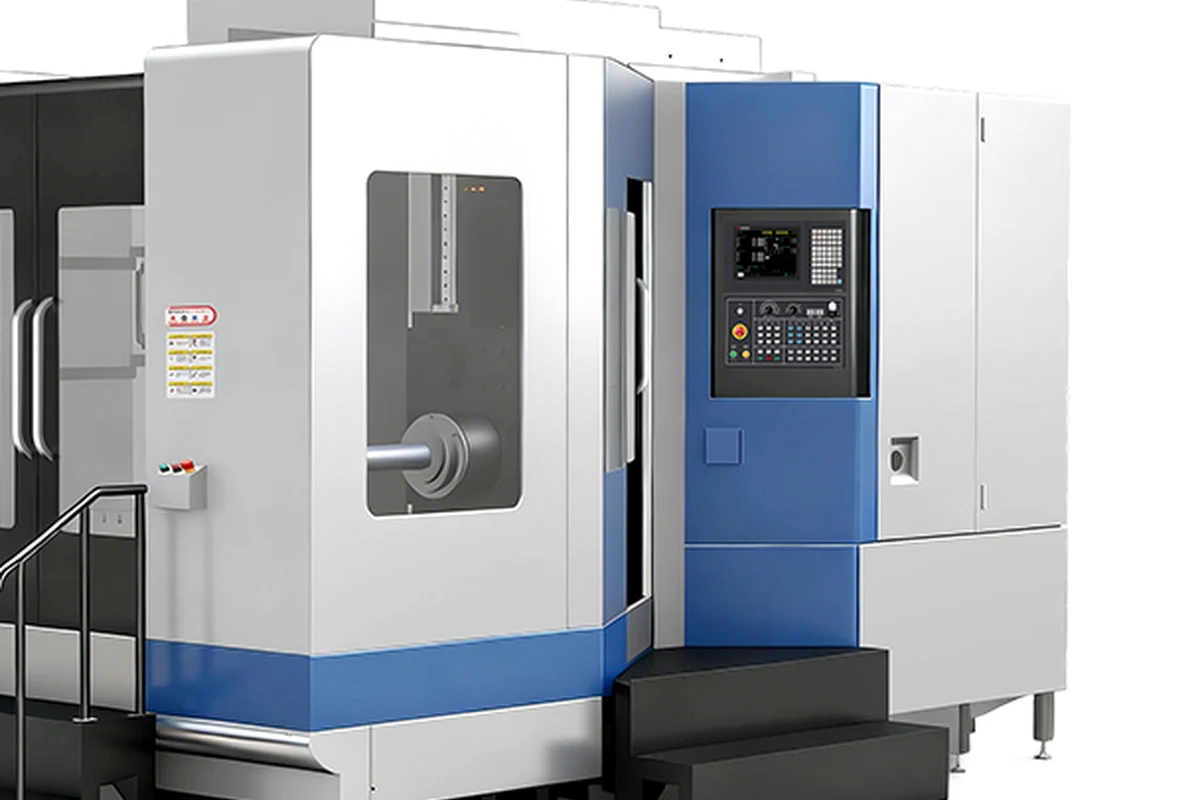
Once the covers were looked at as a setup problem rather than a machining problem, the answer was a horizontal machining centre. On a HMC630-DT horizontal machining centre the cover is held once, on its flange or in a simple fixture on a pallet, and the machine reaches the face, the pilot diameter, the bore, the bolt circle and the off-axis ports without the part coming out. The B axis positions the part for each face; the tool changes come off a magazine. The relationships between the features stop being something the shop has to reproduce and become something the machine simply keeps.
The pallet is the part of the HMC story that shops underrate. With two pallets, the operator loads the next cover while the machine cuts the current one, so the spindle does not stop for a clamp, a gauge or a coffee. On a cover family that runs in steady batches, that change alone usually pays for more than the machine's extra cost over a vertical mill.
Not every cover needs an HMC. Where the volumes are lower or the part is small and mostly round, a VMC1160 vertical machining centre with a fourth-axis table does the same job in one setup, and for covers that are really turned parts with a bolt circle and a couple of radial holes, a TCK6050Y power-turret Y-axis mill-turn centre turns the body and mills the ports in the same cycle. The right answer depends on where the features sit relative to the axis, and on how many parts per year the shop needs to move.
For shops that make covers for gearboxes and housings in volume, the case for a horizontal platform is worth reading alongside VMC vs HMC: How to Choose a Machining Center, because the decision is usually about faces and fixtures rather than about the price of the machine.
Holding a Thin Flange Without Bending It
One clamp does not mean one problem solved. A thin flange still has to be supported rather than squeezed. Two things worked on this job. The cover was clamped on the flange rim with a ring of low-height clamps spread around the circumference instead of at three points, so the load went into the flange as evenly as possible. And the sequence was arranged so the face that everyone measures from was cut early and lightly, then left alone, with the heavier cutting done on features that do not carry that datum. Where a boss or a web allowed it, a small support under the centre of the cover took the cutting load off the flange altogether.
Cutting the Bolt Circle Cleanly
The bolt circle is where the tool choice shows up in the finish. On a cover with a raised boss around each hole, the usual first move is a spot or a counterbore with a flat-bottom tool, then the drill, then any tapping in the same cycle. On a cover with a thin flange, pecking the drill too hard lifts the flange between the clamps, so the feed comes down before the breakthrough and the last millimetre of each hole is cut gently. All of that is a program decision rather than an equipment decision, but it needs the fixture to be quiet enough for the program to work.
Deburring, Cleaning and the Seal Seat
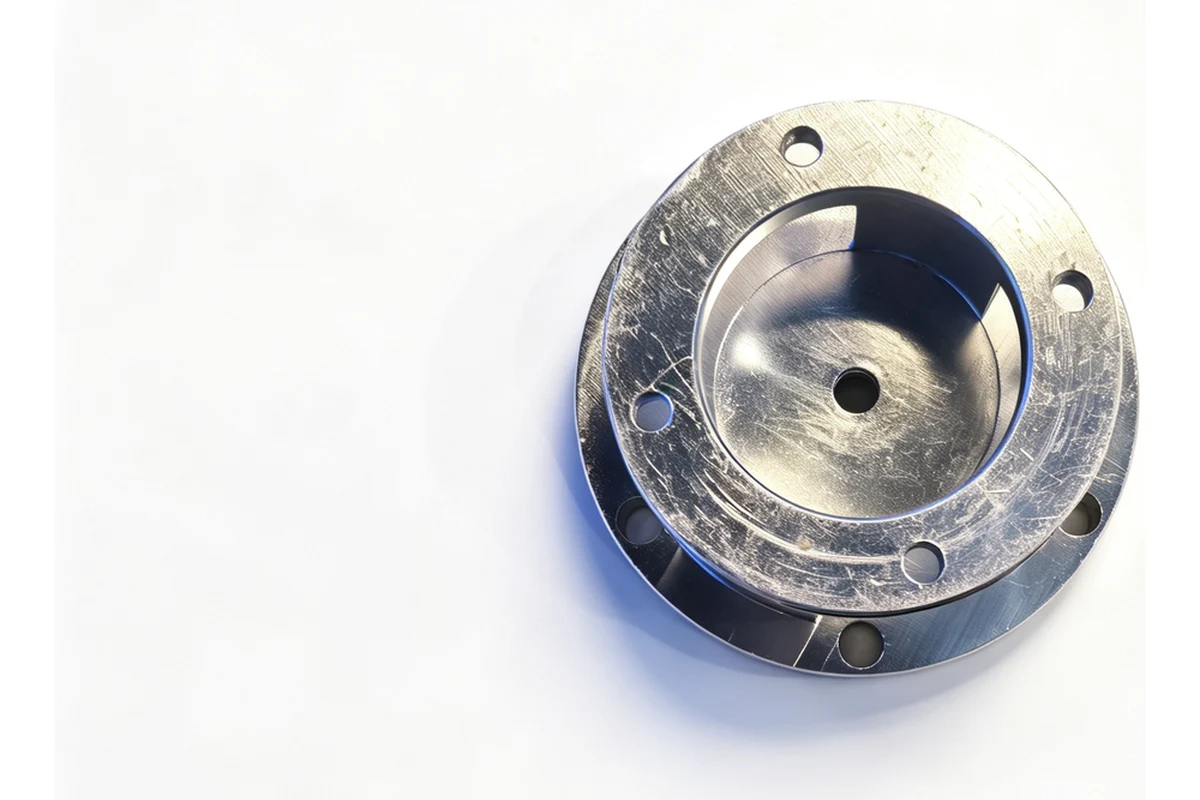
A cover spends its working life holding oil in. That makes two things matter more than they look. The first is the seal seat, which has to come off the machine without a tool mark across it that would give a lip seal somewhere to leak. The second is deburring on the inside of the bolt holes and any cross-drilling, because a chip left in a cover finds its way into the housing the first time the machine runs.
Doing both in the cycle — a light finishing pass on the seal seat, and chamfer tools on the holes before the part is unloaded — removed a bench operation that was showing up in the shop's cost per part without ever appearing on a routing sheet.
What Changed on the Floor
The cover now leaves the machine finished, with the pilot diameter, the face, the bore, the bolt circle and the radial ports all generated from one clamp. Two fixtures came out of the routing, along with the queue at the second machine and the inspection step that used to sit between them. The batch moves in pallets instead of trays, and the parts that reach goods-in are the same shape they were when the last cut was taken.
Nothing about the drawing changed and nothing about the material changed. The shop had been buying capacity for the operations it could see and paying, quietly, for the handling in between. On a part as ordinary as a flange end cover, the handling is where the money was all along.
Materials and Sizes We See on This Family
Flange end covers arrive in cast iron, aluminium, medium-carbon and alloy steel, and occasionally stainless where the housing sits outdoors or somewhere hygienic. Cast covers are usually machined on the flange first to establish a datum, then bored and drilled from that datum; the casting skin is left on the outside for looks. Steel covers are more often cut complete from bar or plate, which changes the fixture but not the logic. Covers in this family generally run from a hand-sized part up to a plate the operator needs both hands for, and the machine choice follows the size and the annual volume rather than the shape alone.
What We Would Check on the Next Job Like This
Three questions settle a cover before any machine is chosen. Which face is the datum, because everything else hangs off it. How thin is the flange where the clamps land, because that sets the holding method before it sets anything else. And where does the bolt circle sit relative to the bore in the customer's own gauge, because a cover measured on a plate reads differently from one measured on the housing, and the disagreement shows up at goods-in rather than in the shop.
If your covers currently move between two machines, the honest way to test a one-setup route is to quote the family both ways, including the handling and the inspection time. That comparison is usually where the decision gets made.
Frequently Asked Questions
Can a flange end cover be finished in one setup?
For most covers in this family, yes. Held once on a pallet or in a simple fixture, the face, pilot diameter, bore, bolt circle and radial ports can all be generated without releasing the part. Whether it is worth doing depends on how many features sit off the main axis and on the batch size, not on the size of the cover.
Should the flange be turned or milled first?
The answer is whichever operation establishes the datum the customer actually measures from, and that is usually the flange face and the pilot diameter. Get those generated early from a clean clamp, then let the bore and the bolt circle follow from them. Doing it the other way round means the datum has to be re-established later, and that is where the relationships start to drift.
How do you hold a thin cover without distorting it?
By spreading the load and supporting from underneath. A ring of low clamps around the flange rim holds better than a pair of heavy clamps at two points, and a small support under the centre keeps the cutting force from bending the plate. Where the drawing allows it, leave the heaviest cutting on features that do not carry the datum.
Does the bolt circle need to be reamed?
Only if the drawing calls for it. Most covers use standard clearance holes for the bolts, so a drill and a chamfer are enough. Where the cover also acts as a locating part, or where the holes are used to pin the joint, the drawing usually says so and the hole sequence changes to suit.
Do you support a first batch for a new cover?
Yes. Covers usually arrive as a sample batch before the volume order, and the datum, the fixture and the operation order are settled on that batch. It is the cheapest place to find out that a clamp was going to distort the flange.
Send Us the Cover You Are Running in Three Operations
If one of your parts spends more time waiting between machines than it spends being cut, that part is worth quoting again. Send us the drawing, the material and the current routing for your flange end cover — or the housing it bolts to — and our team will come back with a machine recommendation and a process note rather than a bare price.
Contact Handemo CNC | Email: sales1@handemocnc.com | WhatsApp: +86 135 6320 3038
Related reading: CNC Machining Flange Bearing Housings: Process and Machines | VMC vs HMC: How to Choose a Machining Center | CNC Machines for Box and Housing Parts | Case Study: Machining a Precision Transmission Shaft