Case Study: Pump Casing Machined in Two Setups on an HMC
Pump casings are the parts that make a quoting sheet look wrong. On paper it is a body with a bore through it and two port faces. In the workshop it turns into four setups, two fixtures and a queue at the horizontal machine. The casting we worked through below arrived exactly that way. It left running in two setups.
This is one of our case studies, written from the shop floor rather than from a catalogue. The customer is a pump and valve maker who supplies water and process industries, and their part family is a family of cast iron casings in three frame sizes.
What the part is
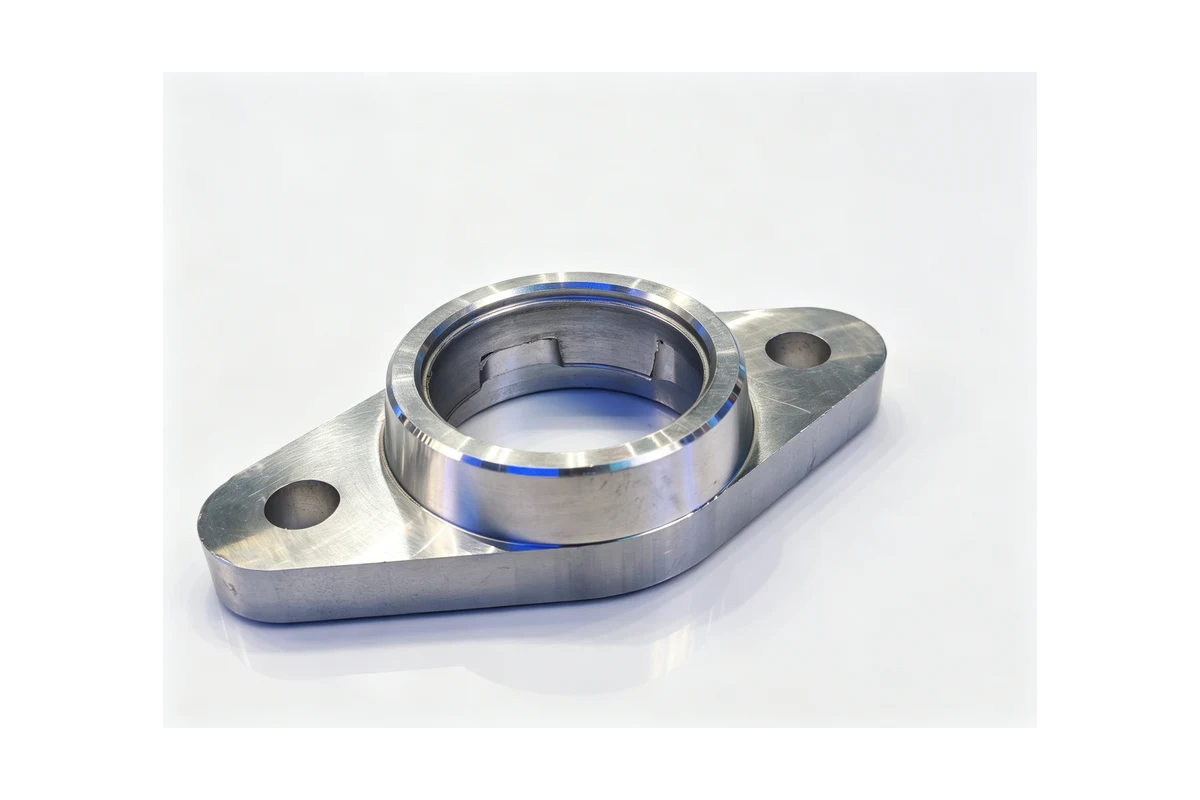
A pump casing is a hollow casting with one bore through the body, a mounting face, and inlet and outlet ports that sit at an angle to each other. The common materials are grey cast iron such as GJL-250 (HT250), ductile iron like GJS-400-15, and cast steel where the pump sees higher pressure or abrasive slurry. Aluminium casings show up on smaller water and chemical pumps.
Two relationships decide whether the pump goes together on the assembly line or comes back. The first is the bore axis to the mounting face. The second is the two port faces to each other. Everything else on the drawing is easier to hold than those two.
Why the four-setup route costs money
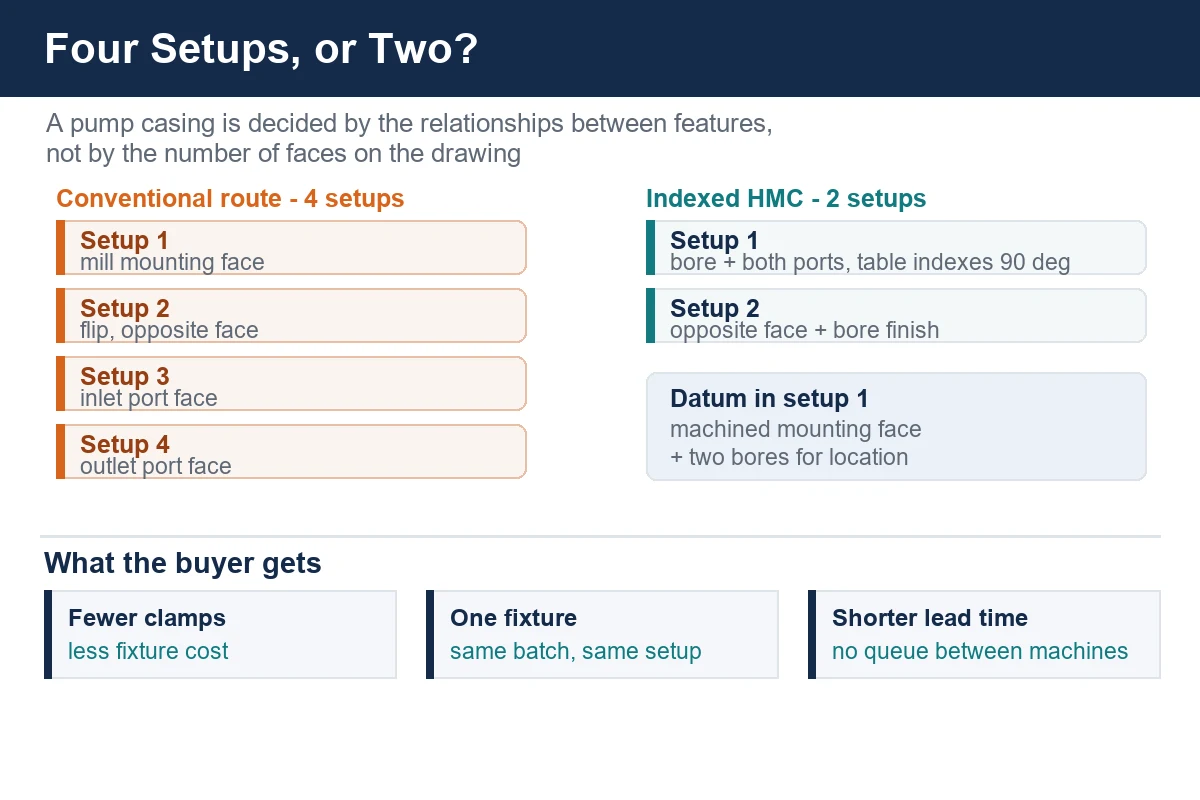
The conventional route is not wrong, it is just expensive. Mill the mounting face on a vertical machine, flip the casting for the opposite face, then set up the inlet port and the outlet port as two more jobs. Four clamps, four chances to lose the bore-to-face relationship you built in setup one.
For a shop running a family of casings in batches, the damage shows up as fixture cost and queue time rather than as cycle time. Every re-clamp needs a fixture, an operator to dial it in, and a place in the schedule. On a thirty-piece batch that overhead is paid thirty times.
What we changed
We moved the work onto an indexing horizontal machining center, in this case the HMC630-DT. The casting is held once on a tombstone fixture, located on its mounting face and clamped against the machined surface. The table then indexes in 90 degree steps to bring each side of the casing to the spindle.
The bore, the mounting face and both port faces are produced inside the same clamp. That is the whole point. Features that have to agree with each other are cut without the part ever leaving the fixture, so the relationship is set by the machine and the fixture rather than by how carefully someone dialled the second setup.
The second setup only handles the opposite face and the final bore pass. Four setups became two, and on the larger frame sizes it also freed the vertical machines for the parts that genuinely suit them.
Clamping and datum strategy
The clamping plan matters more than the machine choice. What worked for this family:
- Datum on the machined mounting face plus two bores, so the part has a stable three-point location before any clamp load is applied.
- Controlled clamp force on thin walls. Cast casings distort if you lean on them, and the distortion shows up at the bore, not at the clamp.
- A firm first pass with a face mill to get under the casting skin and the chill that sits on the surface of a raw casting.
- Index, check the face for square, then commit to the bore. Better to find a problem at the index than after three features have been cut.
- Through-spindle coolant on the deep bore and the blind pockets, plus programmed exits so the cast iron fines do not pack the volute.
- A boring head for the main bore, a chamfer tool and a tapping head for the bolt circle, so the secondary features run in the same cycle.
Consistency across the batch
The quiet win on this job was repeatability, and it does not come from the spindle. It comes from doing the work in the same clamps and the same index positions every time. The second casting runs like the first because nothing about the setup changes between parts. For a customer who assembles pumps in the same order every week, that predictability is worth more than a faster spindle.
We do not publish tooling figures or machine accuracy numbers for export control reasons, so this article stays with the process rather than the numbers. If you want the specifics for your part, send the drawing.
What it means if you buy castings or machine them
Fewer setups means shorter lead time, less fixture cost, and less in-process work waiting between machines. It also means a smaller part of the schedule depends on one skilled operator. For pump, valve and general housing work the decision is worth revisiting whenever a part needs features on more than two sides. The same logic is behind our comparison of vertical and horizontal machining centers for multi-face parts.
If your casings are close to this family, the pump and valve guide on our application pages covers the materials and the port geometry in more detail.
FAQ
Can this casing be machined on a vertical machining center instead?
Yes, and for a one-off or a low-volume part it often makes sense. The horizontal machine pays for itself when the part has four or more faces and the shop runs the family in batches, because then the indexing table replaces fixtures instead of just replacing a spindle direction.
How do you hold a thin-walled casting without distorting it?
Locate on a machined face plus two bores, keep the clamp load controlled, and avoid clamping across an unsupported wall. If the bore moves after unclamping, the fixture is usually the cause rather than the cut.
Do you take small batch work?
Yes. The casing family in this case study runs in batches from a handful of pieces up to a few hundred, on the same fixture.
What about the impeller and the end cover?
They run in the same cell, which keeps the whole assembly in one shop and removes the hand-off between the casing supplier and the pump assembler.
Contact Handemo CNC | Email: sales1@handemocnc.com | WhatsApp: +86 135 6320 3038