Multi-Cavity Fixture for Small Parts, Costed
The enquiry arrived with a number in it that made the job look easy. The shop ran brass spool bodies for pneumatic fittings, and the second operation — face, flat, cross hole, chamfer — was being done one part at a time in a vice on a vertical machine. They wanted to buy a twelve-cavity plate and get twelve times the output. They had already run the payback on that basis, and it came out short enough to approve in a single meeting.
Twelve times was never going to happen, and the reason has nothing to do with how good the fixture is. It is worth writing the arithmetic down, because the same sum decides every "how many parts per cycle" question — on a vertical machine, on a lathe, on a mill-turn.
What the part actually is
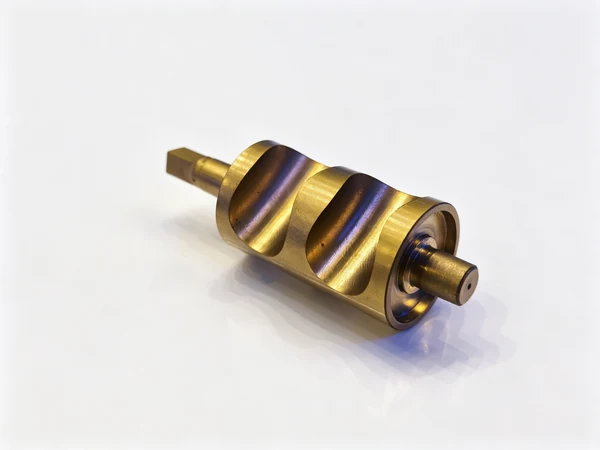
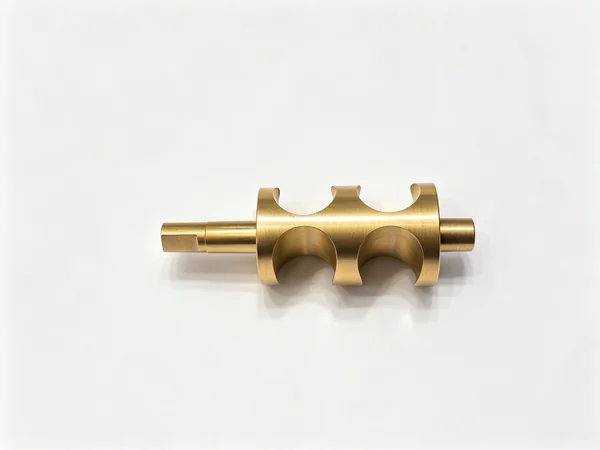
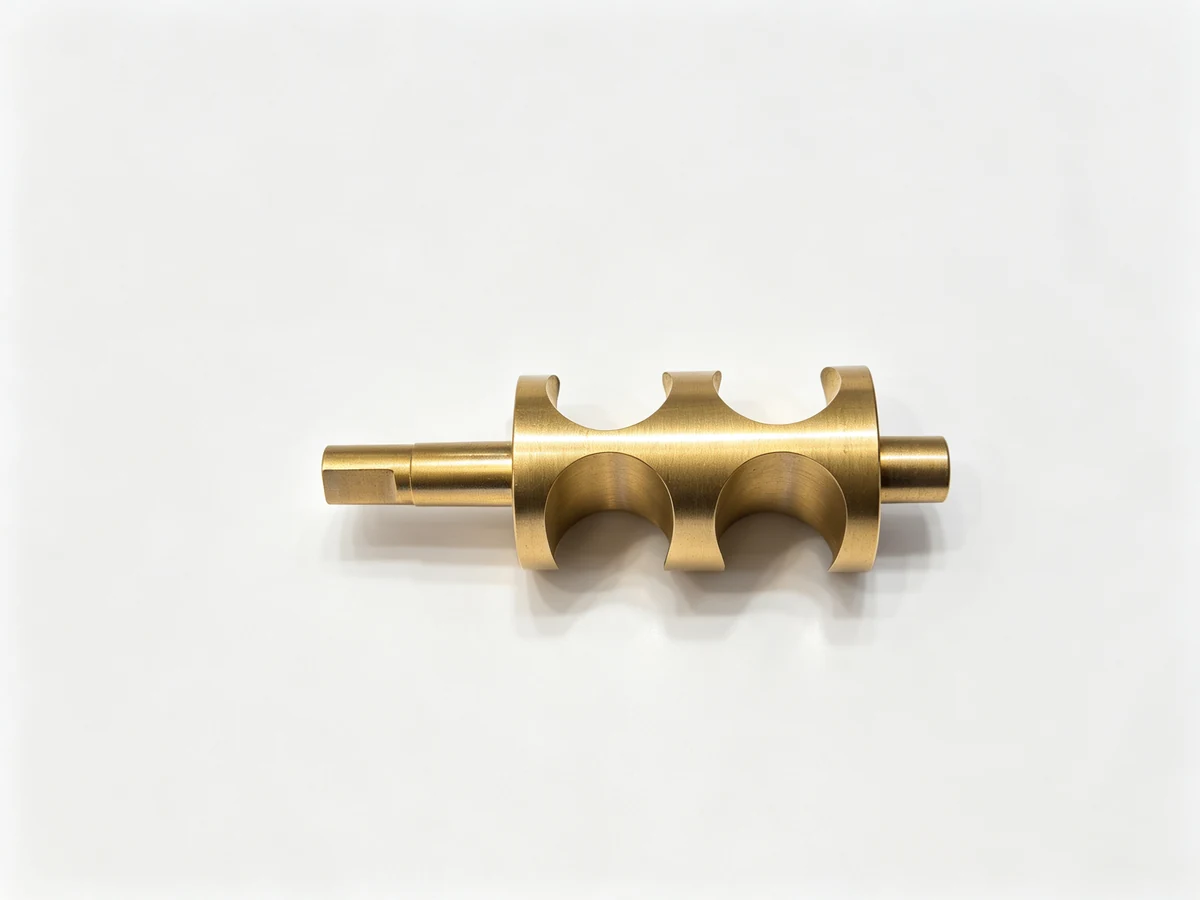
A brass spool body, about the length of a thumb. Two turned diameters with a groove between them, a cross hole through the middle, a flat milled on one flange, and a chamfer at each end. It sits inside a pneumatic cylinder and it slides, so the outside surface matters more than any single dimension on it.
The material is a free-cutting brass, and that matters for the fixture more than for the cut. Free-cutting brass machines easily and it also bends easily. A part this size will follow whatever the jaws do to it, and it will spring back when the clamp opens. That single property decides most of what follows.
The route the shop already had was a sensible one: bar stock turned on a lathe, then over to a vertical machine for the flat and the cross hole, held in a vice against the turned diameter. Two operations, one operator, and a bin of parts moving between them.
That second operation is where most brass fittings on the market are made, and it is the one with the least machine time in it. The case notes in our case studies keep landing on the same point from different angles: when a part is small and the cut is short, the job is decided by handling, not by cutting.
Why the twelve-times quote was bad news for us
It would have been easy to agree, take the order for the plate, and let the shop discover the truth in the first week of production. We have watched that happen at other suppliers, and the argument that follows is always the same: the fixture was supposed to be twelve times faster.
A fixture plate does not divide the work by the number of cavities. It divides only the part of the cycle that the machine does once per cycle rather than once per part. Everything the operator does with their hands still happens once per part, and on a small part with a short cut, the hands are most of the job.
The arithmetic, done honestly
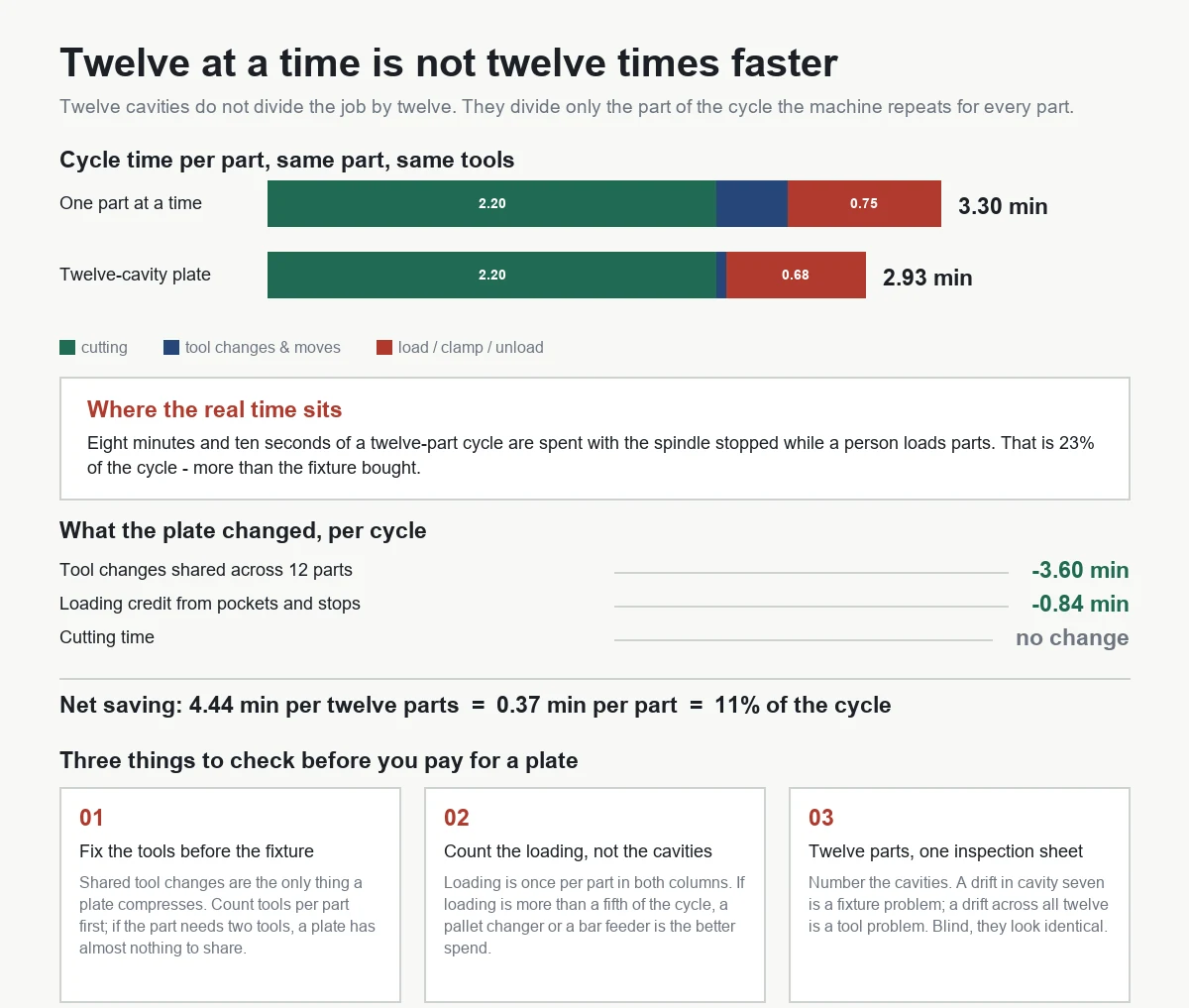
Here is the same part, costed two ways. The cutting time is identical in both columns, because the same material comes off at the same rate; the plate changes nothing about the cut.
| Per part | One at a time in a vice | Twelve-cavity plate |
|---|---|---|
| Cutting, tool in contact | 2.20 min | 2.20 min |
| Tool changes and approach moves | 0.35 min | 0.05 min |
| Load, clamp, blow out, unload | 0.75 min | 0.68 min |
| Total per part | 3.30 min | 2.93 min |
| Wall clock for twelve parts | 39.6 min | 35.2 min |
Eleven percent. Not eleven hundred percent. The fixture did pay for itself — at seventy-two thousand parts a year the saving is around four hundred and forty machine hours, and the plate plus jaws plus a weekend of proving came back inside a quarter — but it paid as a ten percent item, not as a step change.
The shop took it anyway, and the interesting part of the story is what they did next, once they saw where the twenty-three percent of stopped spindle actually sat.
Where the eleven percent comes from
Almost all of it is the second row of that table. On a one-at-a-time part, every part carries its own full set of tool changes: five tools, each one out and back, twelve times over. On a plate, the tool comes out once and stays out until the twelfth part of that feature is cut. That is where the minutes are, and it is the only row a fixture can compress on its own.
The third row barely moves, and this is the part that surprises people. Loading twelve parts does not take the same time as loading one. It takes twelve times as long, minus a small credit for the nest: on this plate the parts dropped into pockets with a positive stop, so the operator stopped measuring each one against a shoulder and simply pushed until it seated. Forty-five seconds a part became forty seconds. That credit is real, and it is small.
The floor nobody puts in the quote
Add up the third row across a twelve-part cycle and you get eight minutes and ten seconds of spindle doing nothing while a person works. That is twenty-three percent of the cycle, and it is a bigger number than the eleven percent the fixture bought.
Which means the next improvement was never going to come from the fixture. It had to come from either taking the loading out of the cycle or making the loading cheaper per part. Those are the only two options, and they are worth naming plainly because most shops buy a second fixture when they should be buying one of these:
Load outside the cycle
A second plate on a pallet changer, or a second machine table, so the next twelve parts are being loaded while the current twelve are being cut. The eight minutes do not disappear, they move behind the spindle. On a part with a short cut like this one, that change is worth more than the fixture was — and it costs more, which is the honest trade.
Load without a person
A bar feeder on a lathe removes the loading entirely for a part that is mostly turned and fits inside the bar capacity. For this spool body that is the strongest answer of all, and it is the reason the same shop later moved the part to a bar-fed lathe with a sub-spindle and kept the plate for the parts that arrive as castings. The arithmetic behind that move is set out in dual-spindle turn-mill: both ends in one setup.
Load several parts per grip
Rarely useful on a part this small, but worth knowing: if the blank arrives as a casting with two or four parts on one runner, the fixture can hold the runner and cut all of them before the operator touches anything. The credit is real and the deburring bill goes up.
Making the plate behave once it is on the table
A twelve-cavity plate is not twelve independent vices. It is one piece of aluminium or steel that has to hold twelve parts the same way, and everything that goes wrong with it goes wrong at the level of the plate.
Cut the pockets in place
The plate is bolted to the table, then the pockets, the stops and the clamp faces are cut in that position. A plate machined on another machine and then bolted down inherits the difference between the two setups, and the symptom is a fixture where cavity one and cavity twelve disagree. Chasing that with offsets per cavity is a trap: you end up with twelve slightly different programs and no idea which one is right.
Clamp to a stop, not to a torque
Brass this size will oval under a clamp screw. The part should seat against a positive stop so the axial position is set by the stop and not by how hard the operator turned the handle, and the clamp should only hold it there. A torque driver on the clamp screws costs almost nothing and removes the day-to-day drift between one operator and the next.
Support under the cut, not around it
A pocket that grips the part around its full circumference looks like good workholding and behaves like a spring: the clamp squeezes, the cut is made in a part that is temporarily out of shape, and the shape comes back when the clamp opens. Support the part on the face that the cut is measured from, and keep the grip on a surface that is not being cut.
Chips, and the pockets nobody looks at
The middle cavities are the ones that fail. Coolant reaches them last, air blast is weakest there, and a brass chip that stays in a pocket during clamping puts the part in at an angle that no gauge will catch until the flat is cut in the wrong place.
Two things fixed it here, and neither is expensive. The plate was drilled through under each pocket so chips fall instead of packing, and the air blast was split into a manifold with a nozzle per row rather than one nozzle at the corner. The first part of every cycle now blows the pockets before anything is clamped, which sounds wasteful until you have scrapped twelve parts at once.
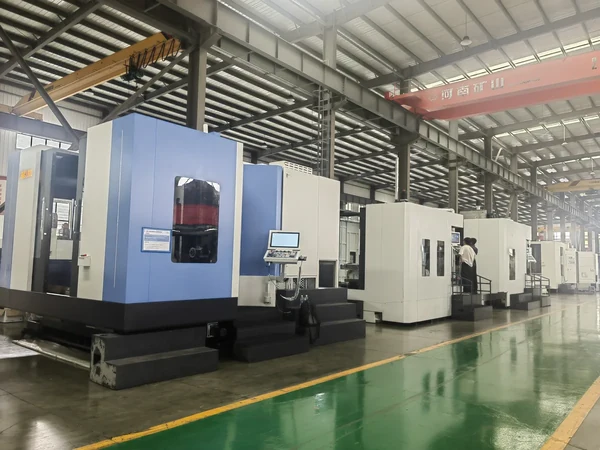
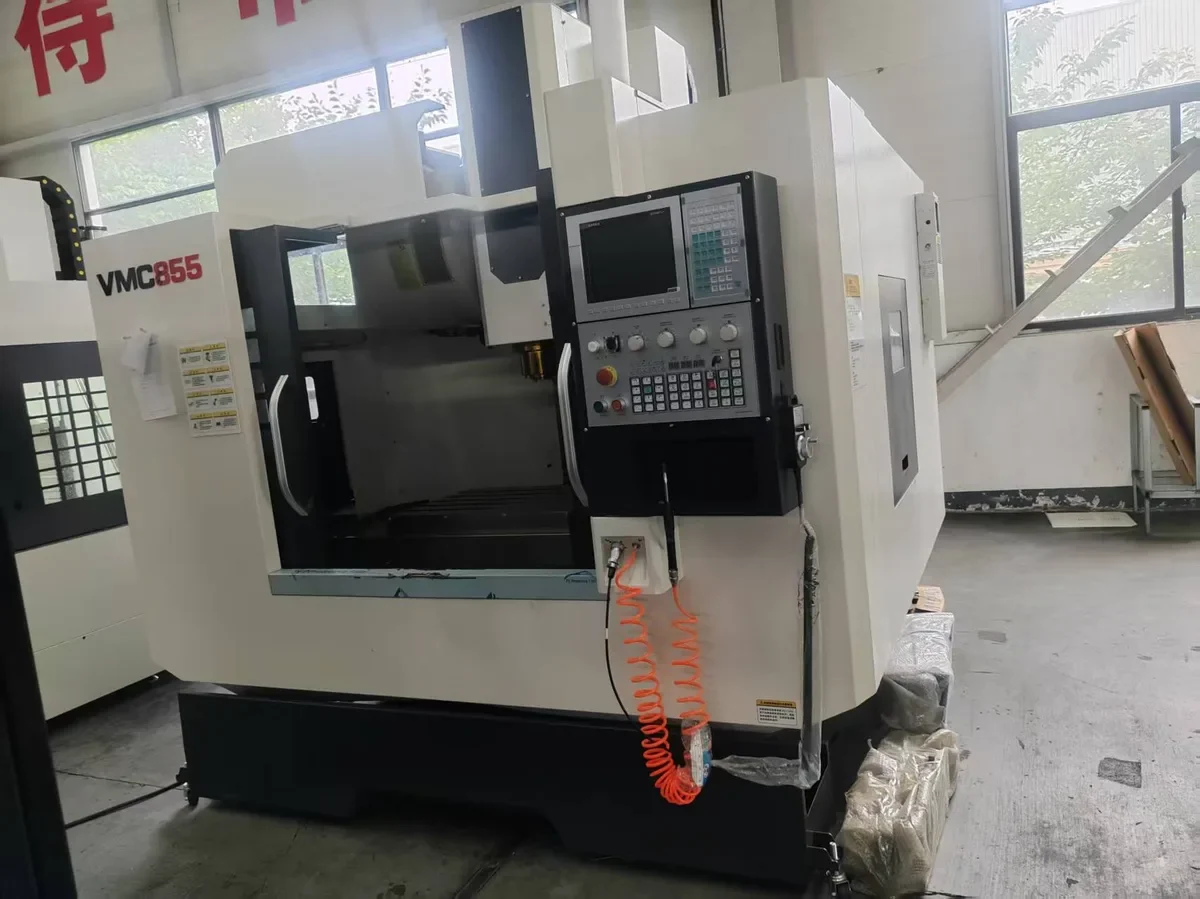
The machine under the plate in this job was a VMC855 vertical machining centre, a 1000 x 550 mm table with 800 / 550 / 550 mm of travel. That table takes a twelve-cavity plate for a part this size with room to spare, which is worth checking before you design the plate: a fixture that hangs over the table edge is a fixture that will be re-made.
Twelve chances to be wrong
This is the cost that never appears in the payback sheet. One part at a time, a bad cut ruins one part. Twelve at a time, a bad cut ruins twelve, and a fixture fault ruins twelve every cycle until somebody notices.
The shop's answer was crude and it worked: the cavities were number-stamped on the plate, and the inspection sheet had twelve columns. When a reading moved, the sheet said whether it was cavity seven or the tool, and those are completely different problems — one is a fixture to be re-cut, the other is a tool to be changed. Without the numbers, every drift gets blamed on the machine, and the machine is usually innocent.
What the customer got, in the end
A cycle that runs eleven percent shorter, which is what the arithmetic promised. A first-article check that now happens on the plate rather than on a part, so a fixture fault is caught before it becomes a bin of scrap. And a decision they would not have made from the original quote: the family of parts that are mostly turned moved to a bar-fed lathe, where the loading time stops existing altogether, and the plate kept the castings and the second operations that a lathe cannot reach.
That is the useful lesson. A multi-cavity fixture is not a multiplier. It is a device for sharing the machine's own overhead across several parts, and it is worth what that overhead is worth — no more. Measure the operator's loading time first. If it is a large share of the cycle, the fixture will disappoint you and a different machine or a different loading method will not.
Frequently asked questions
How many cavities should a fixture plate have?
Work back from two numbers: how long the operator is willing to stand at the machine in one go, and how much of the cycle the plate can actually remove. A plate that holds more than the operator can load in one comfortable stretch just moves the queue. For most small parts, eight to twelve is where the sharing gain has already flattened out.
Does a multi-cavity plate reduce cost per part?
Yes, typically by ten to twenty percent on a manually loaded machine. The saving is shared tool changes and approach moves. It is not the cutting time and it is not the clamping time, so a plate cannot deliver the multiplier that the cavity count suggests.
Can I inspect one part and ship the batch?
No, and this is the failure mode that hurts. Cavities are not interchangeable; they are twelve slightly different pockets in one plate, and the one that drifts is rarely the one you checked. Number the cavities and record which one each reading came from.
Is a bar-fed lathe better than a fixture plate for small parts?
For a part that is mostly turned and fits inside the bar capacity, yes — it removes the loading time instead of sharing it. For a part with milled features off the centreline, or one that arrives as a casting, the plate is the better tool. Many shops end up with both, split by part family.
What decides the quote on a small-part batch job?
The number of operations, the loading time per part, and how the blank arrives. Send the drawing, the annual quantity and a photo of the blank, and the three of them together usually settle the route before any machine is chosen.
Send us the part
If you are running a small part one at a time and wondering whether a plate, a bar feeder or a pallet changer is the right money to spend, send the drawing and the annual quantity through our drawing upload page. We will tell you where the time is going before we quote a machine.
Contact Handemo CNC | Email: sales1@handemocnc.com | WhatsApp: +86 135 6320 3038