Hard Turning vs Grinding: Where the Wheel Still Wins
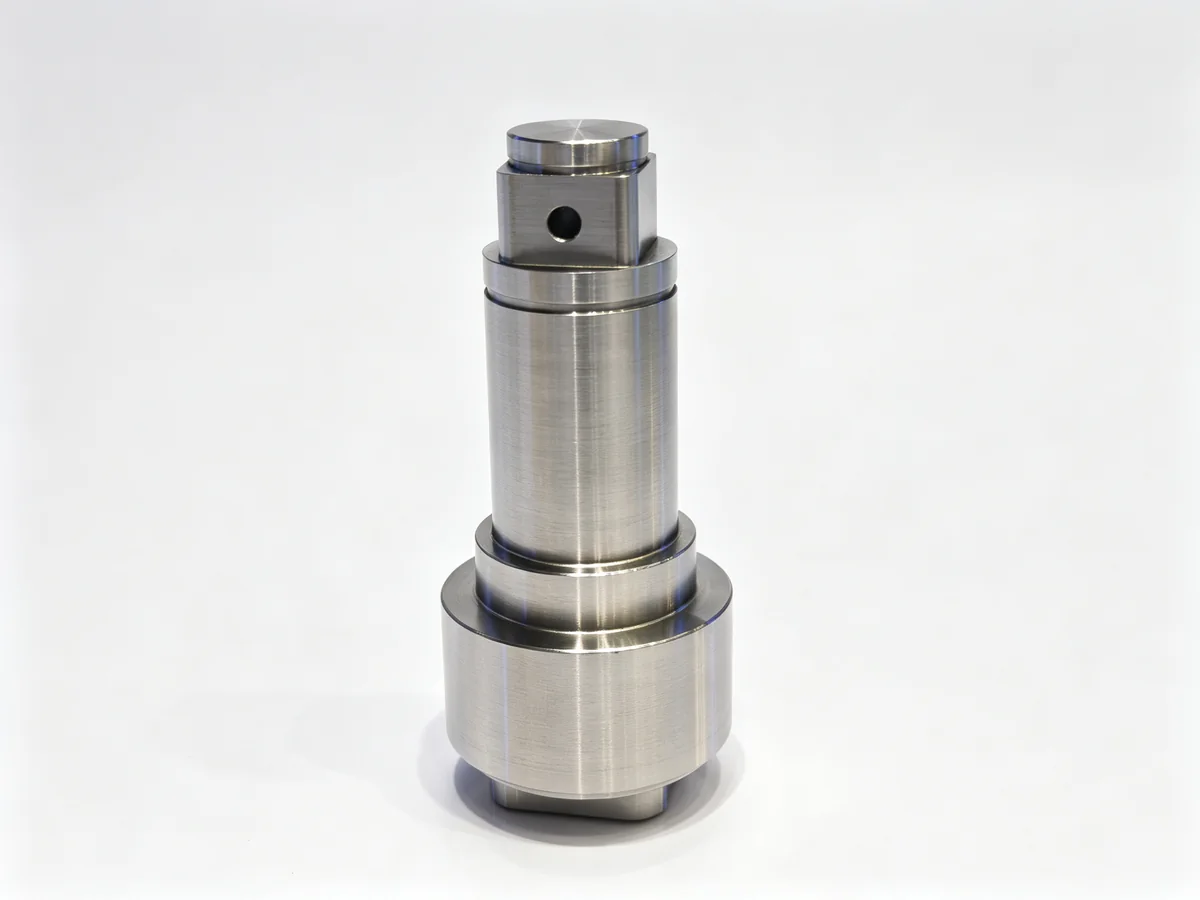
A purchasing manager sent over a drawing last month: a pump shaft in 42CrMo, quenched and tempered, both bearing journals induction hardened to 58 HRC, and in the corner of the title block two words — harden and grind. The quotation came back with three lines: turn, harden, grind. He asked the only reasonable question a buyer can ask. Can we drop the grind.
The answer is not on the drawing and it is not in the price list. It sits in a different question: the layer of material you left for the wheel, where exactly were you planning to remove it? Because that layer is not a number you write on a process sheet. It is a relationship between what the lathe delivered and what the wheel is allowed to find when it arrives.
This page is about choosing between hard turning and grinding on real parts, and about the one cost that almost never makes it onto the quotation — the trip between the two machines, and what happens to the geometry while the part is in transit.
Grinding Does One Thing Turning Cannot
Grinding looks like a finer version of turning. It is not the same operation at a smaller scale; it is a different physical arrangement, and three consequences follow from that arrangement.
The first is force. A wheel takes millions of very small cuts instead of one continuous cut, so the total push on the part is small even when the material is hard. That is why a long slender shaft, or a thin wall, can be finished on a grinder when turning it would bend it away from the tool.
The second is self-sharpening. As the grains dull they fracture and expose new edges, so the wheel keeps cutting material that would take the edge off a carbide insert in a few passes. This is the reason hardened parts go to a wheel in the first place.
The third is the spark-out. At the end of a grinding pass the infeed stops and the wheel keeps running over the same surface for a few revolutions. The cut depth falls toward zero by itself rather than being commanded to zero. The size is reached by letting the system settle, not by driving the slide to a coordinate and trusting it.
There is a fourth consequence and it is the one that decides most selections, though it is rarely written down.
A grinder follows the centre line the part already has. A lathe writes the centre line the machine has.
Put a shaft between centres on a cylindrical grinder and the wheel orbits the line defined by those two centre holes. Whatever roundness, taper or run-out the part arrived with, the wheel can reduce it, because the reference is the part itself. Put the same shaft in a lathe and the tool goes where the guideways and the ball screw send it. Any error in the machine's geometry is copied into the workpiece, not corrected.
That single sentence settles a surprising number of these decisions. If the requirement is that a journal be round and concentric with the other journal, and the previous operation left it neither, only a process that references the part's own axis will fix it. If the requirement is a size and a finish on a surface that is already in the right place, a tool that removes the material in one pass will do the job and do it faster.
The Allowance Is Not a Number, It Is a Relationship
Process sheets usually carry the grinding allowance as a diameter figure — leave a few tenths of a millimetre, sometimes more on a long part. Read that way it looks like a fixed quantity to be removed. It is not.
What the wheel actually encounters is the sum of three things: the geometric error the turning operation left behind, the depth of the layer that heat treatment disturbed, and whatever the part did while it was cooling, being straightened, or sitting in a stillage. The allowance has to cover all three. It also has to be small enough that the wheel is cutting, not rubbing.
Get that relationship wrong in one direction and the symptom is a wheel that is in contact for part of each revolution and in air for the rest. That is an interrupted cut on a brittle abrasive, and it shows up as chatter marks and burn spots that no amount of wheel dressing will remove, because the cause is upstream. Get it wrong in the other direction and the wheel is buried, the pores load up, the heat has nowhere to go but into the part, and the surface comes out burned or cracked.
This is why so many grinding complaints are actually turning complaints. The wheel was asked to correct a geometric error that was larger than the stock it had to work with, and it did what any tool does when it is asked to remove more than is there — it cut on one side.
The practical rule that comes out of this is unglamorous: the turning operation has to deliver a part whose geometry is already close to finished, and the wheel removes a thin, even layer. Turning is not the roughing operation before grinding. It is the operation that decides whether grinding is possible at all.

Where Hard Turning Actually Wins
Hard turning means cutting the part after heat treatment with a polycrystalline cubic boron nitride insert, in one pass, at a depth shallow enough that the tool is shaving the hardened layer rather than ploughing through it. On the right part it removes an entire operation and the logistics that go with it.
The advantages are concrete. There is no cleaning stage between operations, because there is no wheel to clog. The part can be finished complete, including features a wheel cannot reach. Changeover is a insert and a program, not a wheel and a dressing cycle. And the machine is a lathe, which most shops already have.
The biggest advantage is the one nobody puts in the brochure: a turning tool can cut a surface a wheel cannot. A journal with a keyway running into it, a cross-drilled oil hole, a spline, a thread, an eccentric diameter, a flat — a wheel is a circle, and a circle meeting an interruption is an impact. A single-point tool meets the same interruption with an edge that is designed to survive it, and then keeps going.
The costs are just as concrete, and they are usually understated.
- The stock has to be even. Hard turning takes the material that is there. If the turned blank ran out, the depth of cut changes around the circumference, the cutting force changes with it, and the part deflects by a different amount on each side. The result is a taper or an oval that was created during the finishing pass.
- The surface layer changes. The heat of the cut, concentrated in a very thin layer under the edge, can leave a band of material that never got tempered — hard, brittle, and in the wrong stress state. On a locating surface carrying a rotating load, that band is a fatigue initiation site. This, not the size, is the real risk in hard turning a bearing journal.
- The tool wears into the size. A wheel can be dressed back to a known condition and the process re-established. An insert wears progressively, so the size drifts across a batch and the last parts are not the same as the first.
- The machine has to be thermally boring. A long shaft grows with the bed temperature. A lathe that is fine for soft steel in the morning is a different machine at three in the afternoon, and a finishing pass that removes a shaving has no margin to absorb that.
Read that list together and the application writes itself. Hard turning suits short, stiff parts, with even stock, on surfaces that carry a fit rather than a fatigue load. Grinding suits long or thin parts, parts whose geometry has to be corrected rather than reproduced, and surfaces where the failure mode is fatigue and the surface layer matters as much as the size.
The Part That Decides It: A Keyway
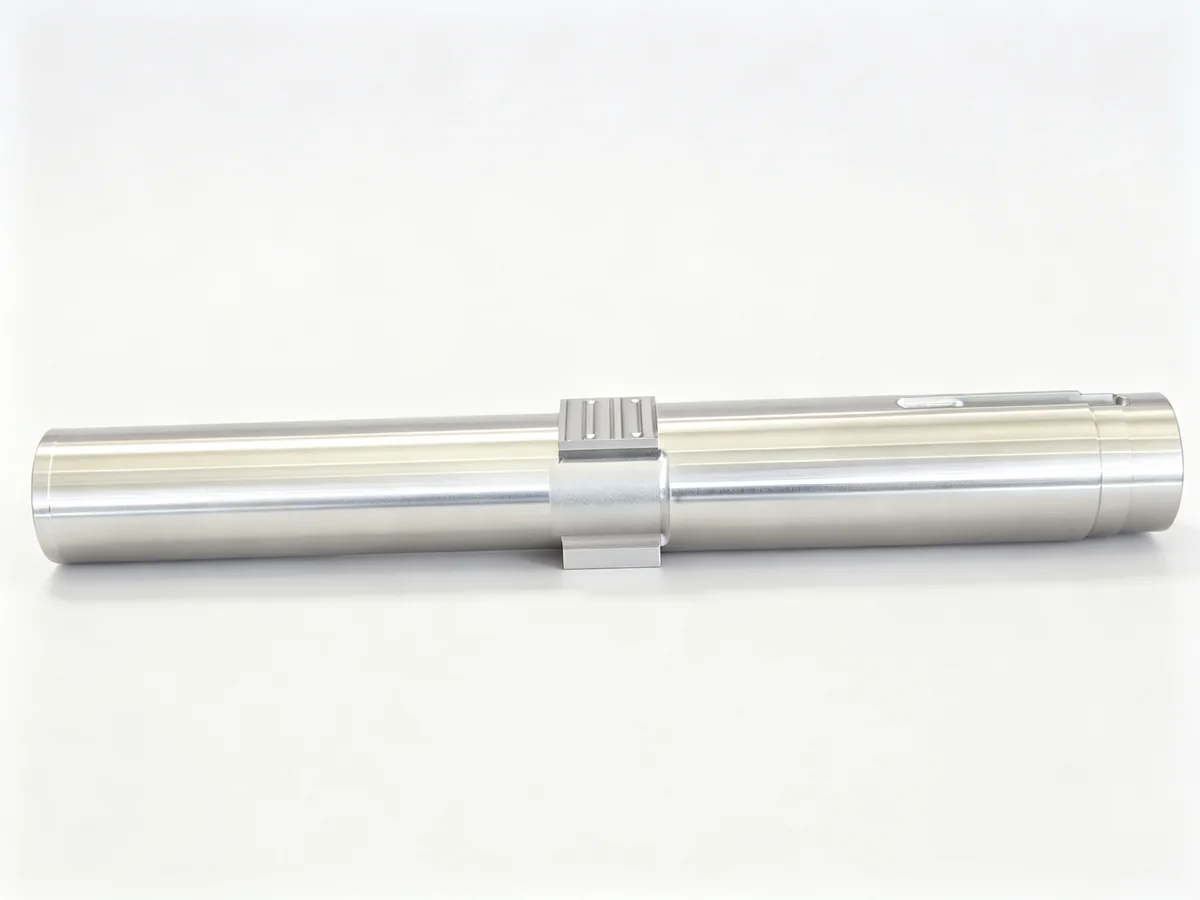
Here is the case that separates the two answers cleanly. A pump shaft, bearing journals hardened at both ends, a keyway in the middle that runs right up to the shoulder of one journal.
On a grinder, the wheel enters the journal, crosses the keyway, drops into the gap, and comes back out — twice per revolution, at wheel speed. Even with a soft wheel and a light pass, that is an impact on a brittle abrasive. Shops have solved it in three ways over the years, and all three are worth knowing.
The first is to grind first and cut the keyway afterward. It works, and it puts a milling cutter into a hardened journal, which usually means an end mill that struggles near the shoulder and leaves a burr exactly where the bearing has to sit.
The second is to stop the keyway short of the journal, leaving a continuous cylindrical band for the wheel. This changes the drawing, and it is usually the correct answer, because the band is also what the bearing needs. A keyway that runs into a bearing seat is a stress riser and a place for oil to escape.
The third is to hard turn the journal and mill the keyway in the same setup on a lathe with driven tools, so the interruption is cut by an edge that was chosen for it.
None of those is a machine selection. They are geometry decisions, and they are made at the drawing review, months before anyone compares quotations. The most useful thing a shop can do on a hardened shaft is ask whether the drawing can be made easier to machine before asking which machine to buy.
The Second Setup Is the Cost Nobody Quotes
Between the lathe and the grinder, five things happen to the part, and four of them are not machining.
It gets cleaned. Grinding hates chips; a single embedded chip loads a wheel and marks every part that follows. So the part is washed, dried, and often protected, because a hardened journal that rusts in a stillage is a scrap part.
It gets moved. Lifting gear contacts the largest, easiest surface, which is frequently the journal that was just finished. A ding from a sling is not a cosmetic problem on a bearing seat.
It gets set up again. And here is where the geometry quietly changes. The grinder will reference the part from the centre holes if they exist and are clean, or from the outside diameter if they do not. Those are two different axes. If the turning operation never touched the centre holes, the wheel is now producing a very round journal around a centre that is not the one the rest of the part was turned from.
It waits. Grinders are usually the busiest machines in a job shop, because there are fewer of them and everything hardened goes through them.
And the allowance survives the trip. That layer you left for the wheel was not removed at the lathe; it was carried across the floor, and with it every question about which feature on the part is going to be treated as the truth.
The saving from hard turning is usually presented as the cost of an operation. In practice most of it is the cost of that trip: the wash, the handling, the queue, and the second setup that introduces a second centre. The number on the quotation is the small part of the story.
One Bed, Two Operations
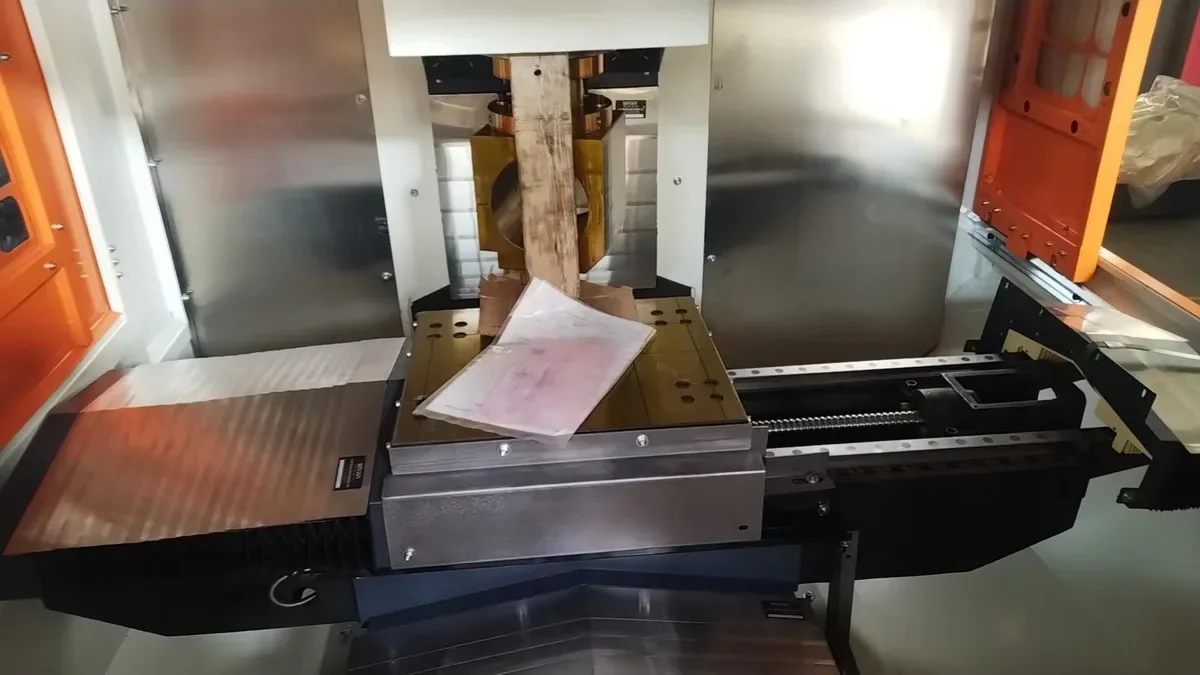
There is a middle option that gets skipped in most comparisons: a lathe with a grinding spindle mounted on the same bed, sharing the same guideways and the same workholding as the turning tools.
The value is not that it grinds better than a grinder. It does not — the spindle is smaller, the wheel is smaller, the coolant delivery is a compromise and the machine cannot dress and true a wheel the way a dedicated grinder can. The value is that the part never leaves the chuck. The journal is ground on the same centre it was turned on, in the same program, without a wash and without a queue.
That makes the machine's real application narrow and easy to state. It suits parts where the ground surface is a small part of the job and the stock to be removed is thin: a seal land, a spool diameter, a bearing journal on a shaft that is otherwise turned complete. It does not suit parts where grinding is the main operation, where a large allowance has to come off, or where the centre holes themselves need to be corrected first.
The honest test is a count. If a handful of parts a month need a ground surface, a separate grinder is cheaper and more capable. If the part is turned complete and one diameter needs the wheel, and the trip between machines is costing alignment, the combined machine solves a problem that a second machine creates.
Which Machine for Which Decision
The table below is the short version. Each row is a different answer to the same question, and the last column is the reason the machine is on the list rather than another one.
| Approach | The parts it suits | Machine | Why this one |
|---|---|---|---|
| Turn complete, grind one diameter in the same setup | Shafts and spools where the ground face is a small part of the job and the stock is thin | Lathe and grinding combination machine | Grinding spindle on the same bed as the turret, 360 mm cutting diameter over 500 mm cutting length, so the journal keeps the centre the turning pass gave it. Buy it to delete a trip, not to delete a grinder. |
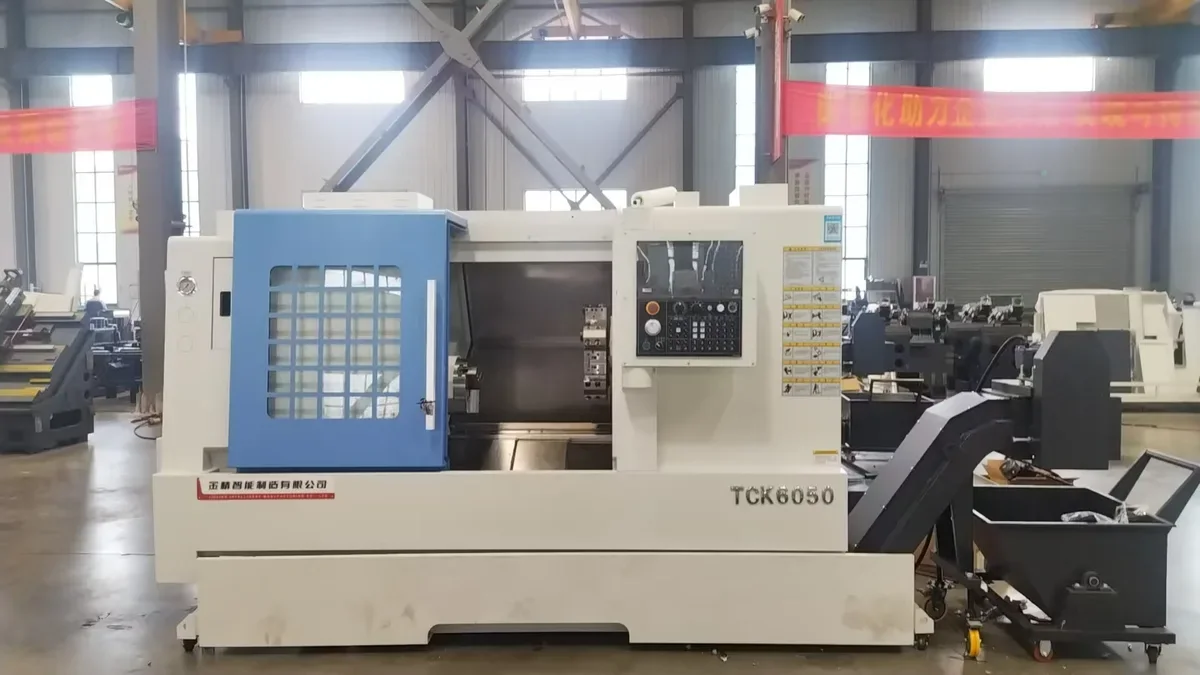
| Turn complete in one setup, milled features included | Valve spools, fittings, shafts with flats or cross holes, where nothing needs a wheel | TCK50 / TCK56D-500 | 500 mm swing class with a 30 degree cast bed and a 65 mm bore. The D version adds a 12-station power turret, so a cross hole or a flat does not become a second operation and a second centre. |
| Hard turn medium shafts, heavier cuts, interrupted surfaces | Journals with keyways, splines or oil holes; short stiff parts with even stock | TCK6350B / TCK6350D | 630 mm swing on a single cast bed with hardened box ways, 96 mm bore, 85 mm bar. The casting mass is what lets the machine take an interrupted cut without the edge chattering through it. |
| Hard turn long journals, or turn a shaft that will be ground between centres elsewhere | Rolls, marine and press shafts, parts that outgrow a 1,000 mm bed | TCK80B-1500 | 1,000 mm swing, 800 mm cutting diameter, 1,500 mm cutting length, 120 mm bore, 12-inch chuck. Buy it for the length between the chuck face and the tool, not for the swing figure. |
| Grind as the main operation, correct geometry, thin walls | Long slender shafts, thin rings, parts whose roundness has to be recovered | Standalone cylindrical grinder | Nothing on this page replaces it. A lathe cannot reduce an error it is copying, and a grinding spindle on a turret does not have the wheel size, the coolant or the dressing to do production grinding. |
Two things are worth saying plainly about that table. First, the row that most shops pick last is usually the one they needed: a part that is turned complete and then ground in place has one centre, and one centre is what assembly cares about. Second, the swing figure in a lathe brochure describes clearance, not capacity — the cutting diameter with the turret in place is the number that decides whether the part fits, and it is always smaller.
Twenty Minutes at the Drawing
Most of these decisions can be closed before anyone quotes, by answering seven questions in order. Stop at the first yes.
- Does the print call for a surface that must be round and concentric with another surface, and does the previous operation leave it neither? Then the process has to reference the part's own axis. That is a grinder, or a lathe with a grinding spindle on the same centre.
- Does the surface to be finished have a keyway, an oil hole, a spline or a thread running through it? Then a wheel will be interrupted. Either hard turn it, or change the drawing so the feature stops short of the seat.
- Is the part long and thin enough that cutting force bends it? Then the low force of a wheel is the reason to grind, and hard turning will fight the part's stiffness rather than its hardness.
- Is the hardened layer deep, or is the stock uneven around the circumference? Then hard turning will produce a taper it created itself. Fix the turning operation, then decide.
- Does the surface carry a rotating load where fatigue is the failure mode? Then the surface layer matters, and a process that leaves an untempered band needs a very good reason.
- Is the total quantity a handful of parts a month? Then the queue at a shared grinder and the cost of a second machine both argue for the simplest route, not the most integrated one.
- Is the ground surface one diameter on a part that is otherwise complete? Then the trip between machines is the cost, and a combined machine is the answer to that specific cost.
Frequently Asked Questions
Can hard turning replace grinding completely?
On some parts, yes, and on those parts it is the better process. What it cannot do is correct geometry that is already wrong, because a turning tool reproduces the machine's geometry rather than following the part's own axis. If the operation before it delivered a part that is out of round or running out, no finishing pass on a lathe will fix that, however good the insert.
How much stock should be left for the wheel?
Enough to cover the geometric error from turning plus the depth of the layer that heat treatment disturbed, and no more. The error is what decides the figure, which is why the allowance should be written after the turning process is fixed rather than before. A generous allowance does not make grinding safer; it makes the wheel rub instead of cut.
Why does a part change between the lathe and the grinder?
Because it is set up again, and the second setup uses whatever feature is convenient as its reference. If the centre holes were never cleaned or never touched during turning, the wheel will work from a different axis than the rest of the part was made on. The part did not move in the stillage. The reference moved.
Is a lathe with a grinding spindle worth it?
For one diameter on a part that is otherwise turned complete, and a stock layer thin enough to take off in a few passes, it removes a trip and a second setup, and that is the whole value. For production grinding, or for a large allowance, or for parts that need their centre holes corrected, a standalone grinder is cheaper and far more capable. Do not buy the combined machine to avoid buying a grinder.
How do you machine a hardened journal with a keyway in it?
Three routes, in order of preference. Change the drawing so the keyway stops short of the journal and leaves a continuous band. Hard turn the journal with an edge chosen for an interrupted cut. Or grind first and cut the keyway afterward, accepting the burr at the shoulder and dealing with it. The first is free, the second costs a tool change, and the third costs a deburring operation on the surface that matters most.
Can you hard turn and grind on the same part in one program?
On the combined machine, yes: the grinding spindle and the turret share the bed, so the turned diameter and the ground journal come off the same setup. On separate machines, no, and that is precisely the trade the two options are making.
What do you need in order to quote a hardened shaft?
The drawing with the heat treatment callout, the hardness and the case depth, the material and its condition, which surfaces are hardened, whether the centre holes are part of the finished part, and the quantity per year. The quantity matters as much as the geometry, because it decides whether a second operation is a cost or a rounding error.
Talking About a Real Part
A customer brought a hydraulic piston rod: induction hardened over the seal land, threaded at one end, a wrench flat behind the thread, and two cross-drilled holes for the piston retention. The original route was turn, harden, grind, then back to a mill for the cross holes — three machines and two trips across the shop for a part under a metre long.
The route we proposed kept the rod on one lathe: turn everything including the thread and the flat, harden, then return to the same machine, pick up the same centre, hard turn the seal land and drill the cross holes with driven tools. The wheel never entered the process. That is not a claim about how close the land lands; it is a statement about how many times the part got a new centre, and the answer went from three to one.
It does not always go that way. On a longer rod, or one where the harden distorts the straightness beyond what the following pass can take out, the wheel comes back — and then the combined machine keeps the trip short instead of removing it.
More comparisons of this kind are collected under machine comparisons, including slant bed versus flat bed and how to read swing, bore and chuck on a lathe datasheet. For a worked example of a hardened part finished without a wheel, read the expansion sleeve case study. If you have a hardened shaft on the desk, the fastest route to a useful answer is the drawing plus the heat treatment callout and the annual quantity. Send the drawing and those notes and you will get a process route back, not just a price.
Contact Handemo CNC | Email: sales1@handemocnc.com | WhatsApp: +86 135 6320 3038