15 Degree or 30 Degree Slant Bed CNC Lathe: How to Choose
A 15 degree slant bed lathe is the first specification most buyers ask for, and it is also the one spec that is most often copied from an old drawing. The angle is not a preference. It is fixed by the bed casting and the turret mounting, which means it cannot be changed after the machine is built. So the question is worth settling properly before an order is placed.
Handemo does not build a 15 degree machine. Our slant bed lathes are 30 degrees for the general-purpose TCK50 and TCK6050 models and 45 degrees for the TCK56Y, TCK600Y and TCK70 families. This page explains what each angle does to chip fall, rigidity and turret clearance, so you can judge whether 15 degrees is what your part actually needs or whether the requirement came from a different machine.
What the bed angle actually changes
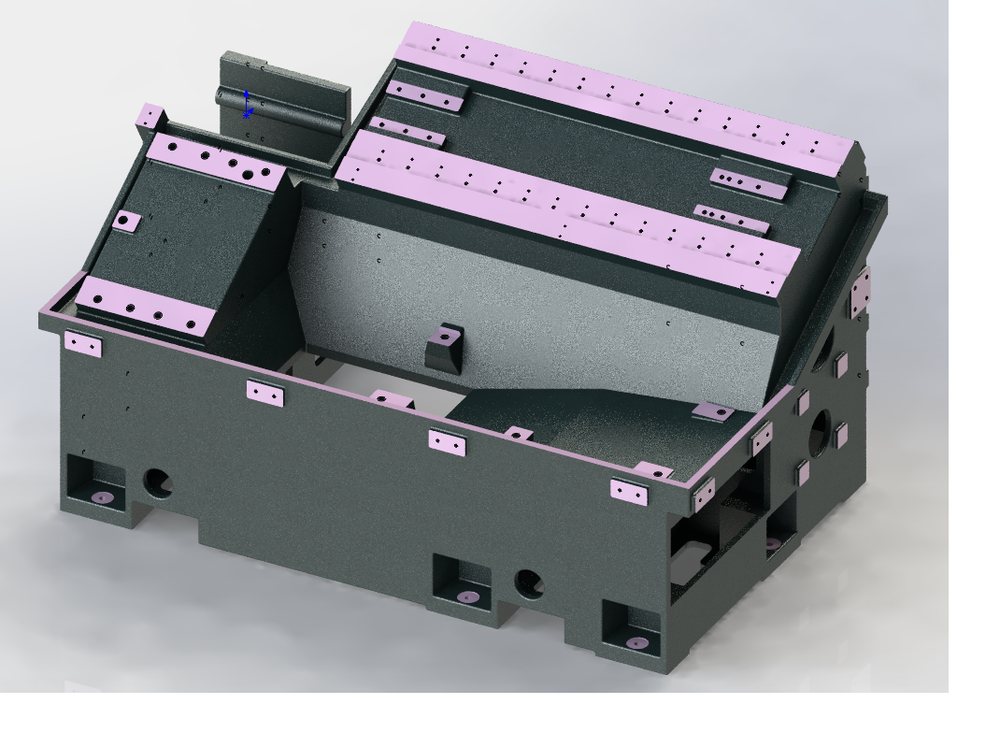
The bed angle is the tilt of the guideway plane measured from horizontal. Three things follow directly from it, and almost every practical difference between a 15, 30 and 45 degree machine traces back to these three.
Gravity and chip fall. A steeper bed lets chips drop away from the cutting zone instead of settling on the guideways and the turret face. On a 15 degree bed, chips still slide but the slope is shallow enough that stringy steel chips can build up along the turret. On 30 and 45 degree beds the fall is decisive enough that a chip conveyor mostly handles transport rather than clearing.
Turret reach across the part. A flatter bed puts the turret closer to the centreline for a given swing, which shortens the tool overhang on large-diameter work. That is the one real advantage of a shallow angle, and it is why large swing machines sometimes use 15 degrees.
Rigidity under the cutting force. The cutting force on an OD turning tool pushes down and toward the bed. A steeper bed puts that force more directly into the casting rather than into the cross slide's overhang. This is the reason 45 degree beds are used on machines that take heavy interrupted cuts.
Where a 15 degree machine comes from
If a drawing or a customer's specification calls for 15 degrees, it usually traces to one of four situations. Knowing which one applies changes the answer.
| Situation | What it usually means |
| The part is large in diameter and short in length | The buyer needs turret reach, not chip fall. A flatter angle is a legitimate choice for this geometry. |
| The specification was copied from an older flat-bed conversion | 15 degrees was a common compromise when flat-bed machines were adapted for chip control. It is not a requirement of the part. |
| The requirement came from a competitor's datasheet | Check whether that competitor actually builds 15 degrees, or whether the number refers to a different feature such as a taper or a swivel range. |
| The part involves heavy interrupted cutting | A shallow angle works against you here. A steeper bed puts the cutting force into the casting instead of the slide. |
30 degrees: the general-purpose answer
Thirty degrees is the angle we build for the TCK50 and TCK6050 because it balances the two competing needs well for typical shaft, sleeve, flange and valve-body work.
Chips fall clear at 30 degrees on steel, stainless and cast iron. The turret keeps usable reach across a 360 mm to 500 mm cutting diameter without excessive tool overhang. The bed casting stays compact enough that a machine with a 500 mm cutting diameter still fits inside a standard shipping container and a normal shop floor footprint.
The practical limit is heavy interrupted cutting on hardened stock. If the part is a forged flange with scale, or a casting with an interrupted skin, 30 degrees is workable but 45 degrees is more forgiving.
45 degrees: for heavy cuts and tight chip control
Forty-five degrees is what we build on the TCK56Y, TCK600Y and TCK70 families. The steeper bed puts the cutting force closer to the casting's strong axis and moves chips away faster.
The trade-off is turret reach. At 45 degrees the turret sits further from the centreline for the same swing, so the maximum cutting diameter at a given turret centre height is smaller. That is why the TCK6050Y, which is a Y-axis machine on a 30 degree bed, keeps a 410 mm cutting diameter while the plain TCK6050 reaches 500 mm.
Forty-five degrees is the right answer when the part is a forging or casting with an interrupted skin, when the material is difficult and the cut is heavy, or when the shop runs unattended and cannot afford chip build-up between operator checks.
Side-by-side
| Characteristic | 15 degrees | 30 degrees | 45 degrees |
| Chip fall | Shallow; stringy chips can collect at the turret | Clear on steel, stainless and cast iron | Fastest; suits unattended running |
| Turret reach at large diameter | Best | Good across 360–500 mm | Reduced; needs a higher turret centre |
| Heavy interrupted cutting | Weakest | Workable | Best |
| Typical use | Large-diameter, short-length parts | General turning: shafts, sleeves, flanges, valve bodies | Forgings, castings, difficult material, unattended cells |
| Handemo models | Not built | TCK50, TCK6050, TCK6050Y, TCK6050SY | TCK56Y, TCK600Y, TCK70 family |
How to settle the question for your part
The angle is decided by four numbers on the part drawing, not by preference. Send these and the answer is a calculation rather than an opinion.
First, the maximum outside diameter and the maximum length in one setup. This tells us whether the part needs turret reach or chip fall more urgently. Second, the material and whether the stock is bar, forging or casting. A forging with scale behaves very differently from bright bar. Third, the heaviest single cut: depth of cut and feed rate on the OD. This is what decides whether the casting or the slide takes the load. Fourth, whether the machine will run unattended. Chip build-up matters far more on a lights-out cell than on a machine with an operator standing at it.
If your enquiry is written around a 15 degree machine, say so on the drawing and tell us where the requirement came from. The angle is set by the bed casting and the turret mounting, so it is a build question to settle with engineering before the order is placed, not a specification to adjust afterwards.
Frequently asked questions
Do you build a 15 degree slant bed CNC lathe?
No. Handemo builds 30 degree machines in the TCK50, TCK6050, TCK6050Y and TCK6050SY, and 45 degree machines in the TCK56Y, TCK600Y and TCK70 families. If a 15 degree machine is mandatory for your drawing, we will say so at the enquiry stage rather than accept an order we cannot build.
Is a 15 degree lathe more accurate than a 30 degree lathe?
The angle does not set accuracy. Accuracy comes from the guideway grade, the casting's mass and damping, the spindle unit and the assembly process. A well-built 30 degree machine will hold a better tolerance than a poorly built 15 degree machine. Judge the machine on its structure and its acceptance test, not on the bed angle alone.
Why does the cutting diameter drop when the angle increases?
Because the turret centre sits at a fixed height above the guideway. Tilting the guideway further moves the turret further from the spindle centreline, so the largest diameter the turret can reach with a sensible tool overhang becomes smaller. This is why the TCK6050 reaches 500 mm on a 30 degree bed while the TCK6050Y, a Y-axis machine on the same bed angle, reaches 410 mm with its taller turret centre.
Can a 30 degree machine handle interrupted cutting?
Yes, within limits. The TCK6050 with its 11 kW main motor and 30 degree cast bed handles interrupted cuts on steel and cast iron stock. For heavy interrupted cutting on forgings or hardened material, the 45 degree TCK70 family with its larger swing and heavier casting is the better match.
Which angle should I choose for valve bodies and hydraulic parts?
Thirty degrees. Valve bodies and hydraulic components are usually cast or forged to near shape and then finished in one or two setups, with moderate depth of cut and a lot of feature work. The 30 degree TCK6050 at 500 mm cutting diameter covers most of this work, and the TCK6050Y adds a Y axis if the part has off-centre holes or milled flats.
Talk to us about your part
Send the drawing with the maximum diameter, the length in one setup, the material and the heaviest cut. We will tell you which bed angle fits, which model covers the envelope, and what the turret and chuck configuration needs to be. If 15 degrees turns out to be a genuine requirement we will say so directly instead of steering you to a machine that does not match.
See the 30 degree slant bed range · See the mill-turn range · Send a drawing