HMC Pallet Size: 630 vs 800 vs 1,000 mm
A 700 mm square gearbox housing arrives on a drawing, and the first quote request asks for a 630 pallet horizontal machining center. The part is bigger than the pallet. That is not automatically wrong, and it is not automatically right either. What decides the answer is not the part's footprint but what happens to its corners when the pallet indexes 90 degrees, four times, with a boring bar still in the spindle.
Pallet size is the figure buyers read first and understand last. On our own spec sheets it sits at the top of the table, above travels and above spindle taper, because it is easy to compare across models. It is also the one number that does not mean what people assume. A 630 pallet does not hold a 630 mm part. An 800 pallet does not buy 27 percent more part than a 630 in the way the number suggests. And the 1000 pallet machine on our list has less room to reach past its own pallet than the 630 does.
This is how we actually work through the choice with a customer, with the arithmetic in the open.
What the pallet number measures, and what it does not
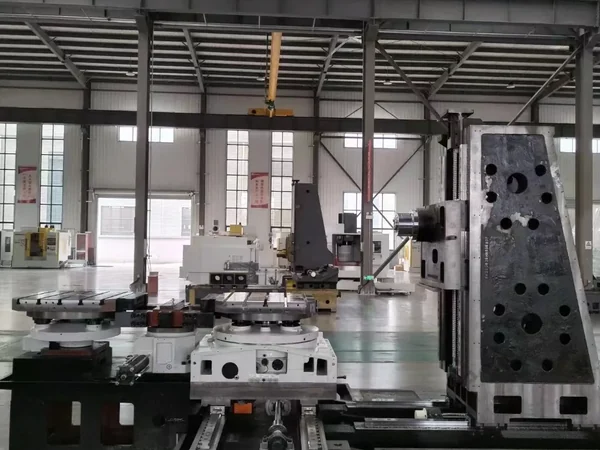
The pallet is the square steel plate the part sits on. It indexes in 90 degree steps on a worm drive, and that rotation is the whole reason a horizontal machine exists: four faces of a part, one clamping. The number 630 means the plate is 630 mm by 630 mm. It says nothing about the part.
Two limits bind you, and they are separate. The first is the pallet surface: the part plus its fixture plus the tombstone has to sit on it, and the fixture bolts into the T-slots. The second is the machine envelope: everything that overhangs the pallet has to clear the column, the way covers and the enclosure as it swings. Buyers check the first and forget the second, which is why a part that fits on the pallet can still hit the sheet metal on the third index.
There is a third limit that only appears in the quote: mass. The pallet carries a rated load, and the fixture spends part of it before the workpiece is even bolted down.
The swing test: the largest square part a pallet can turn
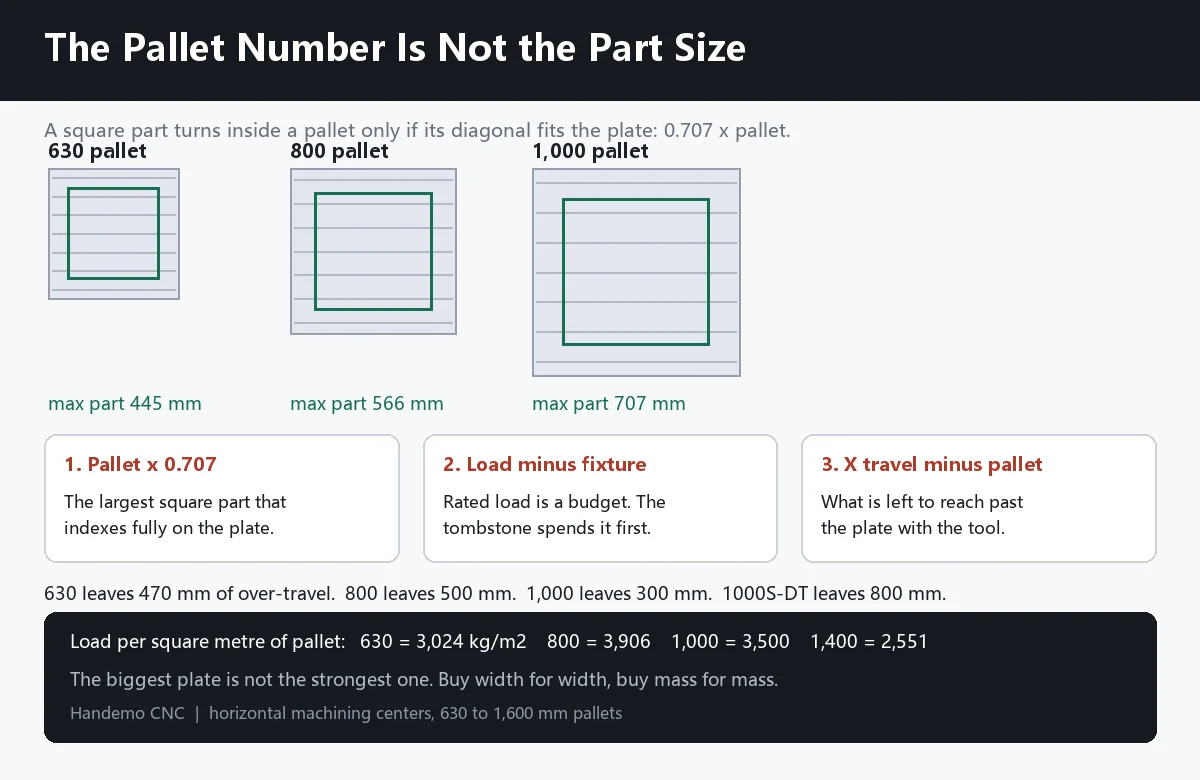
Here is the arithmetic nobody puts in the brochure. A square part of side s, centred on the pallet, sweeps a circle of radius s multiplied by 0.7071. To stay inside a pallet of side P, that radius must not exceed P divided by 2. So the largest square part that can rotate fully on the pallet is P multiplied by 0.7071.
On a 630 pallet that is 445 mm. On an 800 pallet, 566 mm. On a 1000 pallet, 707 mm. A customer who reads "630" and orders a 600 mm cube has a part that will not index without the corners running off the plate and, on most machines, into something solid.
| Pallet | Largest square part that indexes fully on the pallet | Rated load | Load per square metre of pallet |
|---|---|---|---|
| 630 x 630 | 445 mm | 1,200 kg | 3,024 kg |
| 800 x 800 | 566 mm | 2,500 kg | 3,906 kg |
| 1,000 x 1,000 | 707 mm | 3,500 kg | 3,500 kg |
| 1,400 x 1,400 | 990 mm | 5,000 kg | 2,551 kg |
| 1,600 x 1,600 | 1,131 mm | 10,000 kg | 3,906 kg |
Read the last column before the middle ones. The 800 pallet carries 3,906 kg per square metre of plate. The 1,400 pallet carries 2,551. So the 1,400 machine is not automatically the heavy one; it is a large plate rated for parts that are big but not dense. If your part is small and solid, an 800 pallet takes more than half the weight of a 1,400 on a quarter of the area. Buying the 1,400 for mass alone is paying for floor space you do not use.
Load is a budget, and the fixture spends it first
A 630 pallet rated 1,200 kg sounds generous until you price the tombstone. A four-face tombstone for 630 pallets typically weighs 350 to 450 kg, and it is dead weight that never comes off. Two parts at 380 kg each plus a 400 kg tombstone is 1,160 kg, which is inside the rating by 40 kg. Nothing about the drawing told you that. The number on the spec sheet did not either, because it does not mention the tombstone.
On an 800 pallet, 2,500 kg with a 600 kg tombstone leaves 1,900 kg. That is either two parts at 950 kg or four at 475 kg. The jump from 630 to 800 is often justified by this arithmetic alone, not by the part's width: the same part that barely fits on the 630 can be run two-up on the 800 with the same fixture weight, which halves the machine hours per part.
Two habits keep this honest. Weigh the fixture, not just the part, and write the total on the setup sheet. And keep the tombstone's heaviest face empty when you can, so there is one face left for the odd heavy part that shows up later.
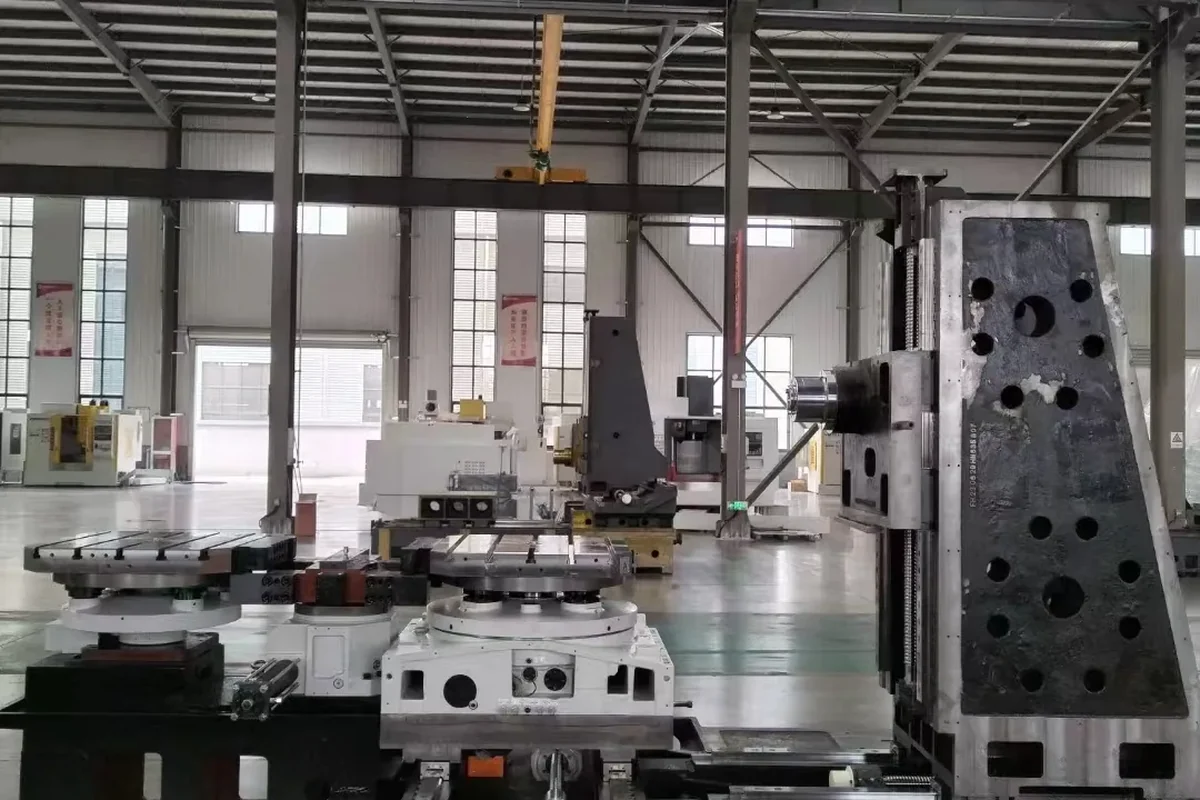
The figure nobody checks: X travel minus pallet width
Pallet sizes grow faster than travels do. Look at what is left over after the pallet takes its share of the X axis:
| Machine | Pallet | X travel | Travel left over past the pallet |
|---|---|---|---|
| HMC630 | 630 | 1,100 mm | 470 mm |
| HMC800 | 800 | 1,300 mm | 500 mm |
| HMC1000 | 1,000 | 1,300 mm | 300 mm |
| HMC1000S-DT | 1,000 | 1,800 mm | 800 mm |
| HMC1400S | 1,400 | 1,800 mm | 400 mm |
| HMC1600S | 1,600 | 2,000 mm | 400 mm |
The 1,000 pallet machine in the standard T-type layout has 300 mm of over-travel. That is the tightest figure on the list. It is fine for parts that sit inside the pallet footprint, and it is a trap for long housings that overhang, because the tool cannot reach the ends without the part coming off the pallet and onto an angle plate. The 1000S-DT, which is the deep-hole and T-structure version, has 800 mm, and that is where long boring work belongs.
This is the single most useful comparison in the whole decision, and it takes two subtractions.
T-slots decide whether your tombstone bolts up at all
The T-slot pattern is printed in the spec table as three numbers: count, slot width, pitch. On the 630 and 800 pallets it is 7 slots of 22 mm at 100 mm pitch. On the 1,000 pallet, 7 slots of 22 mm at 125 mm pitch. On the 1,600, 7 slots of 28 mm at 220 mm pitch. The TH500 uses 5 slots of 18 mm at 100 mm.
If you already own tombstones, this decides whether they transfer. A tombstone drilled for 100 mm pitch lands on the 630 and the 800 without an adapter. Move to the 1,000 and the same fixture needs an adapter plate, which adds height, which eats Z travel, which is already the tightest axis on a boring job. Shops that run the same family of parts across a 630 and a 1,000 keep two sets of tombstones for this reason, and they buy the second set at the same time as the machine rather than six months later.
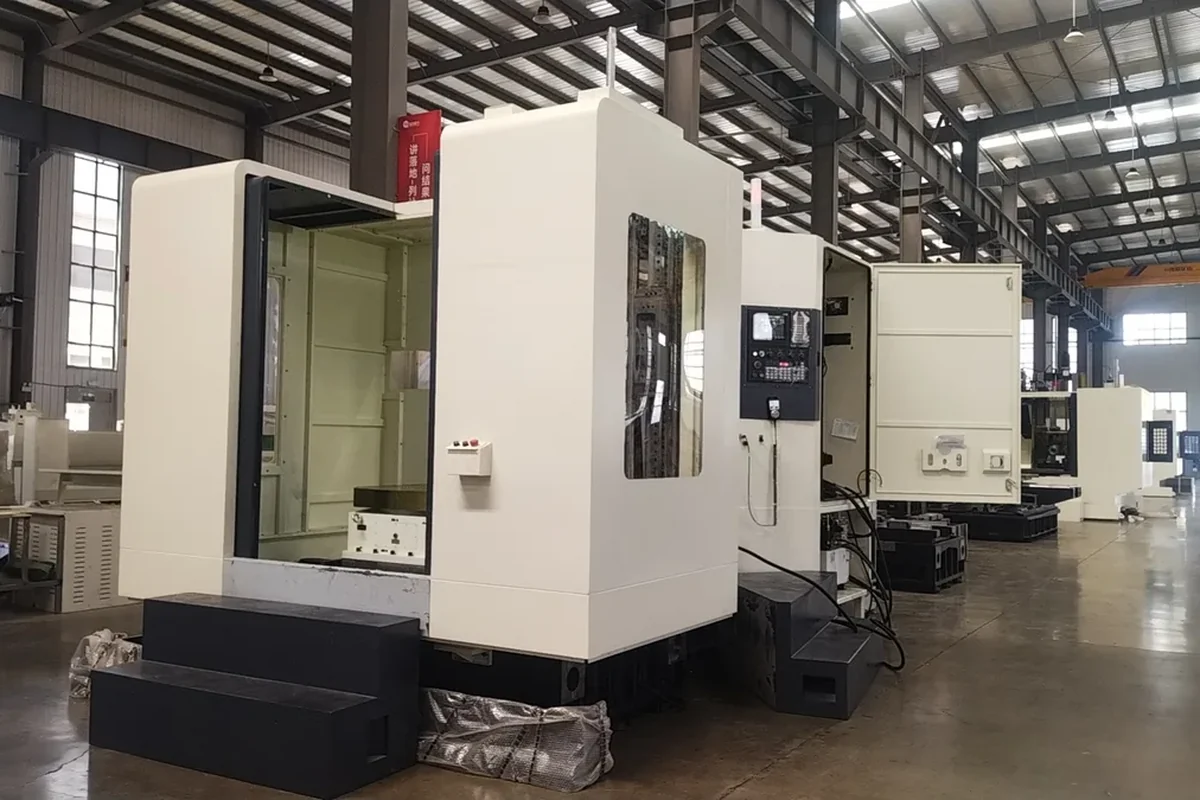
The Handemo pallet range, side by side
Everything below is from the published tables on the individual model pages, not from a summary sheet. Where a model is listed as BT50 without a further figure, the head is the boring configuration and the drawing should be checked for your job.
| Model | Pallet | Max load | T-slots | X / Y / Z | Rapid X/Y/Z | Taper | Machine weight |
|---|---|---|---|---|---|---|---|
| HMC630 | 630 x 630 | 1,200 kg | 7-22-100 | 1,100 / 900 / 1,000 | 18 / 15 / 15 m/min | BT50-190 | 12,000 kg |
| HMC800 | 800 x 800 | 2,500 kg | 7-22-100 | 1,300 / 1,150 / 1,000 | 12 / 12 / 12 m/min | BT50-200 | 16,000 kg |
| HMC1000 | 1,000 x 1,000 | 3,500 kg | 7-22-125 | 1,300 / 1,100 / 1,200 | 15 / 12 / 15 m/min | BT50-190 | 18,000 kg |
| HMC1000S-DT | 1,000 x 1,000 | 4,000 kg | 5-22-160 | 1,800 / 1,000 / 1,300 | 14 / 12 / 14 m/min | BT50 | 16,000 kg |
| HMC1400S | 1,400 x 1,400 | 5,000 kg | 7-22-125 | 1,800 / 1,300 / 1,500 | 14 / 12 / 14 m/min | BT50 | 19,500 kg |
| HMC1600S | 1,600 x 1,600 | 10,000 kg | 7-28-220 | 2,000 / 1,500 / 1,800 | 12 / 12 / 12 m/min | BT50 | 24,000 kg |
| TH500 | 1,200 x 600 | 800 kg | 5-18-100 | 1,100 / 750 / 650 | 24 / 18 / 24 m/min | BT40-150 | 7,200 kg |
Two things to notice. The TH500 pallet is rectangular, 1,200 by 600, which is not a small 1,000 and not a large 630; it is a plate for long, light parts such as brackets and rails, with the fastest rapids on the list and the smallest spindle. And the rapid figures do not climb with size: the 630 runs 18 m/min, the 800 runs 12, the 1,000 runs 15. Reading speed off the price list and assuming bigger means slower, or smaller means faster, will mislead you in both directions. The 12 m/min on the 800 is a mass decision, not a capability one.
Which pallet for which part
630: the default for parts under 445 mm that need four faces
Valve bodies, small pump casings, bearing housings up to about 400 mm, hydraulic manifolds, gearbox covers. The part indexes fully, the tombstone is light enough for one person to handle with a hoist, and the 1,200 kg rating covers two medium parts or one heavy one. If your part is inside 445 mm square and under about 350 kg, a 630 does the job and the extra money for an 800 buys floor space you will not use. The trap is buying a 630 for a part that is 480 mm and planning to "just let it overhang a bit". It will overhang on the index, and the corners are what hit.
800: when the part crosses 445 mm, or when two-up matters
The 800 solves two different problems. The first is geometry: parts between roughly 445 and 566 mm square, which cannot index on a 630. The second is throughput: the same 400 mm part run two-up on a tombstone, at 2,500 kg of rated load, halves the hours per part without any change to the cut. Most of the 800 machines we ship go out for the second reason, not the first, and the buyer usually discovers it during the quote rather than before it.
Watch the rapid figure here. At 12 m/min the 800 is the slowest of the three common sizes, and that is deliberate: the plate and the parts on it are heavier, and the machine is built to move that mass without the structure arguing back. If your cycle is dominated by cutting time rather than rapid moves, the difference does not show up in the quote comparison. If your cycle is a thousand small features, it will.
1,000: for housings that fill the plate, with a caveat
The 1,000 pallet takes a 707 mm square part that indexes fully, and up to 3,500 kg. Gearbox housings, large pump bodies, machine tool columns, and the mid-size frames that are awkward on an 800. The caveat is the 300 mm of over-travel: this machine is for parts that live inside the pallet outline. If the part has to overhang to be machined, take the 1000S-DT instead and get 800 mm of reach on the same pallet size.
1,400 and 1,600: when the bore is the problem, not the width
Past 1,000, pallet size stops being about part width and starts being about bore length and part mass. A 1,400 pallet with 5,000 kg and 1,500 mm of Z is for frames, beds and large castings where a boring bar has to run a long way through the part. The 1,600 at 10,000 kg and 1,800 mm of Z is the one that takes the really heavy work, and its 1,500 rpm spindle tells you what it is for: it is not a machine for aluminium.
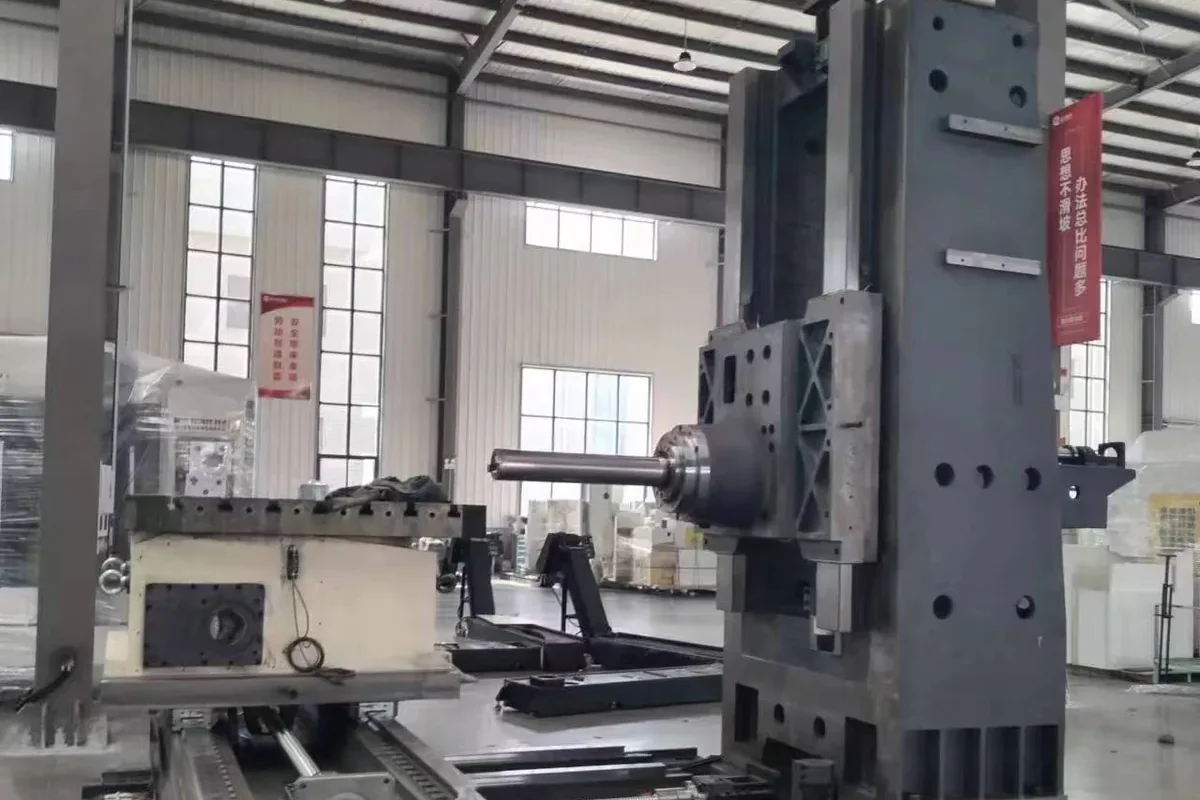
Two pallets, or one?
A pallet changer is the second most expensive option on the quote and the one most often bought for the wrong reason. The arithmetic is simple: if your setup time on the tombstone is longer than the pallet change, a second pallet pays for itself; if you load one part number and run it for three weeks, it does not.
In practice a pallet change on a machine this size runs in the low tens of seconds, and a tombstone reload with a new part, a fixture check and a probe run is measured in minutes. That ratio is what you are buying. Shops running high-mix work with five to twenty pieces per job use the second pallet every hour. Shops running one family for a month use it once a shift and would have been better off spending the money on a larger tool magazine.
One detail that catches buyers: the second pallet also needs its own tombstone, which is another 350 to 600 kg of fixture and another line on the invoice. Budget the pair, not the plate.
What a bigger pallet does not buy
It does not buy reach. The table above shows the 1,000 pallet machine with 300 mm of over-travel, less than the 630's 470. If your part needs the tool to get past its edge, a bigger plate does not help; a longer X travel does.
It does not buy spindle capability. The taper and the top speed come from the head, not the plate. A 1,600 pallet machine turning 1,500 rpm will not run a small-diameter tool in aluminium any faster than a 630 at 6,000 rpm. If the part is large and the features are small, you are choosing between two machines, not one.
It does not buy floor space economy either. A 1,600 class machine is roughly 24 tonnes and needs a foundation and a crane that a 630 does not. The plate is the visible number; the building work behind it is the invisible one.
And it does not fix a fixture problem. A part that chatters on a 630 because it is held on four points will chatter on a 1,400 for the same reason. The plate does not make the clamp stiffer.
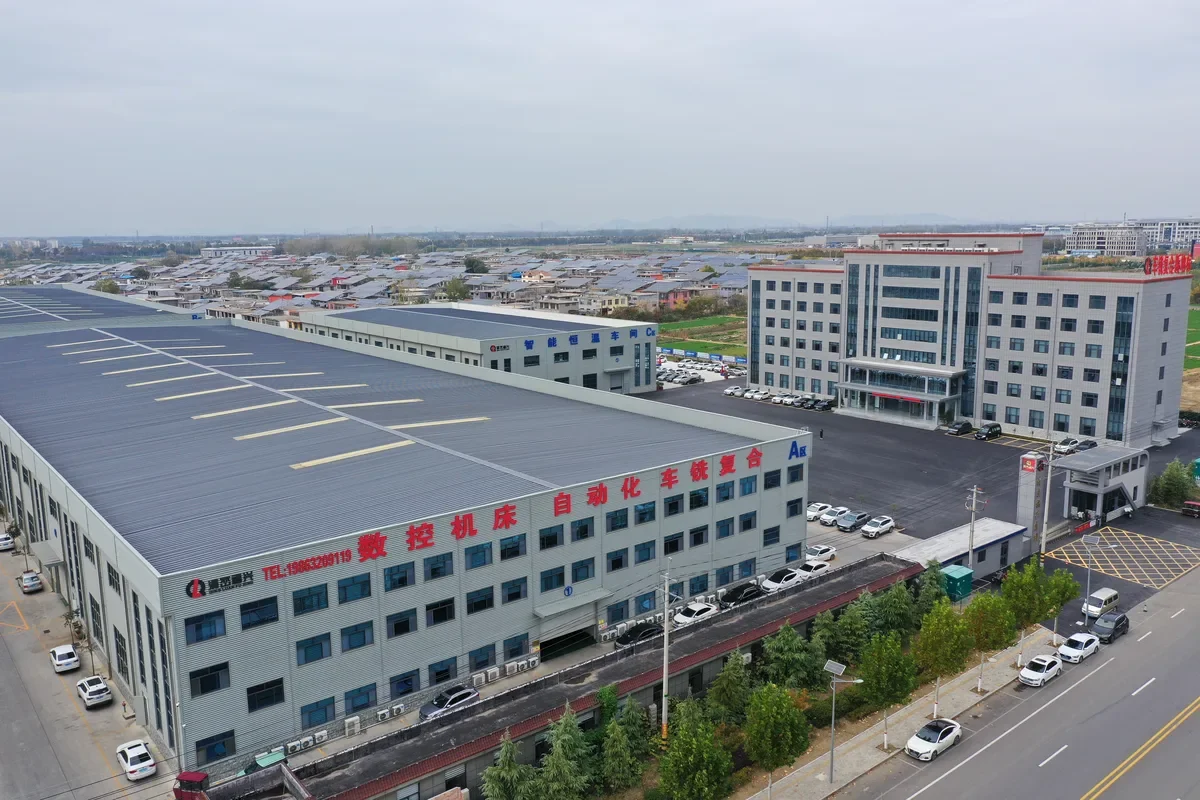
What to send us to get a pallet recommendation
We can answer the pallet question in one pass if the enquiry carries five things:
- The part drawing with the plan-view outline and the overall height, and the corners that matter marked.
- Part mass, and the mass of the fixture or tombstone you intend to use, or a note that you need one designed.
- Which faces have to be machined in one clamping, and which can come off and come back.
- The largest bore diameter and its depth, if the part has one, because that decides between the standard and the deep-hole layout.
- Whether you already own tombstones, and their T-slot pitch, so we do not quote a machine your fixtures cannot bolt to.
With those five, the choice between 630, 800 and 1,000 is usually settled by two subtractions and one weighing, and we will tell you when a smaller machine does the job. We would rather quote the 630 and be right than quote the 1,000 and be expensive.
Questions we get on pallet size
Can I machine a part bigger than the pallet?
Yes, if it is clamped on an angle plate or a riser and does not have to index through the full 360 degrees, and if the overhang clears the column and the enclosure through the angles you actually use. It is common for long shafts and rails. It is not a way to get a 700 mm cube onto a 630 pallet, because the corners will find the machine on the first index.
Is a 630 pallet with two pallets better than an 800 with one?
Usually yes for high-mix work with small parts, because the second pallet removes setup from the spindle time. Usually no for one large part run for weeks, where the plate size is the binding constraint and the second pallet just sits loaded.
Why is the 800 slower than the 1,000 on rapid?
Because the published figure reflects the mass the axis has to accelerate, and the 800 configuration in our range runs a heavier column and plate combination than the 1,000 T-type. It is not a ranking. Compare cutting performance on your part, not rapid figures on a sheet.
Can I run a 1,000 part on a 1,000 pallet?
Only if it does not have to index. A 1,000 mm square part has a 1,414 mm diagonal, roughly twice the pallet's half-width, so the corners leave the plate immediately. For a part that size you need a 1,400 pallet, or a fixed setup with the part clamped once and the head doing the moving.
Does pallet size affect the foundation?
Yes, and it is the cost that surprises people. A 1,400 or 1,600 class machine needs a poured foundation with a specified depth and grout cure of 7 to 14 days before the machine is levelled and run. A 630 often goes onto a prepared slab. If the building is not ready for that, the plate size question is premature.
Start with the part, not the plate
Send the drawing and the fixture weight and we will run the swing arithmetic against the models on this page and tell you the smallest pallet that holds the part through four indexes. If the answer is a 630, that is what we will quote. If your part needs 800 mm of over-travel for a long bore, we will say so before you sign anything.
Contact Handemo CNC | Email: sales1@handemocnc.com | WhatsApp: +86 135 6320 3038
Related reading: vertical or horizontal for multi-face parts, choosing a machining center for box and housing parts, and a deep-hole boring job on a horizontal machine.