CNC Machining Mold Bases: Process and Machines
Mold work is usually described as cavity work, but most of the hours in a mold shop go into the plates that carry the cavity. A base is a stack of thick steel plates that has to finish up flat, parallel and square, with pockets that seat the insert without rocking and guide bores that bring the two halves back into line every time the tool closes. When a plate is not flat, nothing bolted to it will be flat either, and the fitter is the one who finds out.
This guide is about the plate side of the job: what a mold base actually has to do, the steels involved, the sequence that keeps a large plate stable through machining, the workholding it needs, and the machines we would put on it. If you are cutting the cavity itself rather than the plate around it, our guide to mold cavity machining covers that route; this one stays on the base, the plates and the guide system.
What a Mold Base Has to Do
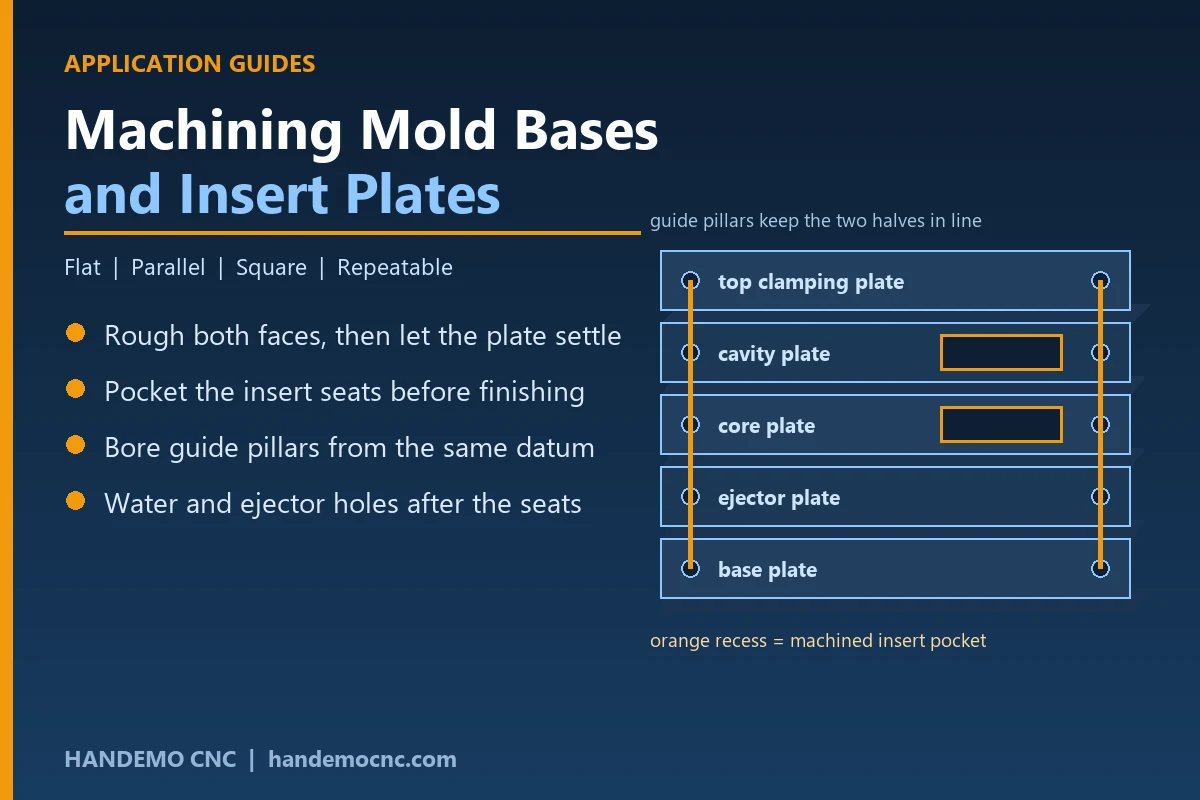
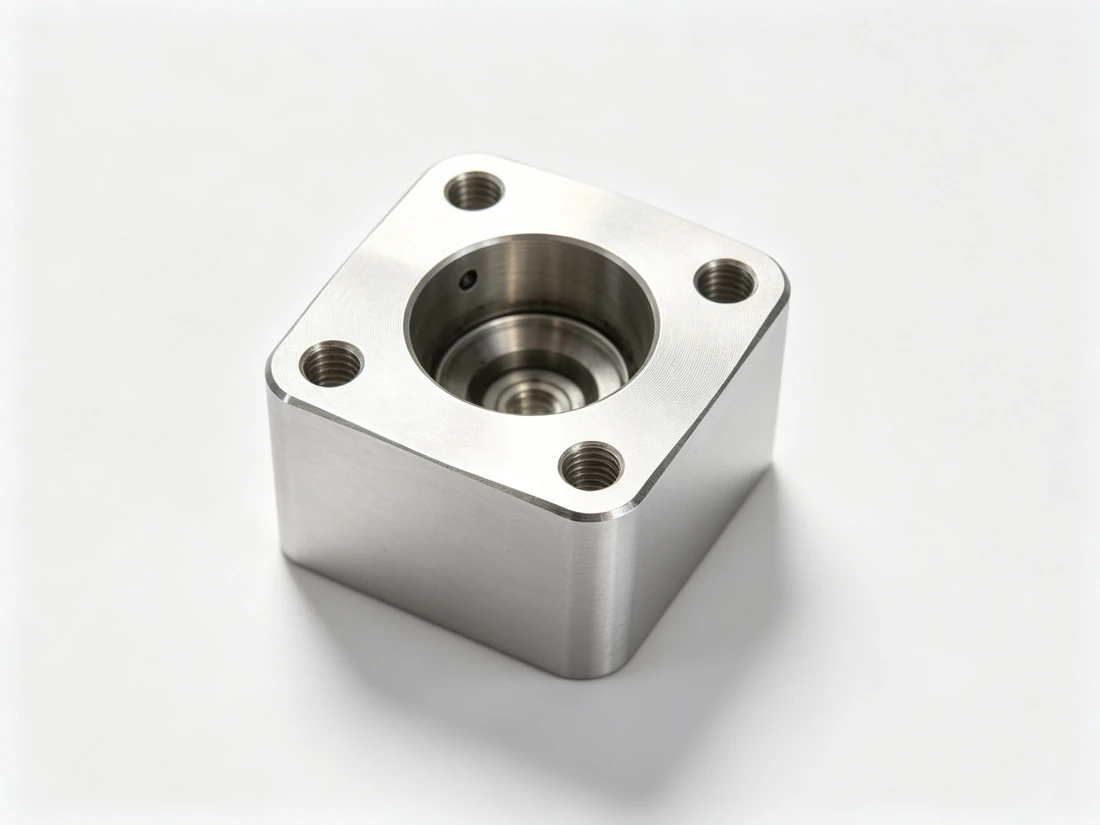
A base is a frame with several jobs at once. It has to hold the cavity and core inserts in a fixed relationship to each other, guide the halves into line on every cycle, carry the ejector system, and provide the water circuits that pull heat out of the tool. Each duty lands on a different feature, and each feature has its own place in the machining sequence.
The faces matter most. The fixed and moving halves reference each other through their parting faces, so the outer faces of each plate have to be flat and parallel to one another. If they are not, the plate ends up shimmed or scraped at assembly, and shimming a base is a sign the machining was never finished.
Next come the seats: the pockets that hold the inserts, the guide pillar and bushing bores, and the pattern of ejector and water holes. The pockets decide where the cavity sits and how well it is supported. The guide bores decide whether the halves line up every time. A pocket that is slightly generous lets the insert shift under injection pressure; a guide bore machined off position pulls the halves sideways as the tool closes.
The Steels You Will See
Most bases are cut from plain or pre-hardened plate rather than tool steel, because the plate does not form the part, the insert does. Common choices are a low or medium carbon plate for small tools and prototypes, a pre-hardened plate where the pockets and guide bores will see repeated clamping, and stainless plate for tools that run corrosive polymers or sit in humid storage between runs.
- Mild steel plate for prototype tools and short-run bases
- Pre-hardened plate for production bases that are assembled and stripped repeatedly
- Stainless plate for corrosive resins and medical or food-contact tooling
- Hardened inserts and guide pillars, fitted into plates that stay soft around them
The condition of the plate decides the first operation more than the grade does. Hot-rolled plate arrives with a skin and with stress locked into it. If you remove the skin from one face and not the other, the balance changes and the plate bows. Cutting both faces in the same clamping, and leaving a light allowance for a finishing pass later, is what stops a plate moving after it has been pocketed.
The Order of Operations
On a base the sequence is not a matter of preference. It is what keeps the part flat when the last operation is finished.
Rough Both Faces First
Rough both faces in one clamping so the plate releases its stress evenly, then let it settle before finishing. Heavy stock removal belongs at the start, while the plate is still thick and stiff, not after pockets have been cut into it. Where the plate is large, taking the roughing cut in more than one pass at a steady step-over is easier on the fixture than one heavy pass.
Pocket the Insert Seats
Insert pockets are normally machined after the faces are roughed and the plate has settled. Cut them with a rigid tool and a controlled step-over rather than a long reach, because a pocket wall cut with a flexible tool will not sit square to the face above it. Where a pocket has an internal corner a rotating cutter cannot reach, that corner is left for EDM or finished by hand, and it is worth agreeing that with the toolmaker before the plate goes to the wire machine.
Bore the Guide Pillar and Bushing Holes
Guide bores are the alignment of the whole tool, so among the critical features they are machined last and from the same datum as the pockets. Boring them in the same setting, rather than on a second machine after the plate has been moved, is the cheapest insurance in the job. The bores are usually finished with a boring head or reamed to suit the pillar that will be pressed in, and the fit should be tight enough to hold the pillar while still allowing it to be pressed without distorting the plate.
Water Lines, Ejector Holes and Tapped Features
Water lines and ejector holes follow the seats, so that a wandering drill cannot damage a finished bore or break into a pocket wall. Cross-drilled circuits need plugging at the ends, and it is worth proving the circuit with air before assembly rather than finding a blocked line after the tool has already run a batch.
Workholding on a Large Plate
Large plates are the parts most likely to be machined out of flat by the clamping itself. A plate clamped down hard onto a table that is not true will be cut to the clamp condition, then spring back the moment the clamps come off, and the error only shows up at assembly.
Three habits cover most of the risk. Support the plate across its whole area with matched parallels or a squared sub-plate, so nothing is being bridged between two contact points. Keep the clamping over rigid points rather than in the middle of a span, and take the finishing passes with light pressure. And for a plate that has to be turned to reach both sides, machine a pair of ledges or use soft jaws so the second setup repeats on the same reference every time.
Where a plate is thin relative to its footprint, a magnetic table or a vacuum plate spreads the hold across the face and removes local pressure points altogether. For a shop running the same family of bases repeatedly, a dedicated fixture with fixed stops pays for itself inside the first batch.
Machines We Would Quote for Base Work
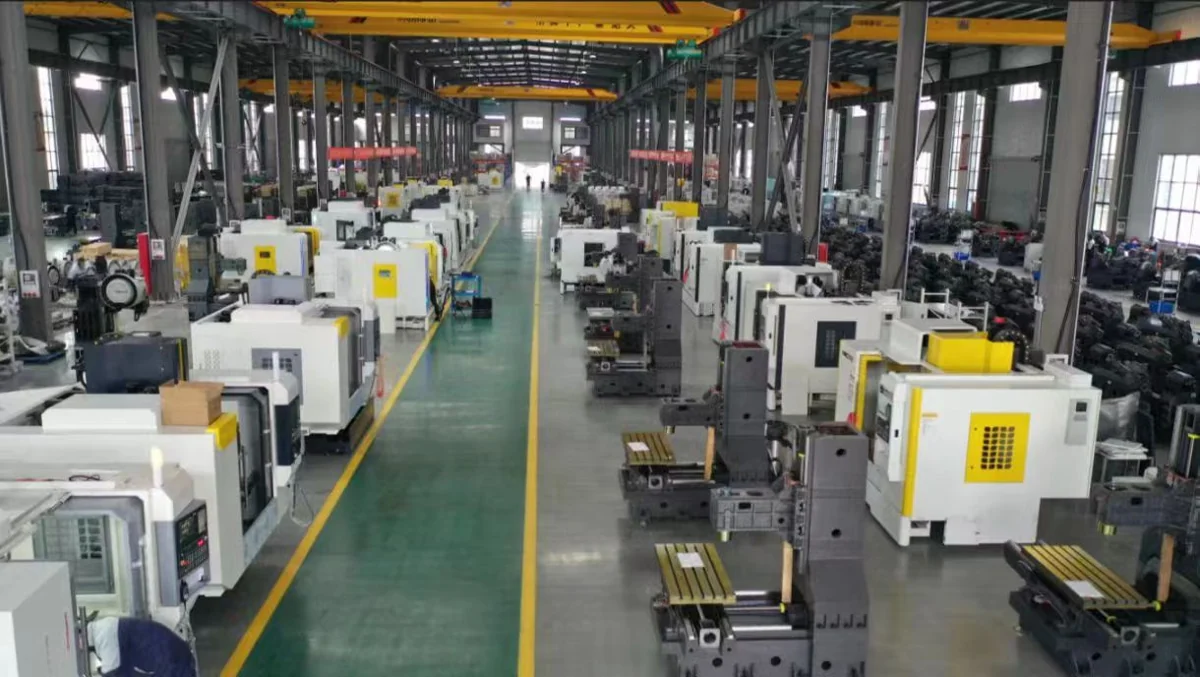
Base work is mostly face milling, pocketing and boring on a plate that is wide rather than tall, which points at a vertical machining centre with enough table and travel to cover the plate in few settings. In our range the VMC1370D is the machine we would look at first: it is built in the mold and die group, with the table for a large base and the spindle for finishing pocket walls. Smaller bases and insert seats fit comfortably on a VMC1160.
Where the pockets are deep, or the part has features that are best reached from the side, a horizontal machine cuts down the number of settings. The HMC800DT indexes the pallet so several faces of a base are machined without releasing the plate, which keeps the faces, the pockets and the guide bores related to one another. For plates that carry angled slides, lifters or three-dimensional water circuits, a five-axis platform finishes the angled work without a special fixture, and the HTMC800T covers families of that shape.
When bases are produced in volume, the bottleneck is usually loading rather than cutting. A gantry loader or a pallet pool lets one plate be machined while the next is set, and since a base is heavy and awkward to lift by hand it is exactly the kind of part that suits automation. The rule we would apply is to automate a plate job that already runs cleanly, not one whose process is still being changed.
Checking the Assembly Before It Ships
A base is not finished when the last cut is taken. It is finished when the plates come together and the guide system slides without binding. At assembly the parting faces are checked against a straight edge or a surface plate, the pockets are blued to confirm the insert seats over its full base rather than on two corners, and the guide pillars are checked for free movement with the plates closed and the screws drawn down.
Finding a seat that only touches on two corners is far cheaper in the machine shop than in the press. Keeping a surface plate and a spotting press beside the assembly area, and recording the seat contact for each tool, turns a subjective "it feels right" into something the next shift can repeat.
FAQ
Can a mold base be machined from a single plate instead of a stack?
Small tools are sometimes cut from one block, but a stacked base is easier to machine, easier to maintain when a single plate wears, and easier to modify when the part changes. For anything in production, the stack is the practical route.
Should the pockets be cut before or after the faces are finished?
Pocket after the faces have been roughed and the plate has settled, but leave the finishing pass on the faces until the pockets and bores are done. That way the reference faces are machined last, from the plate as it will finally exist.
How do you stop a large plate from bowing?
Rough both sides in the same clamping, let the plate settle, support it completely when it is clamped, and finish with light pressure. Most bowing comes from uneven stress release and from the clamping itself, not from the cutter.
Does a base need a horizontal machining centre?
Only when the geometry asks for it. A flat plate with pockets and bores on one face runs well on a vertical machine. Where the part carries critical features on several faces, indexing on a horizontal keeps them related without re-clamping the plate.
What do you need in order to quote a base?
The plate drawing with pocket and bore positions, the plate material and condition, the insert sizes for the seats, and the annual number of tools. With that we can propose the operation sequence, the workholding, and the machine in our range that carries the cycle.
Send Us the Plate You Are Trying to Produce
Send the drawing, the material condition and the annual quantity, and we will come back with the operation sequence, the fixture and the machine from our range that fits the work. Handemo has been building machine tools since 2008 and supplies buyers in more than 150 countries from a plant of 220,000 m², so we would rather tell you which bases should stay on a vertical machine with a simple fixture than sell you a cell that does not match the volume. Our mold and die manufacturing page lists the machine families we build for this work, and the wider set of application guides covers the neighbouring part families.
Contact Handemo CNC | Email: sales1@handemocnc.com | WhatsApp: +86 135 6320 3038
Related reading: CNC Machining Mold Cavities and Electrodes | CNC Machining Guide for Bearing and Flange Housings | VMC vs HMC: How to Choose a Machining Center