CNC Machining Automotive Parts: An Application Guide
Automotive work rarely arrives as a single part. It arrives as a bracket on a pallet, a housing with a casting number stamped on it, or a shaft that a buyer has been sourcing from someone who is now three weeks late on a repeat order. The part itself is often the easy part. What decides whether the job is profitable is how many times it has to be clamped, how much of the cycle is spent cutting instead of waiting, and whether the fiftieth thousand pieces behave like the first one.
This guide is about the shape of automotive machining work rather than one component: what actually comes through the door, how the material and the drawing push you toward one machine rather than another, and the fixture and process decisions that quietly set the cost per part. For the component-level detail, our guides to gearbox housings, hydraulic valve bodies and bearing and flange housings go deeper on those families.
What Actually Arrives on an Automotive Job
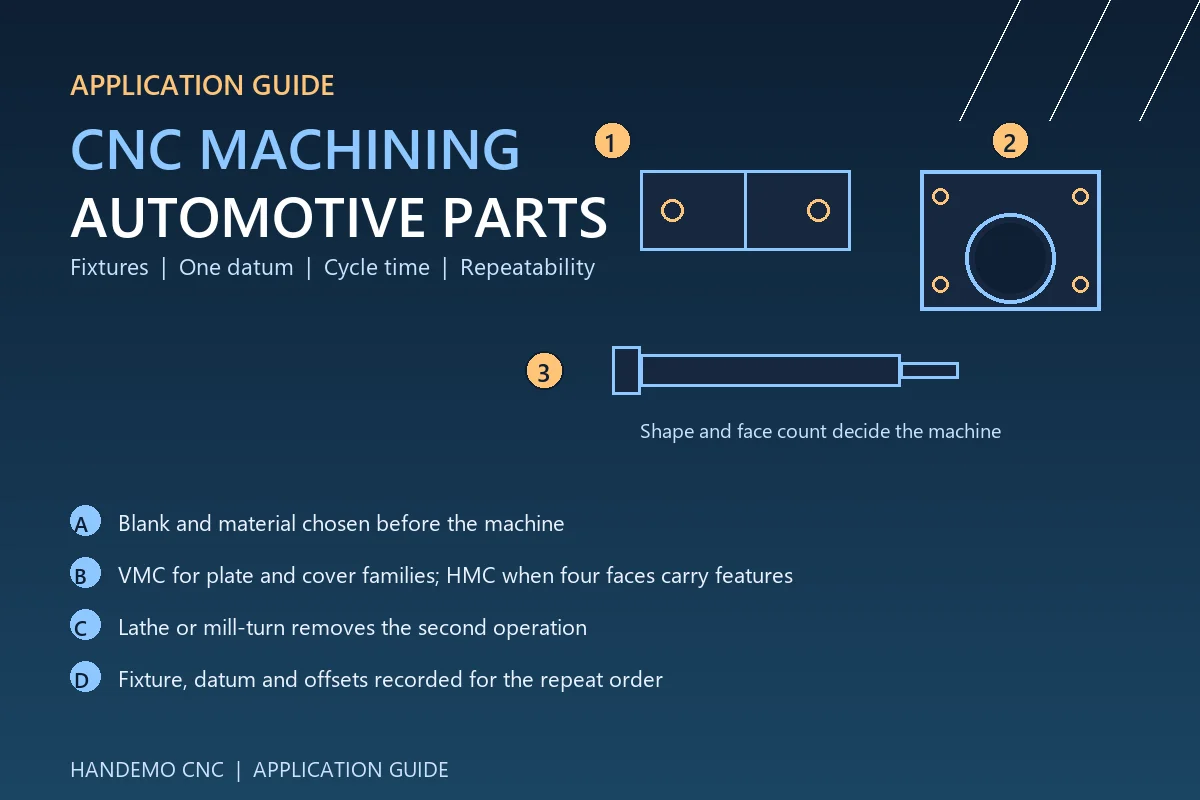
Automotive machining work divides into a few recognisable shapes, and each one has a different cost driver.
Brackets, plates, covers and small housings arrive as castings or as flat plate. The features are spread over two or three faces, the volumes are high, and the cycle is short. Here the money is won or lost on load and unload time and on how many parts a fixture can hold at once.
Large housings, gearbox casings and clutch bodies arrive as castings with bores that have to line up with each other across a long axis. Setup count is the enemy. Every time the part comes off the table, the relationship between the bores and the mounting faces is placed at risk.
Shafts, spindles, axles, sleeves and fittings arrive as bar, forging or tube. They are round, they want to be turned, and any milling or cross drilling on them is usually a second operation that can be absorbed into the same machine.
Safety and structural parts arrive as thicker steel, sometimes forged, and the drawing usually comes with a note about traceability. Those jobs are decided by tool life and by how well the blank is controlled, not by spindle speed.
Material and Blank Decide the Tooling Before the Machine Does
The same bracket in two materials is two different jobs. Aluminium alloys cut freely, produce long chips that have to be evacuated before they wrap around a tool, and give a good surface with a light finishing pass. Cast iron cuts short and dusty, holds a stable edge, and punishes any coolant strategy that lets the dust settle into the ways. Steel is the middle case, and the higher-strength and hardened grades are the ones that decide whether a shop needs a heavier machine.
The blank matters as much as the material. A casting arrives with its own internal stress and a hard skin that has to come off evenly, or the part will move after the first cut. A forging needs its flash cleared before the surfaces that matter can be cut cleanly. Bar or plate removes everything between the finished features as chips, which costs cutting time but removes an entire sourcing dependency.
Our usual advice for a new automotive part is to prove the process on the blank that is easiest to get, then move to near-net blanks once the quantities justify the tooling. That sequence keeps the machining decisions separate from the foundry's timetable.
Machine Choice Follows the Shape of the Part
There is no single automotive machine. Three families carry almost all of this work.
Vertical Machining Centres for Plate, Bracket and Cover Work
For parts that are open and reachable from above, a vertical machining centre with a rigid frame is the most cost-effective tool there is. A machine such as the VMC1160 has the work envelope for a door-sized casting, and the VMC855 handles the smaller plate and bracket families where the cycle is measured in a couple of minutes. Where the same datum face is used all day, a vertical machine also keeps the operator's view of the cut, which matters more than people admit on a first article.
Horizontal Machining Centres Where Several Faces Matter
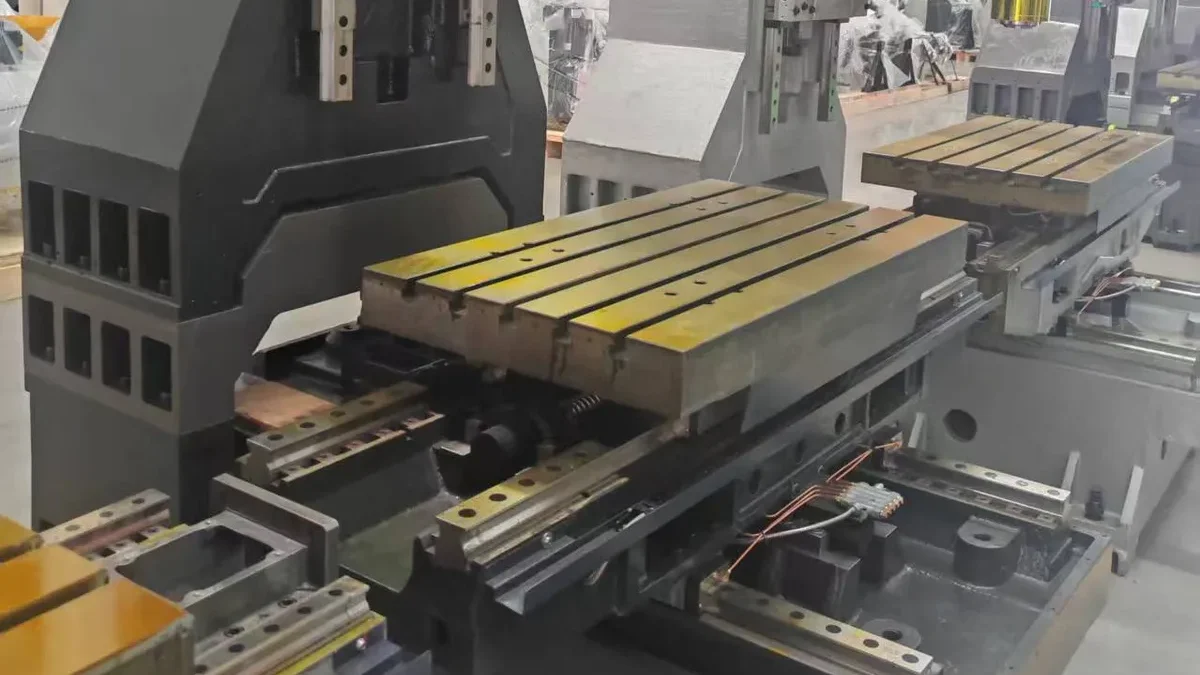
When four faces of a casting carry features, a horizontal machine with a rotary table and a pallet changer changes the arithmetic. The part is clamped once and indexed, so the bores, faces and bolt patterns are cut in one relationship, and the operator loads the next pallet while the spindle is still cutting. On a part with a five-minute cycle and features on four sides, this is usually the difference between one setup and three. A HMC630-DT covers the housing families, and for heavier and deeper work the boring and milling machines in the horizontal range take bores that a three-axis machine has to reach with long, slender tooling.
Shafts, sleeves and fittings go onto a CNC slant bed lathe first and then come back for a second operation, or they never leave at all. A dual-spindle mill-turn machine finishes the back end while the front end is being cut, and a Y-axis machine such as our mill-turn range handles cross holes and off-centre features without a second fixture. On automotive round parts, removing the second operation is worth more than a faster spindle.
Fixtures Decide More Than the Machine Does
A shop can buy an excellent machine and still lose money on a part because the fixture lets it move. Two rules cover most cases.
The First Operation Sets Everything After It
The surfaces the customer will measure from should be the surfaces the machine works from, established on the first operation and kept for every operation that follows. On a housing this usually means boring the main bore and facing the mounting face while the part is still on the raw casting fixture, then using that bore and face as the reference for everything else. On a bracket it means finding the mounting plane and the two locating holes in one clamping, once, at the start.
Clamping Where the Part Is Strong
Castings and thin covers deflect when they are pulled down. A clamp that closes a gap at the edge of a part will open a gap somewhere else. The practical answers are to clamp over support and not over air, to sequence the clamping so the part seats before it is tightened, and where the wall is thin, to support it from below or fill the cavity rather than squeeze it harder. We would rather add a support block than argue with a part that will not repeat.
Where Automotive Jobs Are Won: Cycle and Changeover
On a production part, the cutting time is often not the biggest part of the cycle. Loading, checking, waiting for a program to be selected and clearing chips can quietly add up to more than the cut.
Three habits pay back on almost every automotive job. Keep the tool count in the turret or magazine low enough that the machine is not swapping tools for a five-second cut. Keep the fixture so the part can only go in one way, because a reversed part is scrap and a scrapped casting costs more than a machined one. And keep the program and offsets for the part stored and named so the next batch starts where the last one finished rather than from a blank page.
Batch size also changes the plan. A short first batch justifies a soft fixture and a cautious cut; a standing order justifies a dedicated fixture, pallets, and a serious look at whether a horizontal machine with a pallet changer pays for itself inside a year.
Keeping the Second Year Like the First
Consistency between runs comes from records more than from equipment. Write down the fixture and clamping method that settled a job, the tools used at each stage including the reach on the finishing tool, and the order of operations when the finishing pass was split. That short log is the difference between a repeat order and a new development project every time the part comes back.
Replace wear parts on schedule rather than on failure. Fixture pads, locating pins, soft jaws and collets all move with use, and a locating pin that has worn quietly will produce a batch that is difficult to explain. Where the customer asks for capability evidence, the answer is a defined gaging plan and a machined reference piece kept as a control, not a number printed on the drawing. We are happy to build that plan with you, and we keep it in plain language so it survives a change of operator.
FAQ
Can you machine automotive parts from castings we supply?
Yes. Send the casting with its drawing and a photograph, and note where the raw material is added. We will check the stock left on the features that matter, because uneven stock on a casting is the most common reason a first article moves.
What batch sizes do you take?
Everything from a handful of prototypes to standing monthly orders. The first batch is usually run on a simple fixture to prove the process; the dedicated fixture and pallet arrangement come once the quantity is known.
Which machine do you put aluminium automotive parts on?
Open, reachable parts go on a vertical machining centre. Parts with features on four sides go on a horizontal machine with a rotary table, and round parts go on a lathe or a mill-turn machine so the second operation disappears.
Can you work to a controlled process for a safety-related part?
Yes. We build a gaging plan with you, keep a machined reference piece as a control, and record the fixture, tools and sequence for every job so that a repeat order starts from a known state.
How fast can you quote an automotive part?
Usually within a working day or two, and a useful quote needs three things: the drawing, the annual quantity, and a photograph of the part if one exists. With those we can price a machine recommendation and a fixture, not just an hour rate.
Send Us the Part You Are Trying to Produce
If you are quoting an automotive part and the volume is real, send us the drawing and a photograph. We will come back with the machine we would put it on, the fixture we would build, and the sequence we would run, so the price you receive is for a process rather than for a machine. Handemo machines automotive castings, forgings, bar and plate work for buyers in more than 150 countries, from a plant of 220,000 m² that has been building machine tools since 2008.
Contact Handemo CNC | Email: sales1@handemocnc.com | WhatsApp: +86 135 6320 3038
Related reading: CNC Machining Guide for Gearbox Housings | CNC Machining Guide for Hydraulic Valve Bodies | VMC vs HMC: How to Choose a Machining Center | CNC Machines for Automotive Parts Manufacturing