Dual Pallet vs Single Table HMC: Does It Pay?
A gearbox housing programme reached us last spring with a plain question attached. The quotation had two lines on it, one for a horizontal machining center with a single table and one with two pallets and a loading station, and the gap between them was not small. The buyer wanted to know what he was buying for the difference, in numbers he could defend to his own board.
We could not answer with a percentage, because the answer lives in one ratio inside his own process, and it is a ratio most shops have never measured: how long a part sits on the table while the spindle is stopped.
This is a buying note rather than a specification sheet. It covers what a second pallet genuinely buys, what it does not buy at all, and the two costs that never appear on the quotation but arrive anyway. It also covers the cheaper route that gets most of the benefit for a fraction of the money, which is the option more shops should be taking and fewer do.
First, the thing a second pallet does not do
It does not reduce the number of setups. This is the single most common misunderstanding in the whole conversation, and it costs people real money because it makes them buy the wrong option.
Take a hydraulic manifold with features on five faces. On a single-table machine that is five clamps, five datum re-establishments, five chances for a chip to sit under a pad. Put the same manifold on a dual-pallet machine and it is still five clamps and five datum re-establishments. The second pallet changes nothing about the sequence. It only changes who is waiting while the sequence runs.
If your pain is that five setups drift against each other and the bore stops lining up with the port, a second pallet is the wrong purchase. What you want is a machine that reaches more faces per setup, which is a different conversation about spindle orientation, rotary table and travel. We wrote about that separately in HMC or VMC for parts with features on several faces, and it is worth reading before you read the rest of this.
If your pain is that a 1,200 kg casting takes forty minutes to hang on the table with a crane while a machine worth six figures stands idle, that is the other pain, and it is the one a second pallet actually treats.
What the second pallet really buys: decoupling two clocks
A machine tool runs on one clock and a shop floor runs on another. The spindle clock is the cutting time. The floor clock is everything a person does around the cut: fetch, lift, clamp, indicate, blow off, unclamp, take away. On a single-table machine those two clocks are wired in series, so the slower one sets the pace for both.
A pallet changer puts them in parallel. The operator works on pallet B while the spindle cuts on pallet A, and neither waits for the other as long as the loading work fits inside the cutting time.
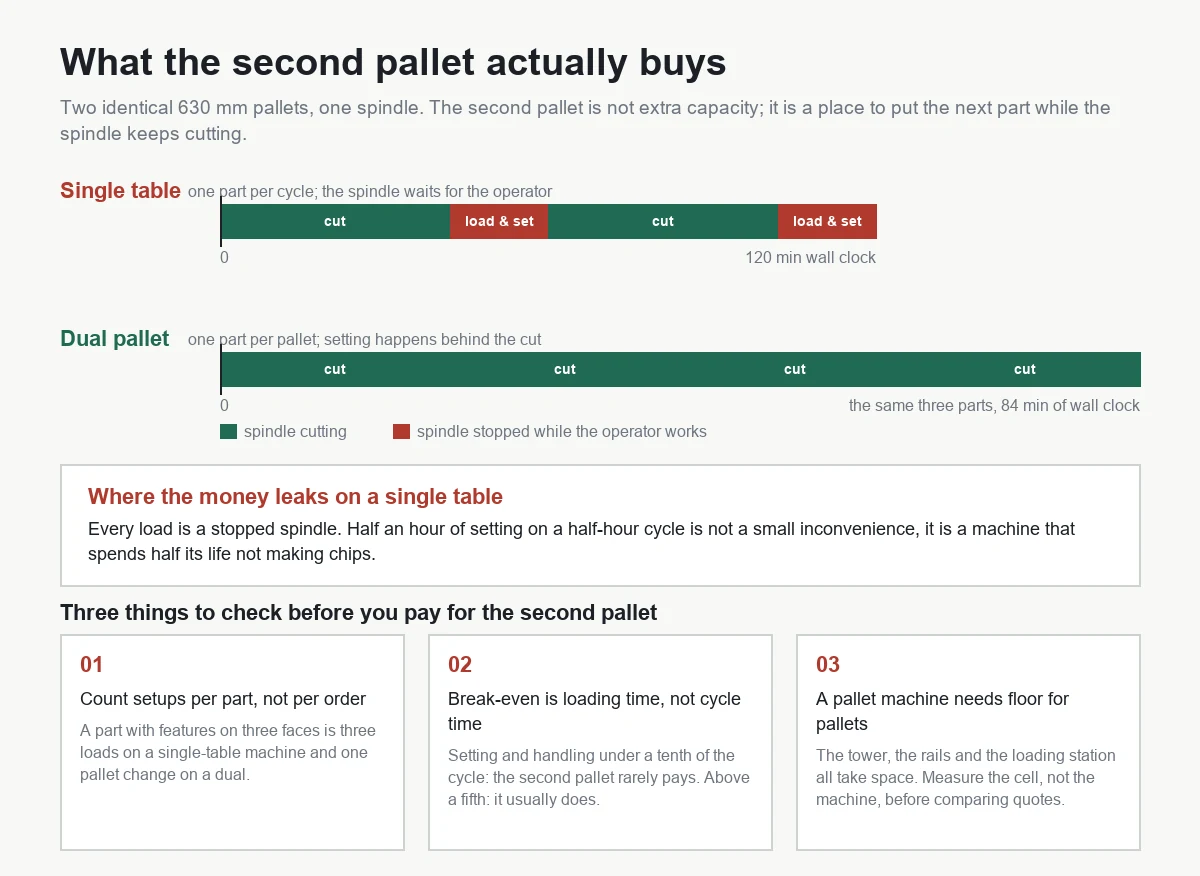
The arithmetic is not complicated. Write C for cutting time per part and L for the loading and setting time per part.
| Single table | Dual pallet | |
|---|---|---|
| Wall clock for n parts | n × (C + L) | n × C + L |
| Spindle utilisation | C / (C + L) | Aim for C / (C + L) of the operator, and near 100 percent of the spindle |
| The number that decides it | L / C — loading time as a fraction of cutting time | |
That last row is the whole decision. Nothing else in this article matters as much as that one fraction, and it is measured, not estimated.
Measuring L/C without buying anything
You do not need a new machine to find this number. You need two weeks and a clipboard, or a shop floor terminal that already logs stops.
Log the cutting time
Take the actual cycle time from the control, not the quoted cycle time from the CAM simulation. Then subtract the tool change time and the rapid moves if you want to be strict about it. Most shops find their real cutting time is twenty to thirty percent lower than the programmed figure, because programmed feeds assume conditions the operator never quite achieves.
Log the loading time
Start the clock when the previous part leaves the fixture and stop it when the next part is clamped, indicated where needed, and the cycle start button is pressed. Include the crane, the walk to the fixture store, the air blow, and the chat with the inspector. Do not include the lunch break, but do include the twenty minutes of hunting for the right chuck jaws, because that is a real cost that a second pallet hides.
Read the result
Below 0.1, the second pallet is a decoration. Between 0.1 and 0.25 it depends on how many years you plan to run the part and how much floor the pallet cell costs you. Above 0.25, the pallet changer usually pays for itself inside the first couple of years on a two-shift pattern, and above 0.4 the case is not close.
One honest caveat. That arithmetic assumes the loading work genuinely fits inside the cutting time. If hanging the next casting takes fifty minutes and the cut takes thirty, the pallet changer becomes a very expensive parking space, because the operator is still the bottleneck and now the pallet is simply sitting there loaded. When L is longer than C, the pallet changer does not create capacity. It converts an operator bottleneck into a pallet bottleneck, and you paid for the privilege.
The parts where L/C runs high, and the parts where it does not
Loading time is a property of the part and the fixture, not of the machine. That is why two shops with identical machines and identical parts can reach opposite conclusions.
High L/C: where the second pallet earns its keep
Heavy castings that need a crane and four clamps, and the same casting appears in three or four orientations through the week. Large housings where the fixture has to be dialled in. Parts where a tombstone carries four or six pieces at once and every tombstone load is a small project in itself. Anything where the operator spends more time preparing than the spindle spends cutting.
Low L/C: where a single table is the sensible buy
Long-cycle work that runs three or four hours per part, so the forty minutes of loading is a small slice of a big pie. Small aluminium components in soft jaws where the whole load is ninety seconds. Jobs with one product and one fixture that never change, where the operator has nothing to do during the cut anyway and would just be standing at the loading station staring at a pallet.
The two costs that never make it onto the quotation
This is the part of the conversation that buyers rarely hear before the purchase order, and it is the part that decides whether the project looks good two years later.
Fixtures multiply with pallets
Every pallet needs its own fixture, because the entire point is that pallet B can be loaded while pallet A is cutting. Two pallets means two fixtures. Five pallets means five. A pallet pool feeding a machine through a shift means a fixture for each position in the pool.
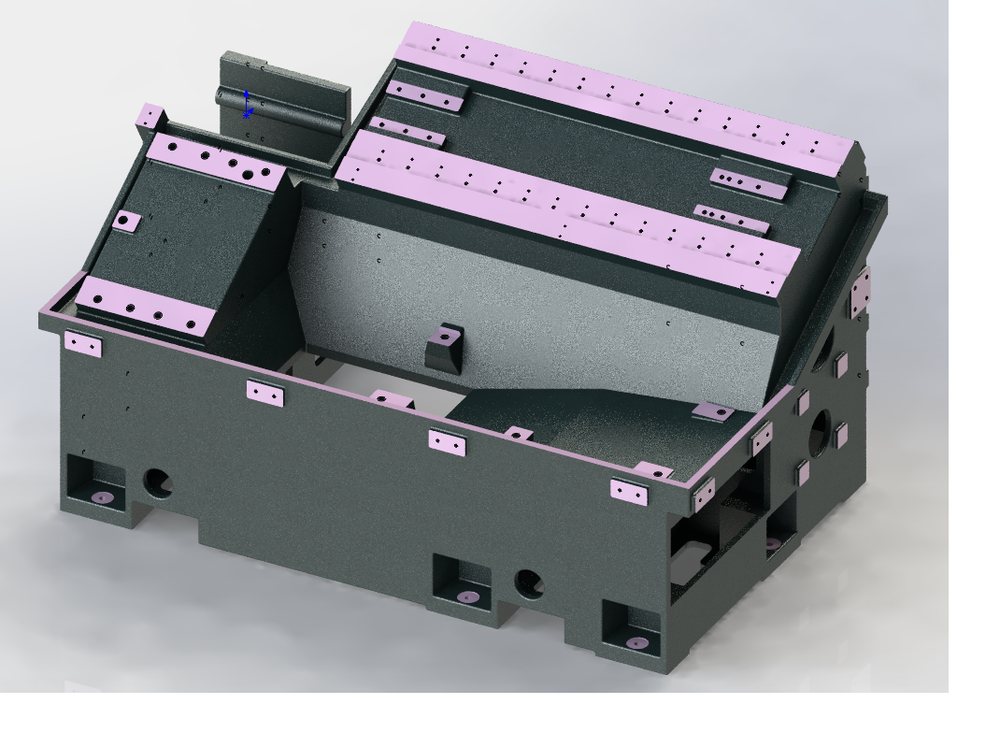
On a mid-size housing that fixture is not a set of soft jaws. It is a fabricated base with machined pads, locating pins, clamps and often a hydraulic or pneumatic clamping package. Multiply that by the pallet count and add the setting time to bring each one in, and on a six-pallet installation the fixture bill routinely lands in the same order of magnitude as the difference between the single-table and dual-pallet machine.
There is a second-order effect that shows up later and is worse. Every fixture is an independent source of position error, and they do not all agree. Pallets one through five may be within a few hundredths of each other and pallet six, built later by a different fitter on a Friday, may not be. The first time you see it is the first time a part from pallet six is inspected next to a part from pallet one, and by then the machine has been blamed at least once.
Floor space, and the crane that no longer reaches
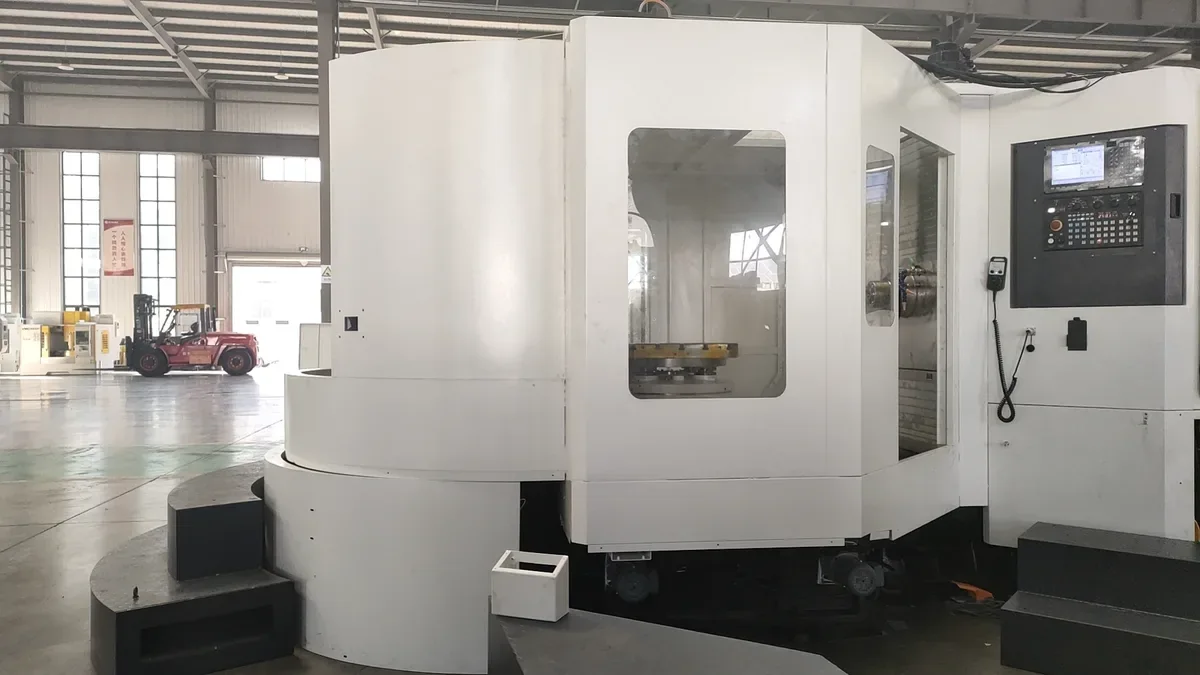
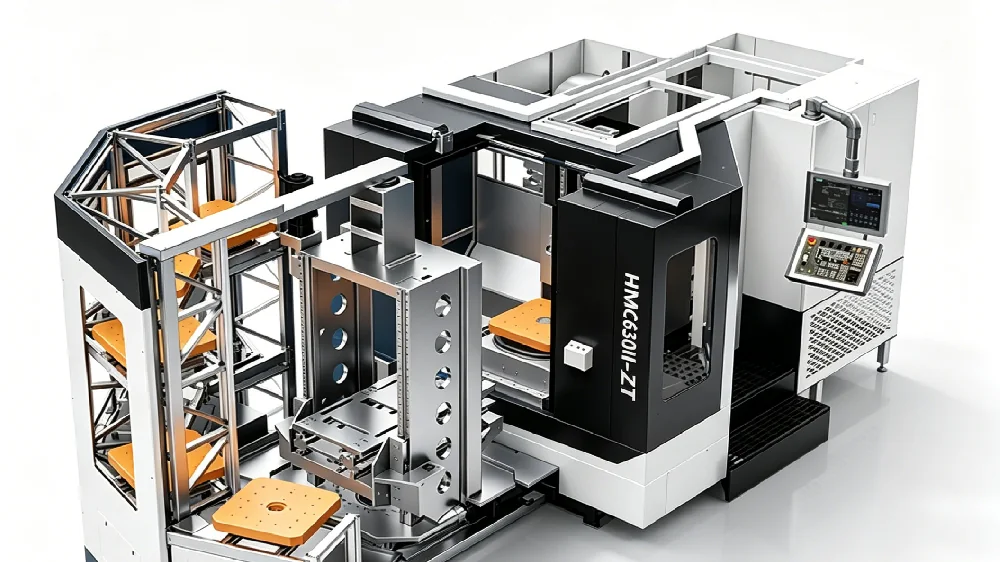
A single-table HMC is a box with a door. A pallet machine is a box with a door, plus a pallet magazine or a shuttle rail, plus a loading station with its own footprint and its own safety fence. On a 630 pallet machine the cell is often twice the footprint of the machine alone.
Worse, the loading station moves the clamping point out from under the existing crane coverage, or puts it where a forklift cannot turn. Shops discover this at installation, when the concrete is already poured and the crane rail is already bolted to the columns. Walk the cell out on the floor with tape before you sign, not after.
The cheaper route that gets most of the benefit
If the measurement says your L/C sits around 0.15 and the pallet cell is a stretch, there is an intermediate answer that costs a fraction and delivers a surprising share of the gain.
Set up an off-machine preparation bench next to the machine, with its own vice, its own torque wrench, its own air line and a full set of spare jaws. Fit a zero-point or quick-change clamping system to the table so the fixture goes on and off in seconds rather than being dialled in. Buy a second identical fixture so one can be built up while the other is cutting. The operator now does the slow work at the bench while the machine cuts, which is precisely what the pallet changer does, minus the automation and minus the floor space.
What you give up is the fixed pallet interface, where the fixture always returns to the same place, and the ability to run unattended through a shift. What you keep is about sixty to seventy percent of the time saving, at perhaps a tenth of the capital. For a shop running one shift with an operator present, that trade is usually right. For a shop trying to run lights-out or through a night shift, it is not, because there is nobody at the bench at three in the morning.
How the machine range splits, in practice
On our own horizontal range the pallet arrangements are not interchangeable, and the difference is worth understanding before you compare prices across models.
| Model | Table / pallet | Rated load | Spindle | Travels X/Y/Z | Machine weight |
|---|---|---|---|---|---|
| HMC630II-ZT | 630 × 630 mm | 1,200 kg | BT50, 6,000 rpm | 1,100 / 900 / 1,000 mm | 12,000 kg |
| HMC630-DT | 630 × 630 mm | 1,200 kg | BT50, 6,000 rpm | 1,100 / 900 / 1,000 mm | 12,000 kg |
| TH1000S | 1,000 × 1,000 mm | 4,000 kg | BT50-45°, 3,000 rpm | 1,800 / 1,000 / 1,300 mm | 16,000 kg |
| TH1400S | 1,400 × 1,400 mm | 5,000 kg | BT50-45°, 2,000 rpm | 1,800 / 1,300 / 1,500 mm | 19,500 kg |
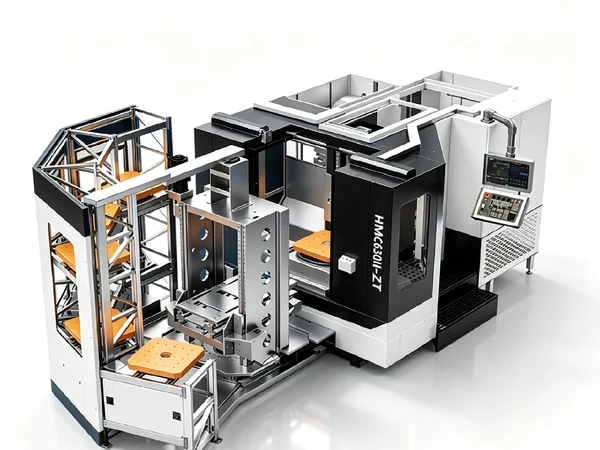
The 630 machines in our multi-station group, such as the HMC630II-ZT, are built around a pallet arrangement from the start, with the loading side, the pallet interface and the guarding designed as one system. The T-type machines in the HMC630-DT family share the same table size and load rating but differ in column and bed layout, which changes how the machine sits in the cell and how a crane reaches it.
The larger TH models add capacity rather than pallet count. A 1,400 mm pallet carrying five tonnes is a different proposition from four 630 pallets carrying 1,200 kg each, and the choice between them is decided by the heaviest single part in the programme, not by the total volume. If you are sizing the pallet itself rather than the pallet count, 630 vs 800 vs 1,000 mm pallets covers that arithmetic in detail.
The check before you commit
Six things, in order. Each one has killed a project we have seen, so they are not theoretical.
One. Log L and C for two weeks on the parts you actually intend to run, and compute L/C per part, not per shop. A programme where one part has a terrible ratio and five have good ones needs a decision about the one, not a new machine.
Two. Confirm L is shorter than C for the majority of the programme. If it is not, the pallet changer cannot help you and the money belongs somewhere else.
Three. Cost the fixtures at full pallet count, and add the setting time for each one. Then look at that number next to the machine price difference.
Four. Tape the whole cell out on the floor, including the loading station, the pallet magazine, the fence, the forklift turning circle and the crane coverage at the loading point.
Five. Ask what the pallet locating elements are, how they are checked, and what happens when they wear. This is the one interface in the whole system that determines whether part five hundred matches part one, and it is a consumable, not a permanent feature.
Six. Ask whether the pallet scheduling you want is standard in the control or an option. Sequence control, pallet priority and unattended running are not always included in the base machine, and the option list is where budgets quietly go.
What we would say if you asked us at the show
A second pallet is a purchase of time, and time only has a price if you know what an hour of stopped spindle costs you. Shops that have that number — usually the ones running two or three shifts on a bottleneck machine — decide in an afternoon. Shops that do not have it tend to buy the pallet machine because it looks more serious, and then run it in exactly the same way as the single-table machine it replaced, which is the most expensive possible outcome.
Measure the fraction first. If it comes out above a quarter, the pallet machine is the right answer and the fixtures are simply part of the price. If it comes out below a tenth, spend the money on a second fixture, a quick-change clamping system and a bench, and put the rest towards the next machine in the programme.
If you have a part with a cycle time and a loading routine you can describe, send us the drawing and the numbers. We will work the arithmetic with you and tell you which of the two lines on the quotation we would sign ourselves. Upload the drawing here, or read the rest of the machine comparison notes if the part in question is multi-faced rather than heavy.
Questions we get asked about pallet changers
Does a dual pallet machine reduce the number of setups?
No. It reduces the time the spindle spends waiting during a setup. The number of clamps and datum re-establishments is set by the part geometry and the machine's reach, not by the pallet count. If setup count is the problem, the answer is more faces per setup, which is a question about spindle orientation and rotary table.
Are two pallets enough, or do I need a magazine?
Two covers the single-part, single-operator case completely. A magazine starts to pay when you need to run a mix of parts across a shift, when different pallets carry different fixtures, or when you want the machine to keep running through a break. Each additional pallet is another fixture, so the cost curve is steeper than it looks.
Can I get the same result on a single table with a quick-change system?
You can get most of it. An off-machine bench, a zero-point clamping system and a second fixture set will recover a good share of the lost time for a small fraction of the capital. What you cannot get is unattended running, because there is nobody at the bench when the shift ends.
Is a pallet changer on a vertical machine the same as on a horizontal?
The idea is the same and the mechanics are not. A vertical machine's pallet usually slides in from the side at table height, which is convenient for a small part and awkward for a heavy one because you are reaching across the table. A horizontal machine's pallet arrives vertically and clamps to a faceplate, so the part hangs on the pallet rather than sitting on it, which is why horizontal pallets carry more weight for the same size.
My batches are small. Does that rule out a pallet machine?
Batch size is the wrong variable. A shop running five parts at a time on a heavy casting with a fifty-minute load can justify a pallet changer more easily than a shop running five hundred small aluminium parts that load in ninety seconds. The ratio of loading time to cutting time is the decision, and batch size only matters through the setup hours it adds per year.
Contact Handemo CNC | Email: sales1@handemocnc.com | WhatsApp: +86 135 6320 3038