
CNC Machines for Box and Housing Parts
Compare horizontal machining solutions for gearbox housings, cases and box-type parts requiring multi-face milling and boring.
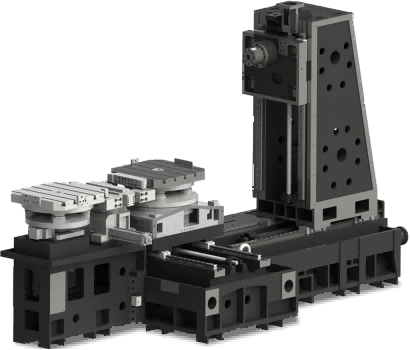
Machining Box and Housing Parts
Gearbox housings, pump casings, spindle housings and bearing pedestals share a defining characteristic: the features that must align are on different faces. A bearing bore on one wall has to line up with a bore on the opposite wall, and the mounting face has to be square to both. Once a part is repositioned, that relationship depends on the fixture rather than on the machine.
This page explains how to choose between horizontal and vertical architecture for housing work, how pallet strategy changes with batch size, and what to establish before the fixture is designed.
Why Housings Are a Setup Problem
Bore alignment across faces
Two bores that must be coaxial are machined either in one setup with the part indexed, or in two setups with the part moved. The first preserves alignment through the machine; the second preserves it only as well as the fixture repeats. For a gearbox with a pair of bearing bores, that difference is usually the whole tolerance budget.
Datum transfer is where error enters
Every repositioning transfers the datum from the part to the fixture and back. Each transfer adds error. Counting the transfers on a process route is a quick way to see whether the route can hold the drawing tolerance at all, before any machine is discussed.
Thin walls move under clamp force
Housings are often stiff in bending but flexible in the wall. Clamping across an unsupported wall pushes the bore out of round, and the part springs back when the clamp is released. Supporting near the bore line and clamping over a rib rather than a wall is usually worth more than a machine upgrade.
Horizontal or Vertical
Horizontal machining centers
When a housing needs four or five faces, a horizontal machining center with a rotary table indexes the part between faces without releasing it. Chips fall clear of the cutting zone, which matters on cast iron where fines pack into a bore. For most gearbox and pump housing work this is the shortest and most accurate route. See horizontal machining centers.
Multi-station and pallet configurations
Once batch size is large enough that spindle idle time during loading becomes significant, a multi-station machine or a pallet pool pays for itself. The multi-station horizontal machining center keeps several parts in process at once.
Vertical machining centers
For a housing that is essentially a box open on one side, with the main work on the open face and modest work on the sides, a vertical machining center with an indexer is economical. The limit is the number of faces that need accurate work; past two or three, the repositioning cost outweighs the machine cost. The trade-off is set out in vertical vs horizontal machining center for multi-face parts and in VMC vs HMC.
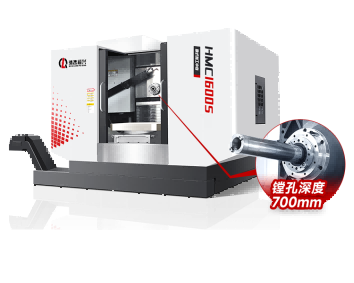
Start From the Two Drawings
Finished drawing
Bore diameters and depths, bore-to-bore distances, face squareness, the datum scheme and which faces are functional. The functional face is what the fixture must locate on, and it is not always the largest face.
Blank drawing
Casting or weldment dimensions, stock allowance, draft, core shift tolerance and the condition of the faces that will be used for location. Casting variation is a common cause of a fixture that works on the sample and fails in production.
The questions that change the answer
Largest and deepest bore, whether bores are through or blind, batch size and repeat frequency, required surface finish inside the bores, and the inspection method. A bore checked with a plug gauge and a bore checked on a CMM place different demands on the process.
Process Notes for Housing Work
Rough, stress-relieve, finish
Removing material releases residual stress in a casting. On a housing with tight bore alignment, roughing, a stress-relief pause and then finishing prevents the bore from moving after the part is accepted.
Bore the two walls from one direction if possible
A line boring bar through both walls in one pass removes the alignment question entirely. It requires a machine with enough travel and a bar long enough for the span, which is a machine specification, not a tooling detail.
Deburr the cross passages
Oil galleries and cross drills intersect the bores. Burrs left at the intersection break loose later and damage bearings. Deburring belongs in the process plan and needs access, which is another argument for a machine that can reach the intersection from several directions.
Related Guides
- Machining gearbox housings - bore alignment and fixtures
- Guide to gearbox housing machining - process planning
- Machining pump housings - bore and face relationships
- Guide to bearing housing machining
- Machining bushings, sleeves and rings
- Choosing a machining center for box and housing parts
- Case study: pump casing in two setups on an HMC
More Application Guides
Handemo builds machines for each of these part families. Each guide covers what the part demands from the machine and how the process is sequenced.
Discuss Your Machining Project
Send HANDEMO your finished and blank drawings, bore specifications and batch quantity for machine and fixturing guidance.
Request a Project Review