
CNC Machines for Mold & Die Manufacturing
Compare CNC machining solutions for mold bases, cavities and complex mold components using HANDEMO VMC and 5-axis machines.
Machining Molds, Dies and Tooling
Mold and die work is judged by the surface it leaves behind. Cores, cavities, sliders and inserts all have steep walls, small corner radii and deep pockets, and each of those features pushes a machine in a different direction. A machine that finishes a large cavity efficiently may be the wrong choice for a small, deep core with tight radii.
This page explains how to match machine architecture to mold geometry, where five-axis motion actually earns its cost, and what information is needed before a quote is meaningful.
Why Mold Work Is Different
Surface finish is the deliverable
On a production part, a tool mark is cosmetic. In a mold, it is transferred to every part the tool ever makes. That raises the requirement on spindle quality, thermal stability and the smoothness of the motion control, because visible witness marks have to be polished out by hand, and hand polishing is the most expensive operation in mold making.
Deep cavities limit tool reach
A cavity deeper than about three times the cutter diameter forces a long, slender tool. Long tools deflect, and deflection shows up as chatter on the wall and a taper over the depth. The machine cannot fix a tool that is too long, but it can provide the rigidity and the look-ahead that keeps the feed rate stable through the corners.
Corner radii set the tool size
The smallest internal radius in the cavity sets the largest cutter that can reach the bottom. That single number cascades into roughing strategy, stepover, and the number of electrodes or the amount of EDM work. Reading it off the drawing early prevents quoting a job around a tool that will not fit.
Matching the Machine to the Mold
High-speed vertical machining centers
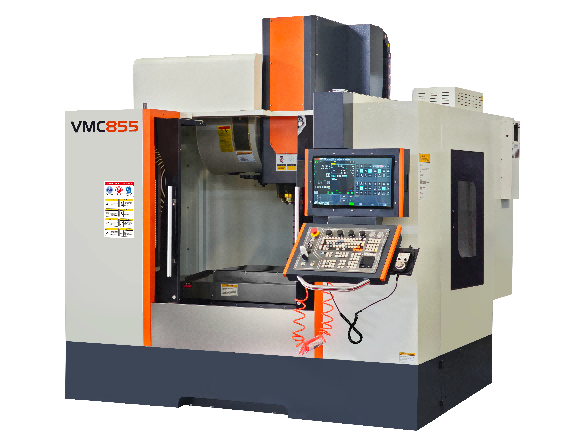
For cavities and cores that fit within a three-axis envelope, a high-speed vertical machining center with a fast spindle and high feed rates is the productive route. The high-speed precision mold and die series is built around this case: elevated spindle speeds, thermal compensation and motion control tuned for continuous three-axis finishing.
Five-axis when the geometry demands it
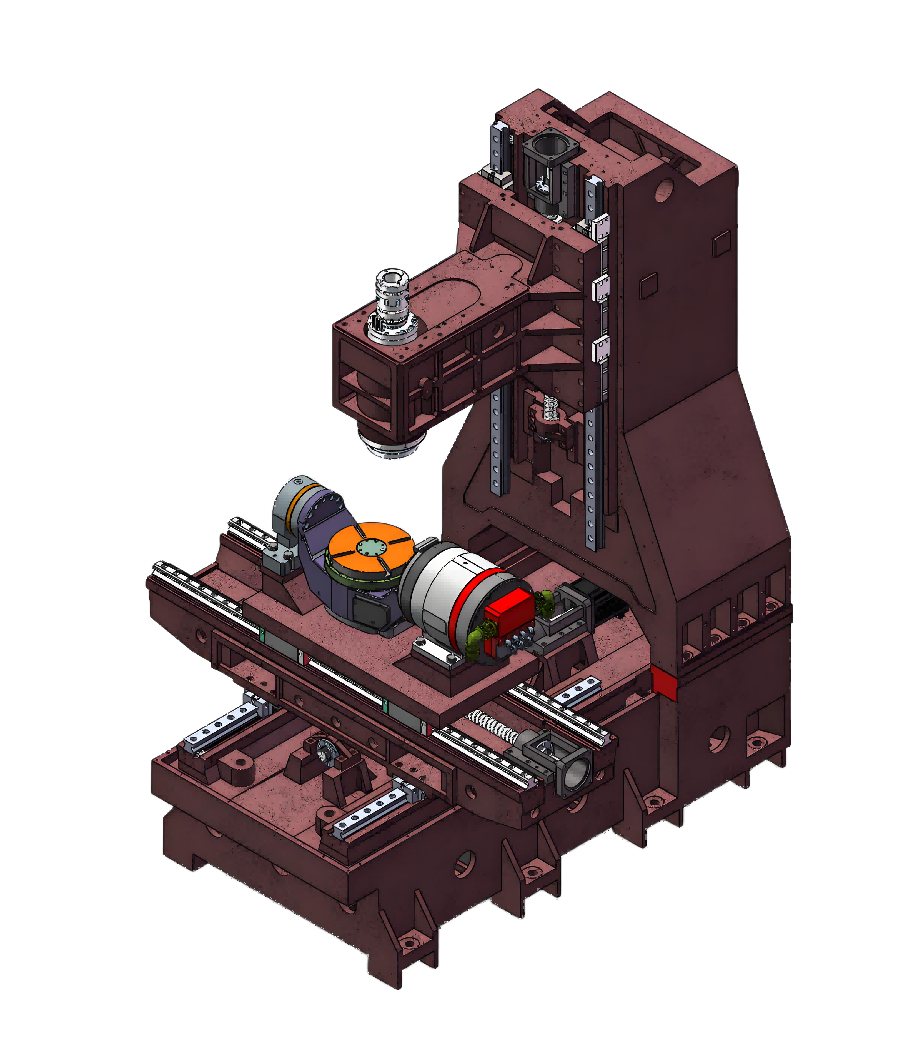
Five-axis is worth its cost when the part has features that cannot be reached from three directions, or when a single setup materially reduces the number of electrodes. It is not worth it when the only benefit is fewer setups on a part that is easy to reposition. Deep ribs, undercut surfaces, angled parting lines and multi-cavity layouts are the cases that justify it. See five-axis machining centers.
Gantry structure for large molds
Automotive fascia molds, appliance panels and large die-cast dies exceed the table of a standard vertical machine. A gantry machine carries the spindle on a bridge so the table only has to carry the workpiece, which keeps accuracy over a long span. The comparison between gantry and vertical architecture is set out in gantry vs vertical machining center.
What Decides the Quote
Geometry and stock
Finished drawing, block or forging dimensions, smallest internal radius, deepest cavity, draft angles and the parting line position. Stock allowance decides roughing time, and roughing time is usually the largest single block in a mold cycle.
Material and hardness
P20, 718, H13, S136 and aluminium behave very differently. Pre-hardened steel at 30 to 40 HRC changes both the tooling and the machine stiffness requirement. Hard milling of a hardened insert is a different process from roughing a soft block.
Tolerance and surface requirement
The surface specification, the dimensional tolerance on mating faces, and whether the cavity will be hand-polished or mirror-finished. A mirror finish requirement moves the process toward higher spindle speed and tighter thermal control.
Batch and repetition
A one-off tool and a family of tools sharing a base plate are different problems. Repeat work justifies pallets and standardised fixturing; one-off work justifies flexibility and fast setup.
Process Notes
Rough before you finish, and mean it
Leaving a uniform allowance matters more on a mold than on a production part, because the finishing pass runs at a small stepover and cannot absorb stock variation. Uniform allowance comes from a roughing strategy that follows the actual cavity shape, not from a fixed offset.
Thermal stability is a finishing issue
A machine that grows 20 microns over a long finishing cut leaves a step where the cut restarted. Warm-up routines, thermal compensation and a stable shop temperature are part of the process, not optional extras.
Electrodes are a machine decision too
If the process needs EDM, the electrode has to be machined to a higher tolerance than the cavity. That work often goes on the same machine, which argues for a machine that holds tolerance on small parts as well as large ones.
Related Guides
- Machining mold cavities - cavity strategies and tool selection
- Guide to CNC machining mold cavities - process planning
- Machining mold bases - base plates, pockets and guide bores
- Gantry vs vertical machining center - choosing by part size
- 5-axis vs 3-axis machining centers - when the extra axes pay
More Application Guides
Handemo builds machines for each of these part families. Each guide covers what the part demands from the machine and how the process is sequenced.
Discuss Your Machining Project
Send HANDEMO your mold drawing, material, cavity depth, smallest radius and surface requirement for machine and configuration guidance.
Request a Project Review