
Robotic CNC Machine Tending Solutions
Plan articulated-robot machine tending for CNC lathes and machining centers, including grippers, storage, signals and safety.
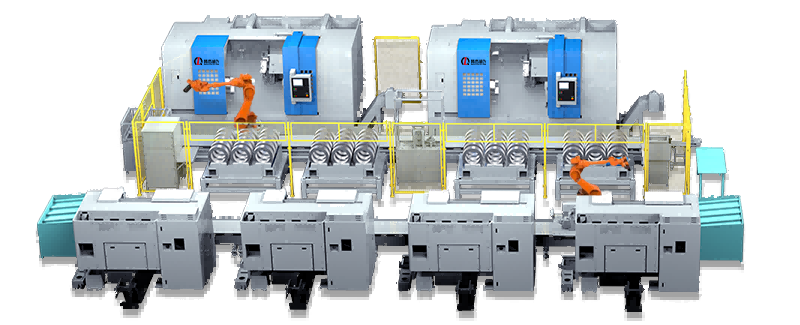
Robotic Machine Tending
An articulated robot becomes the right answer when a shop needs to feed several machines from one handling system, or when parts are too heavy or too awkward for a gantry loader. The robot is not a machine accessory; it is a cell design decision, and most of the cost and most of the risk sit in the cell rather than in the arm.
This page sets out how to choose between a gantry loader and a robot, how to size the arm from the handling task, and what the machines in the cell have to provide.
Gantry Loader or Articulated Robot
Choose the gantry loader when
One or two machines are involved, parts are small to medium and consistent in shape, floor space is tight, and the loading motion is essentially a straight transfer. A gantry is simpler, cheaper, and easier to guard. It is covered in CNC gantry loader automation.
Choose the robot when
Three or more machines share the handling task, parts vary enough that the gripper must change, parts are heavy, or the part needs to be reoriented between operations. A robot also makes sense when the cell has to handle secondary operations such as deburring, washing or inspection, because the same arm can do those between machine cycles.
The real cost difference
A robot cell needs guarding, a safety system, a layout that gives the arm reach to every station, and programming for each part family. Those items, not the arm, dominate the budget. Estimating a robot cell from the arm price is the most common planning error.
Sizing the Arm From the Task
Payload, and why the grip matters
Rated payload includes the gripper, not just the part. A double gripper that holds a raw and a finished part at once can easily weigh as much as the part. Derating the arm to about sixty percent of rated payload leaves margin for acceleration.
Reach and layout
Reach has to cover every station from a single base position with the part oriented correctly at each. Drawing the reach envelope over the actual floor layout early prevents the discovery that one machine sits just outside it.
Repeatability
The arm's repeatability has to be fine enough that the part enters the workholding without forcing. For most machine tending this is comfortably within the capability of a standard industrial arm; the constraint is usually the fixture's lead-in, not the robot.
What the Machines Must Provide
Access and clearance
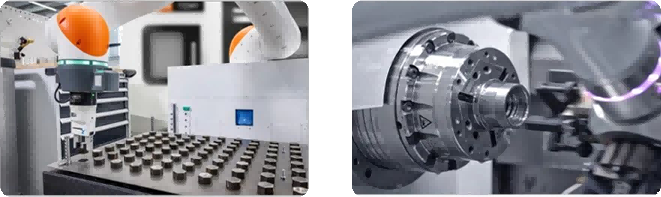
The robot has to reach the workholding without the arm entering the machine's motion envelope during a cut. This usually means a defined loading position and an interlock, not just an open door.
Handshake and safety
Door status, clamp status, cycle complete and fault signals, plus a safety circuit that stops the robot when the machine is not in a safe state. The safety design should be reviewed before the layout is fixed, because it can force a change in machine positions.
Part presentation
Raw parts have to arrive at a known position and orientation. Trays with shaped nests, or a vision system where variation cannot be controlled. Loose parts in a bin require bin-picking capability, which is a different and more expensive problem.
Process Notes
Design for the worst part
A cell is only as good as its ability to handle the most awkward part in the family. Designing around the easiest part produces a cell that is bypassed whenever the hard job runs.
Keep a manual path
Every automated cell needs a documented way to run the machine manually when the robot is down. Shops that skip this lose the whole cell's capacity to a minor fault.
Standardise fixtures
Robot tending rewards repeatability in the workholding. A standard pallet or a common jaw system lets the same gripper and the same program serve several parts, which is where the economic benefit actually comes from.
Related Guides
- Machining thin-wall parts - gripper force and distortion
- Machining EV motor housings - a typical automated cell part
- Machining machine bases and beds - large part handling
- Dual spindle turn-mill in one setup - automation without a robot
Discuss Your Machining Project
Send HANDEMO your machine list, part drawings, weights and target output for robot cell layout and integration guidance.
Request a Project Review