CNC Machining for Food and Beverage Parts
A food plant does not judge a part on how it looks on the bench. It judges it six months later, after the part has been through a hundred washdowns, and the question is whether anything can still grow in a corner of it. That single fact changes how these parts are turned, milled and finished, and it is the reason a fitting that would pass in a hydraulic shop gets rejected at a dairy.
This article belongs to our application guides series, where each one takes an industry and follows the parts from blank to finished, with the machines and the setups that suit them.
The parts that come through the door
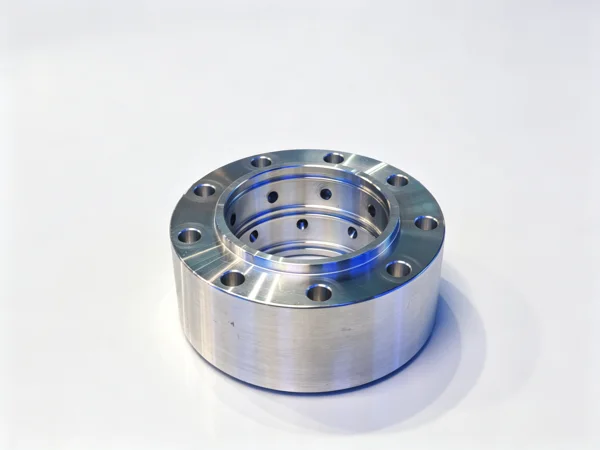
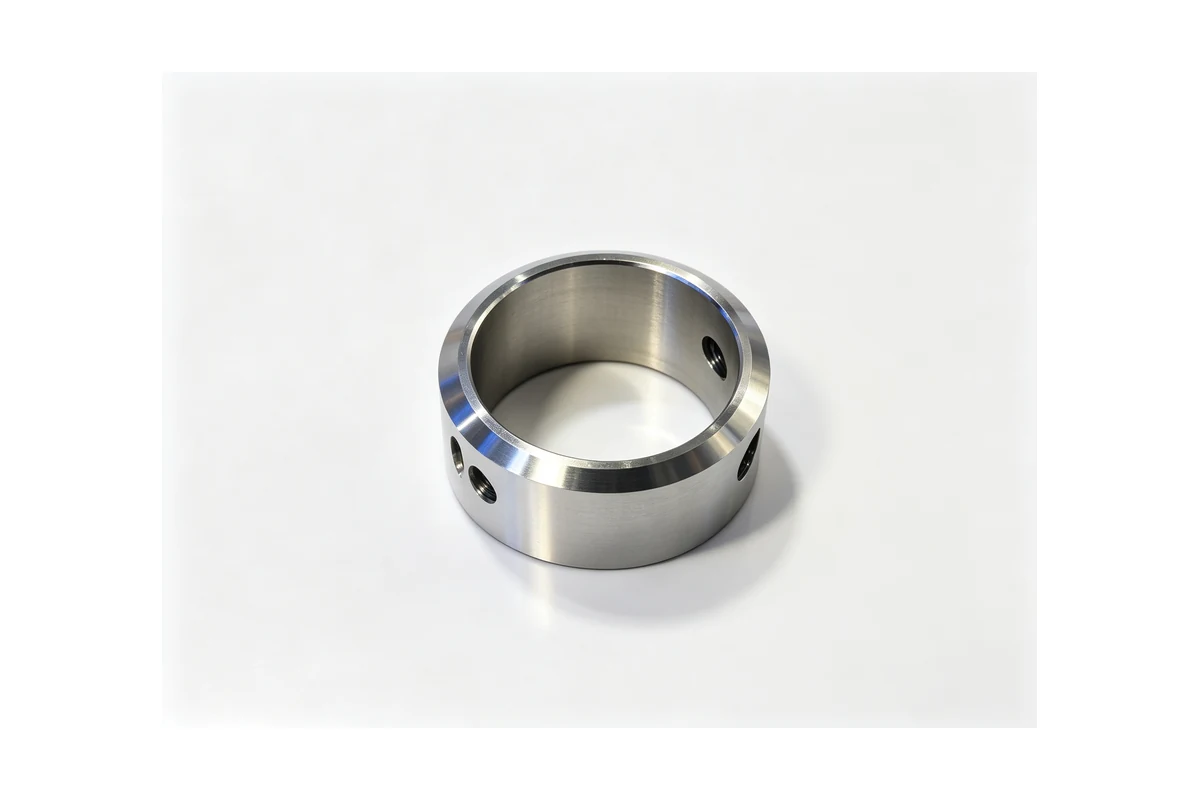
A shop supplying food and beverage equipment sees a fairly consistent mix. Pump housings and impellers for CIP circuits and product transfer. Valve bodies, discs, seats and stems for mix-proof and sanitary valves. Clamp ferrules, tri-clamp adapters, unions and sight-glass rings. Agitator and scraper shafts, sometimes with a pitched blade at the end. Spray balls and tank nozzles. Filler nozzles, change parts and dosing pistons. Then the conveyor and packaging parts that never touch product but still live in a wet room all day.
What these parts share is that the geometry is rarely complicated and the requirements are almost all about the surface, the corners and the joints. A sanitary valve body is not a difficult shape to machine. It is a difficult shape to machine without leaving a thread root, a sharp internal corner or an as-machined crevice that a cleaning cycle cannot reach.
Materials, and why 316L carries the load
Most product-contact parts are 316L stainless, and 304 covers brackets, guards and the parts that stay out of the product path. Where the duty is genuinely aggressive, such as brine, acidic dressings or certain CIP chemicals, the specification moves to a duplex grade like 2205 or to a higher-alloy stainless, and the machining plan has to move with it because those grades work-harden quickly and punish a light, rubbing cut.
Material condition matters as much as the grade. Bar stock is the easy case. A casting can carry a hard skin and a porous patch exactly where a seal face has to sit, and a forging arrives with scale. On product-contact work we plan the first operation around taking that skin off cleanly, because a tool pushed into a hard casting skin will smear and work-harden the surface beneath it, and the finish that follows is worse for the rest of the part's life.
Certification runs alongside the material. Food and beverage customers commonly ask for a mill certificate that traces the heat number of the bar or the casting back to the supplier, and the paperwork has to line up with the part number on the drawing. This is the sort of thing that is cheap to do properly and expensive to fix afterwards.
Turning the shaft and valve family
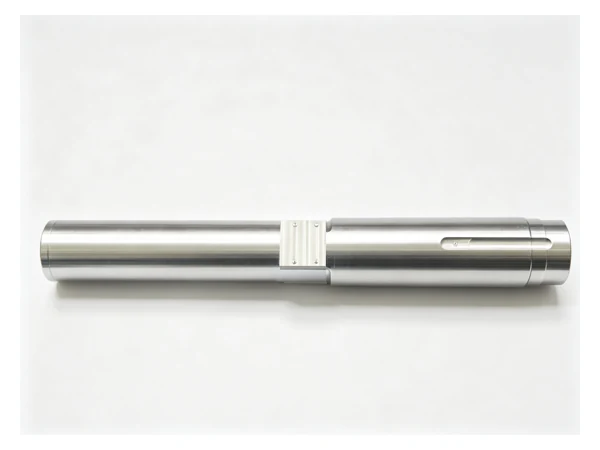
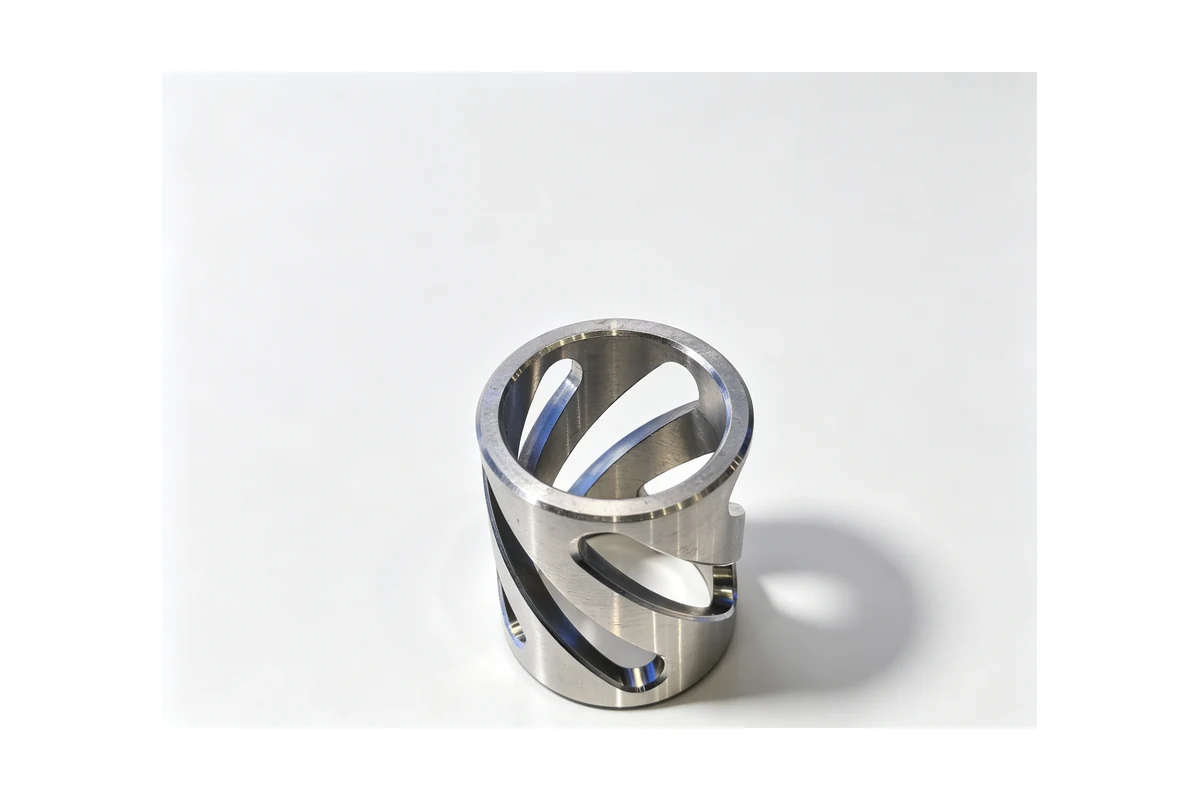
Shafts, stems, pistons and the round sealing parts are the core of the turning work. A sanitary stem usually carries a series of shoulders, an O-ring groove or two, and a thread at the actuator end, and the whole family of features has to run true to the same centreline because the part travels inside a bore all day. Where the shaft is long relative to its diameter, it is turned with a tailstock supporting the free end rather than allowed to flex away from the tool.
For the medium sizes a slant bed lathe with a tailstock, such as the TCK50, handles the family comfortably, including the grooving and threading cycles that turn up on stems and adapters. When a part has features at both ends and concentricity between them actually matters, a mill-turn machine takes the second end without the operator releasing the part and losing the datum, which is exactly the situation on a valve stem with a milled flat at the actuator end. Shafts of this type are covered in more detail in our note on machining stainless steel shafts.
Milling and boring the housings and blocks
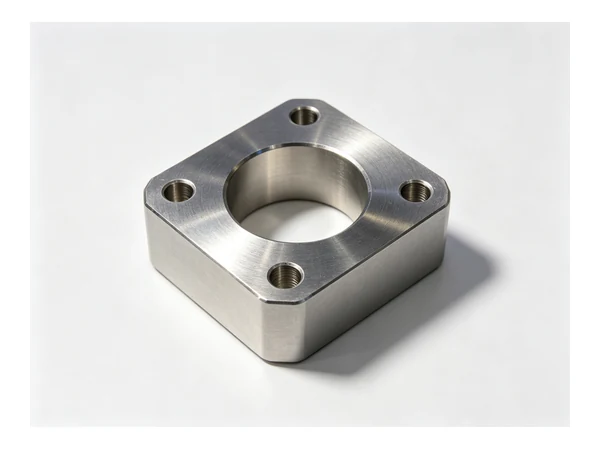
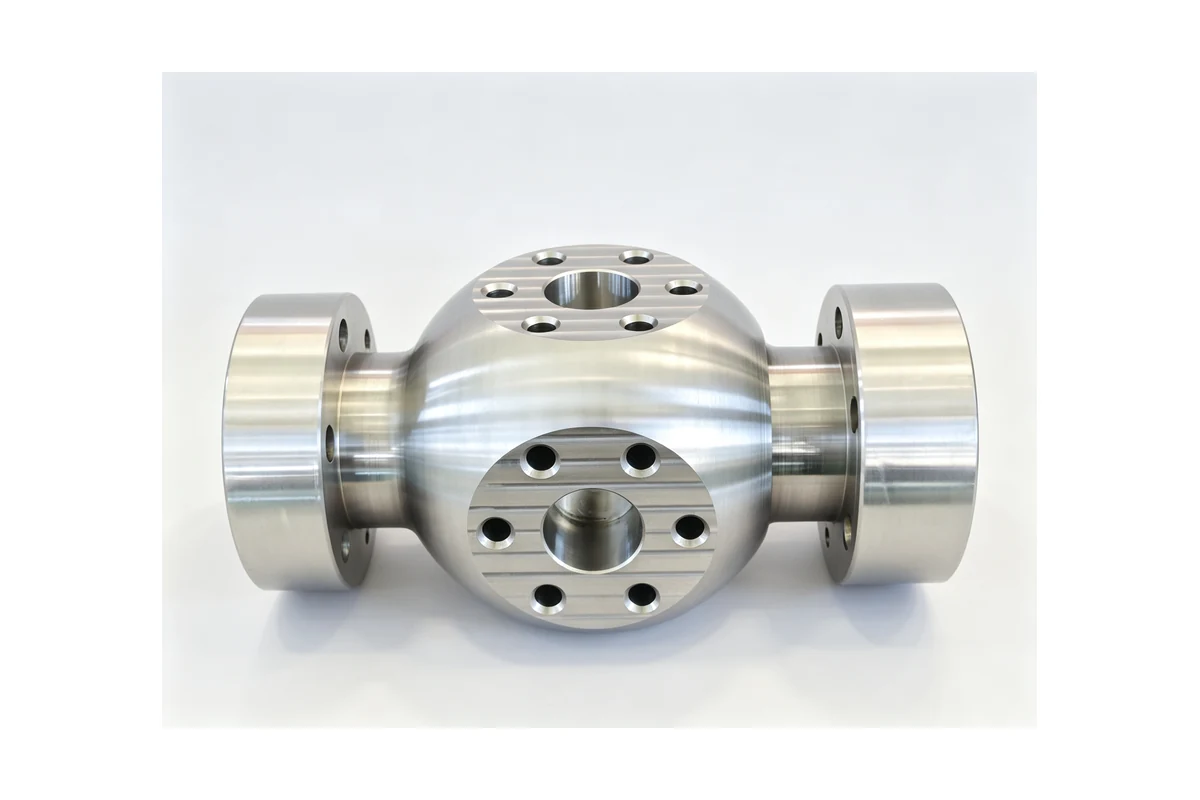
The housings, manifold blocks and valve bodies are where the work turns dimensional. A pump housing carries a volute, a shaft bore and a flange or clamp face, and the relationship between the shaft bore and the cover face sets the clearance in the running machine. A mix-proof valve body carries two bores that share an axis, a seat face and a set of ports, and the seat is the part nobody wants to rework.
A vertical machining center covers the majority of the smaller housings and adapters, and a four-axis VMC855 will bore a medium pump housing and clean up its flange face in one setup. For a body with bores on several faces, a horizontal machine earns its place because the table indexes while the part stays clamped, so the bore-to-face relationships are set once and the chips fall away from the cut instead of being recut. The same reasoning drives the setups in our guide to machining pump and valve parts. That last point matters more on stainless than on steel: chips lying in a bore get dragged round by the tool and mark the surface you have just spent time producing.
The features that actually decide whether a part is hygienic
This is where a food and beverage part is won or lost, and none of it is about hitting a drawing dimension. It is about whether the shape can be cleaned.
- Internal corners carry a radius rather than a sharp root, because a sharp corner creates a crevice that no flow reaches, no matter how long the CIP cycle runs.
- Product-contact faces and seal seats are turned or milled to a fine, consistent finish rather than polished by hand afterwards, because hand polishing rounds the edges that keep a seal located and leaves a surface that varies from part to part.
- Threads stay out of the product path wherever the design allows it. Where a thread is unavoidable, it is placed so that it drains and can be reached by the cleaning fluid.
- Parts drain. A pocket that holds liquid is a pocket that grows something, so the geometry is cut to let the surface empty itself rather than relying on the operator to leave the valve in the right position.
- Clamp and union faces are cut to agree with the mating half. A gasket groove that is turned concentric with the bore but out of step with the face on the other side of the joint is the classic source of a leak that appears only on hot CIP.
- Welds and junctions between machined parts are kept outside the product path where the design permits, and a weld that has to be inside it is dressed and finished as part of the process rather than left as an afterthought.
Holding stainless without wrecking the finish
Stainless is not difficult to cut, but it is unforgiving of a lazy setup. It work-hardens under a rubbing cut, so a dwell in the cut or a feed that is too light will leave a harder skin that blunts the next insert faster than the one before. The countermeasure is a positive, engaged cut all the way through the pass, together with coolant aimed at the cutting edge rather than sprayed at the part.
Holding is the second half of the problem. Sanitary parts are usually thin-walled, and a raw three-jaw grip on a finished surface leaves jaw marks that have to be polished out, which is exactly the hand work the design was trying to avoid. We pre-machine soft jaws to the part diameter for any part produced in a batch and keep clamp pressure consistent from the first piece to the last, grip finished bores rather than finished outside diameters where the drawing allows it, and support thin valve bodies and rings from underneath so they do not ring and deform under the clamp load.
Chips are the third. On a pump housing or a valve body, the bore is often the deepest feature and the last to be finished, so the chip exits are programmed deliberately rather than left to chance. A packed bore on stainless is the quickest route to a scrapped part with a marked seat surface.
What we check before a food and beverage part ships
Inspection on this class of part is a mix of drawings and cleaning. The dimensional side is straightforward: the critical bores, seat faces and clamp faces are checked against the drawing, and the fit with the mating part is confirmed rather than assumed, which is why we ask for the mating half when a joint matters.
The cleaning side is checked by looking for the things a drawing never shows. Internal corners and junctions get a visual check for a crevice or a tool mark that runs across the sealing path. Exposed surfaces are checked for the deep scratches and embedded particles that harbour residue. Parts that have been welded are checked for the discoloured heat-affected zone that has to be removed and re-passivated before the part goes anywhere near a product line. Surfaces are checked by eye and by water break rather than by hand feel, because a surface that feels smooth under a thumb can still hold a film of liquid in a shallow pocket.
We keep machine accuracy figures out of our published material for export control reasons, so this article stays with the process. If you are quoting a sanitary part, send the drawing and the mating half, and we will work from there.
Buying these parts without a surprise
Food and beverage parts are bought in batches for a line that has a maintenance window, so the risk is drift between the first part and the last. The first half of a run has to match the second, which means the clamp pressure, the tool offsets and the datum are recorded rather than remembered, and the same person owns the whole sequence rather than handing the last operation to whoever is free.
The other habit worth having is asking a supplier for the parts they have already made in the same family. A shop that has turned pump shafts and bored valve bodies understands why the gasket face matters more than the outside diameter, and it will tell you when a feature on your drawing is going to be awkward to clean rather than quietly producing it.
FAQ
Can you machine 316L without changing the corrosion resistance of the surface?
Yes, provided the cut is kept clean and the part is not left with a smeared or work-hardened skin. Contamination from carbon steel tooling and from a dirty machine is the real risk on stainless, so the tooling, the jaws and the coolant route are kept separate from general steel work.
Do you finish the surfaces in the machine or by hand afterwards?
Where the drawing allows it, the finish comes off the tool, because a machined face is consistent from part to part and holds the edges that locate a seal. Hand work is kept for weld dressing and for the small areas that genuinely cannot be reached in the machine.
What do you need to quote a sanitary fitting or a valve body?
The drawing, the material and its condition, the surface requirement stated as a finish rather than as a polish, the batch size, and the mating half if a joint or a seal face is involved. A photo of an existing part helps more than people expect.
Can you supply the material certificates with the batch?
Yes. For food and beverage work we hold the certificate for the bar or casting used in the run and match it to the part numbers on the order, so the paperwork ties back to the material that actually went into the part.
Contact Handemo CNC | Email: sales1@handemocnc.com | WhatsApp: +86 135 6320 3038