How to Choose a Vertical Machining Center (Buying Guide)
Buying a vertical machining center is one of those decisions that keeps shop owners up at night. It is also one we see every week at Handemo, because a VMC is not a tool you buy once and forget. It decides which jobs you can quote, how fast you deliver them, and how much of every hour is actually billable. Get it right and the machine pays for itself in two or three years. Get it wrong and you are stuck with a machine that either cannot handle your parts or costs more than it earns.
This guide is the same checklist we walk customers through before they place an order. It covers the machine classes, the specifications that actually matter, the questions most buyers forget to ask, and how to compare one quote against another without getting lost in the brochure.
What Is a Vertical Machining Center and Why Does It Matter?
A vertical machining center is a CNC machine tool with a vertically oriented spindle. The spindle moves up and down on the Z axis while the table carries the workpiece on the X and Y axes. The layout is simple, and that is exactly why VMCs dominate machine shops everywhere: chips fall away cleanly, workpieces are easy to reach, and the footprint is small compared with a horizontal machine.
Most of the parts that run through a typical job shop fit a VMC. Mold bases, automotive brackets, hydraulic blocks, medical implants, aerospace fittings, and plain old production parts all spend time on a vertical machining center. In our own workshop we keep a 855 and a 1160 running most days, and they handle the widest mix of work of any machines we build.
The catch is that "VMC" covers a huge range. A compact 650-class machine and a heavy 1890-class machine share the same name and almost nothing else. The machine that makes money in a tool-and-die shop would slow down a high-volume automotive line, and the machine that feeds that line would be overkill for a two-man job shop. So the buying decision starts before you look at any price list: it starts with your parts.
Step 1: Define Your Workpiece and Production Reality
Before you open a single brochure, write down the answers to five questions. Every later decision hangs on them.
What is the envelope size of your largest part?
Measure the biggest X, Y, and Z dimensions of anything you will ever clamp. Your machine travels must cover those numbers with room to spare for the tool holder, the tool itself, and clearance around the fixture. The most common regret we hear is a shop that bought for today's parts and then lost a bigger job they could not fit.
What material do you cut most?
Aluminum wants spindle speed. Steel and stainless want torque and rigidity. Cast iron wants damping and weight. If you cut mostly steel, a machine with a 12,000 rpm spindle and a light frame will disappoint you; a heavier 8,000 rpm machine with real torque will earn its keep.
What is your batch size?
Job shops running one to twenty pieces need quick changeover and flexibility. Production shops running thousands need cycle time, automation-ready design, and consistency. Those two shops should not buy the same machine.
How precise does your final part need to be?
For demanding parts, invest in thermal stability and high-quality ballscrews. If your parts are more forgiving, a lighter machine saves money. Be honest about your real part mix - over-buying capability wastes budget, while under-specifying can cost you customers.
How many hours will the machine run?
A one-shift shop doing light work has different needs from a three-shift shop cutting heavy steel. Duty cycle drives the spindle choice, the guideway type, and the cooling package. A machine that runs 20 hours a day needs components that stay accurate when they are hot.
Step 2: Match the Machine Class to Your Work
Vertical machining centers group by table size and travel, and the class you need follows directly from the answers above. Reading any catalog becomes easier once you know where each class sits.
Compact VMCs: the 650 and 855 class
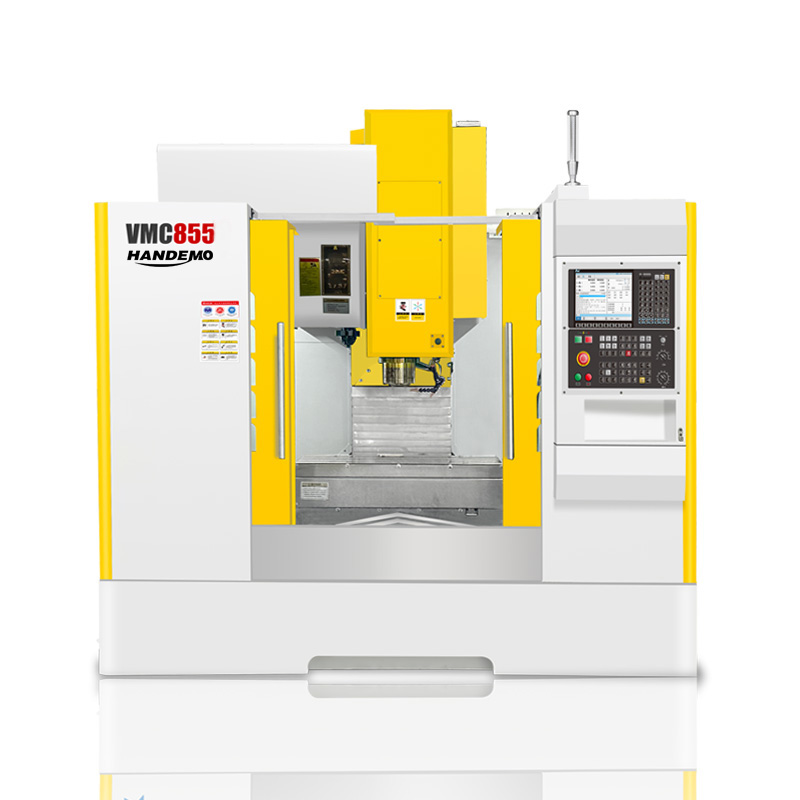
These machines carry tables around 800 x 500 mm and X travel of 650 to 850 mm. They suit small job shops, prototyping, and light production on aluminum, plastics, and lighter steel work. The Handemo 650 is the entry point: a compact frame, an 8000 rpm BT40 spindle, and a 3800 kg weight that keeps it stable in a small shop. The Handemo 855 steps up to a 1000 x 550 mm table, a 5300 kg frame, and a 24-station tool changer, which is why it is the machine we recommend to most growing shops.
Mid-size VMCs: the 1160 class
The 1160 class brings X travel to around 1100 mm and tables near 1200 x 600 mm. This is the most versatile class and the default choice for contract manufacturers. It handles medium molds, automotive brackets, and general production parts, and it leaves room to grow. The Handemo 1160 carries an 800 kg table load, travels 1100 / 600 / 600 mm, and maintains stable machining performance.
Large and heavy-duty VMCs: 1370, 1560, 1690, 1890
These machines push X travel from 1300 mm up to 1900 mm and table loads to 1500 kg and beyond. They are for large molds, heavy steel components, and workpieces that need a rigid, stable platform. They cost more, weigh more, and occupy more floor space, so buy this class only when your parts genuinely demand it. The Handemo 1370D, for example, carries a 1400 x 700 mm table, an 800 kg load, and a 9000 kg frame built for high-speed mold work.
Vertical Machining Center Comparison: Handemo Model Lineup
To make the class decision concrete, here is how the main Handemo VMC models compare on the specifications that matter. All use a BT40 spindle taper, an 8000 rpm belt-driven spindle, and a 24-station automatic tool changer unless noted.
| Specification | Handemo 650 | Handemo 855 | Handemo 1160 | Handemo 1370D |
|---|---|---|---|---|
| Table size (mm) | 1000 x 400 | 1000 x 550 | 1200 x 600 | 1400 x 700 |
| Max table load (kg) | 400 | 500 | 800 | 800 |
| X / Y / Z travel (mm) | - | 800 / 550 / 550 | 1100 / 600 / 600 | 1300 / 700 / 750 |
| Rapid traverse (m/min) | 32 / 32 / 24 | 24 / 32 / 18 | 24 / 24 / 18 | 24 / 24 / 18 |
| Spindle speed (rpm) | 8000 | 8000 | 8000 | 8000 |
| ATC stations | 16 | 24 | 24 | 24 |
| Machine weight (kg) | 3800 | 5300 | 6500 | 9000 |
| Best for | Compact shops, light production | Job shops, small-batch versatility | Contract manufacturing, medium molds | High-speed mold work, heavy steel |
The 855 and 1160 cover the majority of job-shop parts without the cost of a larger frame, which is why they are the two models we sell most. If your work is molds or heavy steel, the 1370D's 9000 kg frame gives you the rigidity and damping those jobs need. For the largest workpieces, Handemo also builds 1560, 1690, and 1890-class machines with table loads up to 1500 kg and beyond. Full specifications are on the high-precision heavy-duty VMC series page.
Step 3: Evaluate the Three Things That Determine Real Performance
Brochures list dozens of numbers, but only three groups actually decide how the machine performs in your shop: the structure and guideways, the spindle, and the control.
Machine structure and guideways
The base, column, and guideways carry the cutting forces. A heavier, better-ribbed casting damps vibration and improves finish. Guideway type matters more than most buyers realize:
- Box ways (hardened steel guideways) give maximum rigidity and damping. They suit heavy cutting and steel work.
- Linear guides give higher speed and lower friction. They suit aluminum, high-speed work, and lighter cutting.
- Many modern VMCs use linear guides on X and Y with box ways on Z, which is a good balance for general machining.
If you plan heavy steel or cast iron, put casting weight and guideway quality near the top of your list. It is the biggest factor in whether the machine stays accurate in year five.
Spindle speed and torque
Everyone quotes spindle speed first, but torque and bearing quality matter more for real work. An 8000 rpm spindle with healthy torque cuts steel all day. A 12000 rpm spindle with low torque is a great aluminum machine and a frustrating steel machine. Match the spindle to your dominant material, and check the motor power at the speed you will actually use, not the peak number on the spec sheet.
CNC control system
The control is the brain. Fanuc, Siemens, Mitsubishi, GSK, and the domestic controls all do the basics well. The right one depends on your operators' experience, your CAM post-processors, and the service network in your region. If your shop already runs Fanuc, staying with Fanuc saves training time and spares inventory.
Step 4: Check the Details That Cause Costly Surprises
A few details decide whether the machine is a joy or a headache to own, and they are easy to miss in a quote.
Automatic tool changer
Tool magazine capacity (16 to 24 tools is typical) and change time (around 2.5 seconds) affect productivity directly. Make sure the ATC accepts the tool holders and lengths your parts need. A machine that cannot hold your longest drill is a constant frustration.
Chip management
Coolant delivery, chip conveyor options, and guards determine how much time your operators spend cleaning instead of cutting. For aluminum and high-volume work, a chip conveyor is close to essential. Ask whether it is standard or an option, because retrofit costs are painful.
Thermal stability
Spindles and structures heat up over long runs, and heat causes drift. Spindle oil cooling, double-wall columns, and thermal compensation keep the machine accurate across a shift. If your parts need tight consistency on long runs, this matters more than peak speed ever will.
Accessibility and safety
Full enclosure, interlocked doors, and good lighting protect operators and keep the machine running. Check that loading and unloading is practical for your part sizes. A machine that is awkward to load gets loaded less carefully.
Step 5: Compare Suppliers, Not Just Machines
When you buy a VMC from China or any manufacturing hub, you are buying the supplier's support along with the machine. A great machine is a liability if the supplier disappears after delivery.
Ask every supplier these six questions before you commit:
- How long is the warranty, and what exactly does it cover?
- Do you stock spare parts, and how fast can you ship them?
- Do you provide on-site installation and operator training?
- What is the real lead time, in writing?
- Can you give references from buyers in my country or industry?
- What is your technical support response time after delivery?
Here is the thing: a supplier with a 12-month warranty, on-site installation, training, and a stocked spare parts warehouse is worth more than one offering a slightly lower price and nothing else. We have seen customers save a few thousand dollars on the machine and lose far more in downtime waiting for support.
Step 6: Run the Numbers Before You Sign
Calculate the real cost of ownership, not just the purchase price.
Total cost = purchase price + tooling + installation + training + power + floor space + maintenance + downtime risk.
Then estimate what the machine earns. A VMC that runs two shifts at a reasonable shop rate pays for itself far faster than one sitting idle waiting for work. If the machine will sit idle more than 40 percent of the time, question whether you need it at all, or whether a smaller class will do the job for half the money.
Frequently Asked Questions
How much does a vertical machining center cost?
A new VMC from a Chinese manufacturer typically ranges from about $25,000 for a compact 650-class machine to $80,000 and up for a large 1890-class heavy-duty machine. The exact price depends on the spindle, control, options, and shipping. Contact suppliers for current quotes with delivery included.
What is the difference between a VMC and an HMC?
A vertical machining center has a vertical spindle and a horizontal table, which suits flat parts, molds, and general work with easy access. A horizontal machining center has a horizontal spindle, which improves chip evacuation and suits heavy, multi-face production but costs more. Choose a VMC for versatility and value; choose an HMC for high-volume box-type parts.
Should I buy a new or used VMC?
A new VMC from a reputable manufacturer includes warranty, training, and support that a used machine does not. Used machines save money upfront but carry unknown wear and no support. For a first machine or a critical production line, new is usually the safer call. Used only makes sense with a full inspection and a source you trust.
How long does it take to deliver a VMC from China?
Typical lead time is 30 to 60 days from order confirmation, depending on configuration and shipping. Confirm the lead time in writing and plan your production around it. Container shipping adds 2 to 4 weeks of transit depending on destination.
What spindle speed do I need for mold making?
For mold finishing, higher spindle speeds help. A 10,000 to 12,000 rpm spindle with decent low-end torque handles both roughing and finishing. For standard mold work, an 8000 rpm spindle with high torque is a proven, cost-effective choice, and that is what most of our mold customers run.
Your Next Step
Choosing the right vertical machining center comes down to knowing your parts, matching the machine class, and checking the details that keep a machine productive for years. If you are comparing options, look through our global standard VMC models and the specifications there, then send us your part drawings and production targets. Our engineers answer technical questions every day, and you can reach us through the contact page or email sales1@handemocnc.com for a fast reply.
HandEmo CNC Export Team