CNC Lathe vs Mill-Turn: How to Choose
A slant-bed CNC lathe and a mill-turn center both handle turning, but they are not the same machine. One turns round parts; the other turns and mills in the same setup. The difference sounds small, but it changes how a shop runs a part, how many setups it needs, and its cost per piece. Here is how to tell which one your parts need, and where each machine earns its place.

What a Slant-Bed CNC Lathe Does
A slant-bed lathe is built for turning. It holds a round part in a chuck or between centers and turns it while the tool feeds along the axis. It is the fastest way to make shafts, sleeves, discs and flanges. If your part is mostly round and needs turning, grooving, threading and facing, a Handemo CNC lathe is the efficient answer.
The all-slant bed gives a machine a rigid, stable base. The carriage slides on an inclined way, so chips fall away and the tool stays close to the work. It is the workhorse of every shop that turns round parts.
What a Mill-Turn Center Adds
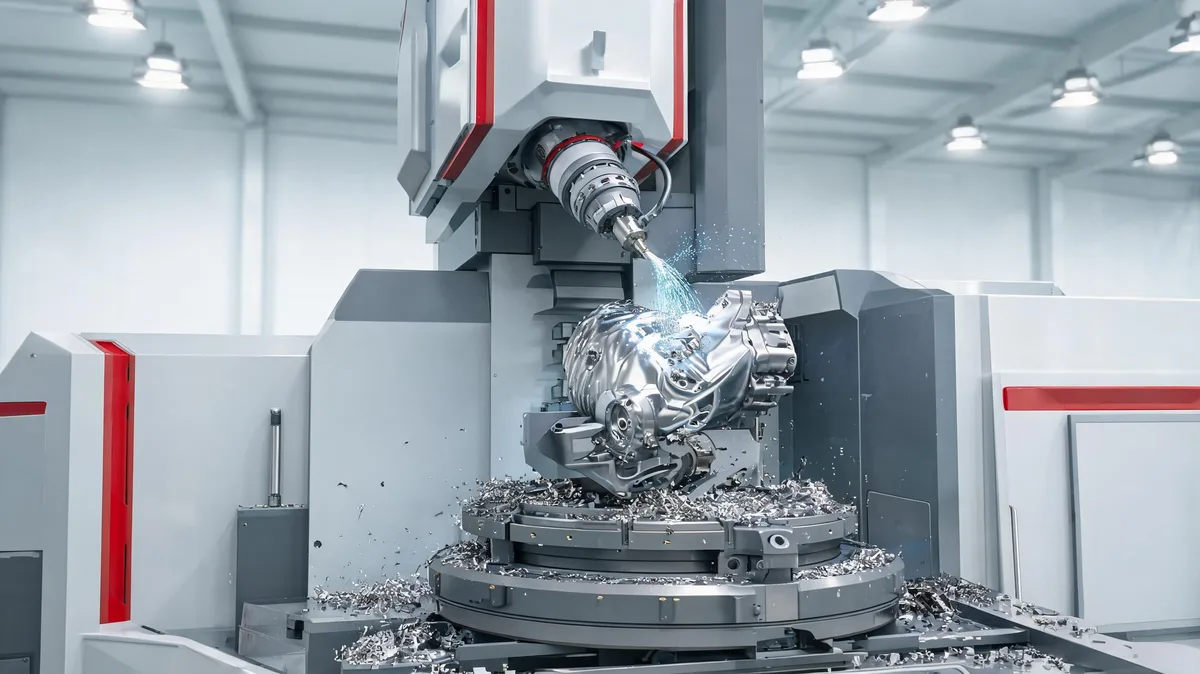
A mill-turn center can turn and mill in the same setup. It has a milling spindle that can drill a cross-hole, mill a keyway or machine a flat face on a round part, without moving the part to another machine.
The moment a round part also needs a milled feature, a mill-turn center saves a setup. You do not have to move the part from the lathe to a mill, re-establish the datum and machine it there. The mill-turn machine does it all in one loading, which removes the second handling and the datum error that comes with it.
Where the Time Goes
The biggest cost in a shop is often not the cutting - it is the handling. Every time a part moves from one machine to another, the spindle stops, the operator walks it over, sets it up and re-references it. That time is idle time, and it adds up.
A simple round shaft with one keyway can be turned on a lathe in a few minutes. Moving it to a mill and cutting the keyway takes another setup. On a mill-turn, the whole thing happens in one run. That is what pays for the machine.
When a Lathe Is Enough
If your parts are pure turning - shafts, sleeves, discs, flanges - a slant-bed lathe is the better choice. It is cheaper, simpler to program and faster on the turning itself. You are not paying for a milling spindle you do not need.
For a shop that turns a lot of round parts with no milled features, a lathe is the machine. Adding a mill-turn center would be money spent on capability you would not use.
When a Mill-Turn Earns Its Cost
A mill-turn center earns its cost when your round parts have milled features. A shaft with a keyway, a valve stem with a slot, a flange with a drill pattern - these are the parts that benefit. Doing them in one setup removes a handling step and a reference error.
It is also the machine you want when the part has to be machined in one continuous run to hold its geometry. Moving a part between machines introduces a small error each time. A mill-turn avoids that.
The Trade-Offs
The choice is a real trade-off, not a simple upgrade.
- A lathe is cheaper and faster on pure turning.
- A mill-turn is more expensive but saves setups on mixed parts.
- A lathe is simpler to program and maintain.
- A mill-turn is more capable, but more to learn and maintain.
If you run many one-off shafts with the odd milled feature, the mill-turn machine usually wins on total time and accuracy. If you turn simple round parts with no features, a lathe wins on cost.
How to Choose for Your Parts
Look at the parts on your bench. If they are round with no milled features, stay with a lathe. If they need both turning and milling, a mill-turn saves you time and error. If the part needs a second operation often, a mill-turn is worth the investment.
We are happy to talk through the parts you run and suggest which machine fits. Reach out through the contact form and we will come back to you.